
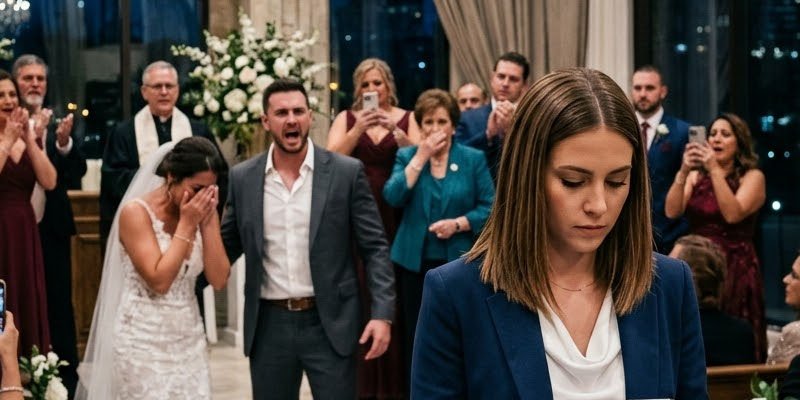
My sister told me I wasn’t “rich enough” to attend her wedding, and my mother coldly added, “Then don’t come.” I didn’t argue. I simply walked away. A few hours later, every entertainment network was replaying the moment her new husband slapped her in front of 300 horrified guests.
When my younger sister, Madison, told me I was not “rich enough” to attend her wedding, she said it casually in Mom’s kitchen, as though she were explaining a required dress code.
“You’d look completely out of place, Claire,” she said, glancing at her diamond bracelet. “Ethan’s family is extremely prominent. There will be executives, donors, television people. I can’t have you showing up in that old Honda and wearing something from a department store clearance rack.”
I looked at her, expecting her to laugh.
She didn’t.
Mom didn’t come to my defense either.
She crossed her arms.
“Then don’t come!”
So I didn’t argue.
I grabbed my purse, left the invitation sitting on the counter, and walked out.
What neither of them knew was that the “old Honda” actually belonged to my assistant.
My own car was in the repair shop.
For the past six years, I had quietly built Northline Media, a crisis-management and broadcasting company that had recently acquired three regional entertainment networks.
I never discussed money with my family because Madison had a way of turning every conversation into a competition.
Two weeks later, the wedding was held at Chicago’s Grand Halston Hotel.
Three hundred guests packed the ballroom.
Celebrity-news cameras were positioned along the aisle because the groom, Ethan Caldwell, was the son of a prominent real-estate developer.
At exactly 8:17 that evening, my phone began vibrating repeatedly.
The first message came from my colleague Jonah.
Call me now.
The second message contained a video.
Madison was standing beside the wedding cake, her face red as she held onto Ethan’s sleeve.
A microphone near the bandstand captured every word.
“You promised your father would transfer the penthouse before the ceremony,” she hissed.
Ethan yanked his arm away.
“You married me for a property?”
“Don’t pretend you’re innocent. Your family wanted a beautiful wife for the cameras.”
Then Madison laughed.
“At least my poor sister had enough sense not to embarrass me by coming.”
Ethan’s expression changed.
“You actually banned your own sister because she doesn’t have money?”
Madison reached for him again.
He slapped her.
The ballroom fell completely silent.
Within minutes, the footage was spreading everywhere.
By nine o’clock, entertainment anchors were repeatedly showing the slap, Madison’s insult, and Ethan’s accusation.
Additional clips started surfacing from guests.
Madison shouting at servers.
Mom insisting that hotel employees remove anyone who was recording.
Ethan’s father ordering security to seal off the ballroom.
Then Jonah called me.
“Claire,” he said cautiously, “Caldwell Development has hired us. They want Northline to handle the scandal.”
I looked at the television.
Madison was frozen on the screen with one hand pressed against her cheek.
I didn’t smile because Ethan had struck her.
I smiled because the sister who had decided I wasn’t important enough to attend her wedding had just become part of a crisis my company had been hired to manage.
PART 2
I accepted the meeting for one reason.
Not because I wanted to protect Ethan Caldwell.
I wanted to find out how much of the disaster had already been concealed.
The next morning at ten, I entered Northline’s conference room dressed in a navy suit.
Ethan was seated beside his father, Richard, with two attorneys and the hotel’s security director.
Ethan looked drained.
His right hand was bandaged, not because Madison had injured him, but because he had punched a bathroom mirror after security pulled them apart.
Richard got straight to the point.
“We need the video suppressed.”
“That’s impossible,” I said. “It has already been copied millions of times.”
“Then change the narrative.”
“The narrative is that your son assaulted his bride in public.”
Ethan visibly flinched.
“I know what I did.”
“Do you?” I asked. “Because remorse isn’t a strategy, and a strategy isn’t absolution.”
I laid out my conditions.
Ethan would issue a statement accepting complete responsibility without blaming Madison.
He would cooperate with the police.
He would begin anger-management treatment.
And he would withdraw from all company appearances.
Northline would never target Madison, expose confidential details, or imply that Ethan’s slap was justified.
Richard abruptly pushed his chair backward.
“We’re paying you to protect us.”
“You’re paying me to keep you from making this situation worse.”
Before he could say anything else, the conference-room doors swung open.
Madison entered with Mom and an attorney named Felicia Grant.
A faint bruise was visible beneath the makeup concealing Madison’s left cheek.
She froze when she saw me sitting at the head of the table.
“What are you doing here?” she demanded.
“This is my company.”
Mom gave a short laugh, as though she thought I was making some kind of joke.
Then her eyes landed on the lettering across the glass wall.
CLAIRE BENNETT
FOUNDER AND CHIEF EXECUTIVE OFFICER
Her face immediately went blank.
Madison looked at the sign, then turned back toward me.
“You own Northline?”
“Yes.”
“Why didn’t you ever tell us?”
“You never asked what I did. You only asked how much things cost.”
Felicia explained that Madison intended to pursue an annulment, bring a civil claim, and cooperate with prosecutors.
She also demanded that Northline step away because I was Madison’s sister.
“I agree,” I said. “My team will hand the Caldwell account over to an outside firm. I will not be involved in representing Ethan.”
Richard fixed his eyes on me.
“You already accepted the case.”
“I accepted an initial consultation. I’m now recognizing a conflict of interest.”
Madison appeared slightly relieved.
Then Felicia set another folder down on the table.
Inside were bank statements, emails, and a draft contract.
Madison had secretly arranged a deal with a streaming producer to turn her wedding into a reality television special.
The producer had encouraged confrontations, installed microphones, and promised Madison additional money if the reception produced “a viral confrontation.”
Ethan looked horrified.
“You planned this?”
“I planned an argument,” Madison replied. “Not that.”
Felicia spun toward her.
“You told me those documents had nothing to do with this.”
Mom reached toward the folder.
I pulled it out of her reach.
The contract did not excuse what Ethan had done.
Nothing ever could.
But it proved that Madison had intentionally turned her wedding, her family, and even my absence into material for a staged spectacle.
Then Jonah walked in carrying even worse news.
A hotel employee had sold the unedited footage to a national network.
The recording showed Madison talking with the producer just minutes before Ethan slapped her.
“If Ethan loses control, we own the week.”
Everyone in the room immediately understood the implication.
By the end of the day, Ethan could be facing criminal charges.
Madison could be facing allegations involving fraud and contractual violations.
And both families could suffer from evidence they had helped create.
Madison looked at me differently now.
There was no mockery.
No sense of superiority.
“Claire,” she whispered, “please help me.”
I closed the folder.
“I’ll help you tell the truth,” I said. “But I won’t help you decide which version of the truth gets to survive.”
PART 3
Madison’s request for help did not magically repair our relationship.
It simply left two adults facing each other across a conference-room table while the consequences continued closing in.
I asked everyone except Felicia and Jonah to leave.
Richard protested.
Ethan surprised him by standing first.
“She needs her own attorney,” he said. “And I shouldn’t be here.”
It was the first sensible decision he had made.
Once the door closed, Madison looked down at the table.
Mom remained beside her, one hand placed on her shoulder, as though that single gesture could erase years of favoritism.
Felicia began speaking.
“Madison, I need everything. No omissions. If I find another document after we issue a public statement, I may withdraw.”
Madison glanced toward me.
“Don’t look at Claire,” Felicia said. “Look at me.”
For the next hour, the truth slowly came apart.
Six months earlier, Madison had met a television producer named Victor Lane at a charity event.
Victor told her that weddings involving wealthy families drew enormous audiences, particularly when the bride came from a more ordinary background.
He offered her seventy-five thousand dollars for access to the wedding preparations, plus another hundred thousand if they captured enough material for a special.
Madison never told Ethan.
Instead, she signed the agreement through a small company Mom had helped her create.
Together, they encouraged vendors to manufacture tension, told bridesmaids to repeat private gossip, and positioned microphones near Ethan’s parents.
Mom had even called me “the unsuccessful sister” during a recorded lunch about the wedding plans.
My absence had already been built into the story.
According to the production notes, Madison was supposed to confront me during the reception over jealousy, then announce that I had arrived in an old car and could not afford an appropriate gift.
When I followed her instructions and stayed home, Victor demanded a different source of drama.
That was why Madison confronted Ethan about the penthouse beside the microphone near the bandstand.
“What did you think he would do?” I asked.
“Argue,” she whispered. “Leave. Say something cruel. Victor said a destroyed cake or a canceled honeymoon would be perfect.”
“But you knew Ethan had a temper.”
She said nothing.
Felicia leaned toward her.
“Had he ever hit you before?”
“No.”
“Threatened you?”
“He punched a wall once. Then he apologized. I thought it was over.”
That detail mattered.
It did not make Madison responsible for Ethan hitting her.
But it did establish that she had knowingly created a confrontation around someone whose anger had already crossed a dangerous boundary.
Mom finally spoke.
“We were trying to give her a future.”
I turned to face her.
“By humiliating me?”
“You were never supposed to find out.”
“That doesn’t answer my question.”
Her lips pressed into a thin line.
“You never needed anything from us. Madison did.”
There it was.
The rule that had governed our family for years.
Because I was capable, I received less.
Because Madison demanded more, Mom called it need.
And every accomplishment I kept hidden became evidence that I had no feelings worth considering.
“I needed a mother,” I said. “You decided I only needed to be independent.”
For once, Mom had nothing to say.
Felicia instructed Madison to preserve every message, surrender the contract, and make no public statement beyond what the existing footage established.
She also advised Mom to retain her own attorney because the production company could argue that both women had falsely represented their authority to record guests and hotel employees.
That afternoon, Chicago police announced that Ethan had voluntarily come in for questioning.
The following day, prosecutors charged him with misdemeanor battery.
His attorneys arranged for his release.
Ethan then released a statement accepting full responsibility.
He did not disclose Madison’s secret contract.
That choice shifted the public conversation.
People continued arguing online, but legally, the situation became much clearer.
Whatever Madison had intended, Ethan had struck her.
And he admitted it.
Three days later, the complete wedding footage was broadcast.
It did not save Ethan.
But it destroyed the image Madison had carefully created for the public.
Viewers watched her berate a server over champagne.
They saw her ridicule a bridesmaid’s weight.
They heard her talk about how much sympathy she could receive if Ethan’s family appeared controlling.
Then Mom appeared on television and said,
“Claire is useful whenever there is a crisis, but she has never learned how to impress important people.”
The network identified me as the founder of Northline Media.
By sunrise, reporters were gathered outside my office.
I declined every interview request.
Northline issued a single statement confirming that I had not attended the wedding, had played no role in the filming, and would represent neither party.
I also instructed security to remove anyone who harassed my employees.
Madison called seventeen times.
I answered on the eighteenth.
“People are threatening me,” she said.
“Send every threat to Felicia and the police. Do not respond publicly.”
“Can I stay with you?”
“No.”
She began crying.
“You said you would help.”
“I am helping. I am giving you practical advice and paying for two weeks at a secure hotel under Felicia’s name. You are not moving into my house.”
“Why are you being so cold?”
“Because helping you does not mean giving you access to my life.”
Neither of us said anything for several seconds.
Then she asked,
“Are you enjoying this?”
“No. But I am not willing to keep suffering so you can feel protected from the consequences of your own choices.”
She ended the call.
The lawsuits multiplied rapidly.
The streaming producer sued Madison’s company for violating confidentiality and failing to secure proper releases.
Several guests threatened legal action after discovering they had been secretly recorded.
The hotel fired two employees who had taken money to overlook hidden production equipment.
Richard Caldwell attempted to remove Ethan from the family company.
Instead, the board suspended both men after reporters uncovered unrelated concerns involving company spending.
Northline stayed completely out of the situation.
Walking away cost my company a valuable client.
But it protected something far more important.
Our credibility.
Within weeks, two national networks approached us specifically because we had refused to exploit private information.
Northline’s revenue grew.
Not because I profited from my sister’s humiliation.
Because I refused to.
Ethan eventually pleaded guilty to misdemeanor battery.
The judge sentenced him to probation, community service, counseling, and a no-contact order except through attorneys.
Five months later, the marriage was annulled because of fraud and its brief duration.
Madison received no penthouse.
No spousal support.
No reality television special.
She did receive a confidential settlement from the production company after Felicia argued that Victor had knowingly encouraged a volatile situation without taking appropriate safety precautions.
Most of that money vanished into legal fees and settlements involving the guests who had been recorded.
Mom sold her house to pay debts associated with the shell company.
For nearly a year, I saw neither of them.
During that time, I learned how peaceful life could feel once I stopped trying to earn a place in my own family.
I bought a townhouse near Lake Michigan.
Whenever someone asked about the Honda story, I told them the truth.
And I promoted Jonah to chief operating officer.
I also began counseling.
Not because I had caused the disaster.
But because surviving a family pattern did not mean I had escaped its consequences.
Eleven months after the wedding, a handwritten letter arrived at my office.
Madison did not ask me for money.
She did not ask me to contact journalists, remove search results, or repair her reputation.
She wrote that she had found a job managing appointments at a dental clinic in Milwaukee.
She was living in a studio apartment.
And she had started therapy.
The final paragraph read:
I thought wealth meant being invited into expensive rooms. You built a life where nobody could decide what you were worth. I hated that because it made my performance look small. I am sorry I used you as proof that I was better.
I read the letter twice.
Then I placed it in a drawer.
I did not forgive her right away.
Three months later, I agreed to meet her at a coffee shop halfway between Chicago and Milwaukee.
She arrived before I did.
She was wearing jeans, a simple coat, and no jewelry.
The bruise had disappeared long ago.
But she looked older.
Mom was not with her.
“I didn’t bring her,” Madison said. “I thought you might leave.”
“I would have.”
She nodded.
“She still believes Victor manipulated us and Ethan destroyed everything. She says we were victims of powerful men.”
“You were manipulated,” I said. “Ethan also assaulted you. Both statements can be true. Neither one erases what you did.”
“I know.”
We talked for roughly forty minutes.
There was no dramatic embrace.
No promise that family holidays would magically become normal again.
I told Madison I was willing to see her occasionally.
But I would not lend her money.
I would not manage her reputation.
And I would not keep secrets from her attorney.
She accepted every condition.
Before we left, she asked one final question.
“Why did you accept that first meeting with the Caldwells?”
I could have given her some polished explanation about professional responsibility.
Instead, I told her the truth.
“For ten minutes, I wanted you to realize that the sister you excluded was the most powerful person in the room.”
Madison lowered her eyes.
“Did it feel good?”
“For ten minutes.”
“And afterward?”
“Afterward, it felt expensive.”
She understood.
Two years after the wedding, Ethan completed probation and moved to Colorado, where he found work outside his family’s company.
Madison remained in Milwaukee and eventually became an office manager.
Mom and I exchanged birthday cards, but our relationship stayed distant.
She wanted reconciliation without accountability.
I no longer accepted that arrangement.
My life did not end with a triumphant television interview or some public revenge campaign.
It simply became richer in quieter ways.
At Northline’s tenth-anniversary dinner, Jonah raised his glass and joked about the day a billionaire developer tried to order me around inside my own conference room.
Everyone laughed.
I looked around at the people who knew exactly what I had built and never needed me to arrive in a particular car to deserve a seat.
During dessert, my phone buzzed.
Madison had sent me a picture.
A small kitchen table.
Two plates of pasta.
A grocery-store cake.
Beneath it, she had written:
First dinner in my new apartment. No cameras. No sponsors. No guests I need to impress.
I replied with one sentence.
That looks rich enough to me.