But nothing in my career could have prepared me for what happened last Thursday night.
It had been a quiet Thursday—though for a second I almost called it Tuesday. My mind was exhausted after working a double shift. I had already treated eleven patients, including several ear infections and a teenage boy who swallowed a quarter because of a dare. Nothing out of the ordinary.
Then Bed 7 came up.
The triage note read: “6 y/o female, possible wrist fracture, fell off monkey bars. Mother present.”
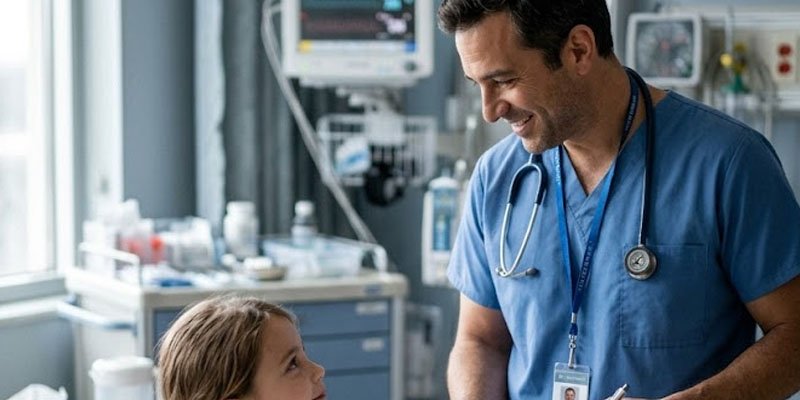
I picked up my stethoscope and stepped into the room.
The woman inside—probably in her mid-thirties, neatly dressed, with a designer handbag resting beside her—greeted me with an instant smile. Too instant. It felt practiced, almost rehearsed.
“She’s such a little daredevil,” the woman said with a laugh as she rubbed the girl’s back. “She’s always climbing on things she shouldn’t.”
The little girl was named Tamara. She sat quietly on the edge of the bed, holding her injured arm close against her chest while staring at the floor. She wasn’t crying. That was the first thing that unsettled me. A six-year-old with what looked like a broken wrist should have been in tears.
Children cry. That’s normal. The ones who stay completely silent are often the ones who have learned that crying only makes things worse.
I crouched down beside her. “Hi, Tamara. I’m Dr. Hewitt. Would it be okay if I looked at your arm?”
She never looked at me.
She looked at the woman.
The woman gave a slight nod.
Only then did Tamara carefully hold out her arm.
I gently pulled back her sleeve to inspect the swelling around her wrist. That’s when I noticed them.
These weren’t ordinary bruises.
They were distinct marks. Evenly spaced. They wrapped around her forearm like the outline of a bracelet—the kind of pattern monkey bars couldn’t leave behind. The kind created by an adult hand gripping tightly enough to twist.
My stomach sank.
I forced myself to stay expressionless. Eighteen years in medicine teaches you that. You don’t react. You don’t gasp. You observe, document, and keep moving.
I glanced toward the woman. She was absorbed in her phone, typing away.
“Tamara,” I asked gently, “does anything else hurt besides your wrist?”
She quietly shook her head.
“Can I take a look at your other arm too?”
The woman immediately looked up. “Why? She landed on the right one.”
“That’s part of our normal examination,” I replied with a smile. Beneath my gloves, my hands were trembling.
Tamara slowly lifted her left arm.
I rolled up her sleeve.
There were more marks.
Older bruises this time, fading into yellow and green. Beneath them was something I had encountered only twice in my entire career.
Thin, intentional lines. They weren’t self-inflicted. They were too neat. Too consistent. Almost as though someone had used a—
I froze.
I examined the pattern again.
Then my eyes shifted to the woman’s handbag.
Specifically, the keychain hanging from its zipper.
It matched.
I slowly stood up.
“I’m going to order an X-ray,” I said, somehow managing to keep my voice calm. “A nurse will take you both down the hall.”
The woman simply nodded and returned to looking at her phone.
I walked straight to the nurses’ station, shut the door behind me, and reached for the phone.
I never called radiology.
Instead, I called Denise from social work.
Then I contacted hospital security.
After that, I opened Tamara’s medical history.
She had visited our emergency department four separate times over the last fourteen months.
Each visit had been handled by a different physician.
Each injury had been explained away as another accident.
But none of that was what truly chilled me.
It was the secondary emergency contact listed in her chart.
Not the woman claiming to be her mother.
I read the name again.
Then a third time.
I had to be certain my eyes weren’t playing tricks on me.
It was someone I recognized immediately.
Someone every person in this hospital knew.
Because that individual wasn’t just Tamara’s emergency contact.
They were upstairs at that very moment, sitting in the chief of medicine’s office.
And suddenly, the conversation I had overheard the previous week made terrifying sense.
I could still hear the words clearly.
“Just make sure the records don’t connect. I’ll handle the rest.”
I looked back down at Tamara’s chart.
Then I glanced at the security camera monitor behind the desk.
The woman was no longer in Bed 7.
Neither was Tamara.
I took off running toward the room.
The privacy curtain had been pulled aside.
The bed was empty.
Tamara’s small jacket still hung over the bed rail.
But resting on the pillow, partially tucked beneath the sheet, was a folded note.
My hands shook as I unfolded it.
Written in uneven red crayon, in the shaky handwriting of a child, were five words that instantly changed everything I believed had happened in that room.
The note read:
“My real mommy is coming.”
This time my heart didn’t merely sink.
It felt as though it had stopped completely.
Real mommy.
Which meant the smiling woman carrying the designer handbag was never her mother.
I stared at the uneven crayon writing.
Every letter showed inconsistent pressure, as though Tamara had scribbled it down in a rush while terrified someone would catch her.
I hurried back to the nurses’ station with the note still clutched tightly in my hand.
Denise was already on the phone.
Her face had turned pale.
The moment she saw me, her eyes widened.
“They’re gone, Mark,” she whispered silently, covering the phone receiver.
“I know,” I replied, holding up the note. “Alert security to every exit. Code Adam. Right now.”
A Code Adam is the emergency protocol hospitals use when a child goes missing. It immediately secures the building, locks down every exit, and sounds alarms throughout the hospital. In an instant, a place built to heal becomes a fortress.
Denise immediately passed along the instruction, her voice tense with urgency.
I turned back to the computer, my hands racing across the keyboard as I reopened Tamara’s medical record.
The woman was listed as Caroline Finch.
The secondary emergency contact was Dr. Alistair Finch—her brother, and the very man sitting in the chief’s office.
Everything fell into place with a sickening realization. The four earlier ER visits. A different physician every time. Every injury carefully documented as another unfortunate “accident.”
They weren’t simply hiding child abuse.
They were manufacturing evidence.
Evidence meant to frame Tamara’s real mother.
My mind flashed back to the conversation I had overheard near the cafeteria. Dr. Finch—calm, influential, and intimidating—speaking quietly to his sister. “Just make sure the records don’t connect. I’ll handle the rest.”
He hadn’t been instructing her to conceal the abuse.
He had been directing her to build a false medical history that would make someone else appear abusive.
I needed answers from him.
I needed to find out exactly what he knew.
“Denise, keep security on the phone,” I said as I headed toward the elevators. “I’m going upstairs.”
“To Finch’s office? Mark, have you lost your mind?”
“Maybe,” I called back without stopping.
The elevator ride to the executive floor seemed endless. When the doors finally opened, I stepped onto thick carpet lined with framed awards—a world completely removed from the nonstop chaos downstairs in the emergency department.
His assistant, a stern woman named Eleanor, tried to stop me.
“Dr. Hewitt, you can’t simply walk in there—”
I kept moving.
Without slowing down, I pushed open the heavy oak doors leading into his office.
Dr. Alistair Finch stood with his back to me, speaking on the phone while looking out across the city skyline. He was the sort of man who inspired obedience through intimidation alone. Perfectly tailored suit. Silver hair. A voice sharp enough to cut through steel.
He turned around, irritation immediately crossing his face.
“What exactly is the meaning of this?”
“Where is she, Alistair?” I asked quietly, my voice steady.
One eyebrow lifted as he slipped effortlessly into his usual air of superiority.
“Where is who?” he replied. “You’d better have an excellent reason for barging into my office.”
“Tamara,” I answered, stepping closer to the enormous desk. “The six-year-old your sister brought into my ER. The child with patterned bruises on both forearms—the same pattern as the keychain hanging from Caroline’s purse.”
His face lost its color.
The change was subtle, almost invisible, but I caught it.
His jaw tightened ever so slightly.
“That is an outrageous and defamatory accusation,” he said, lowering his voice into something cold and threatening. “My sister’s daughter happens to be accident-prone.”
“Her daughter?” I replied. “Interesting, because Tamara left me a note. According to her, her ‘real mommy’ is coming.”
He didn’t respond.
For ten long seconds, the room remained completely silent.
In that silence, the entire ugly truth revealed itself—the influence, the manipulation, and the carefully orchestrated deception.
“You should choose your next words very carefully, Dr. Hewitt,” he finally said, slipping his composure back on like a perfectly fitted mask. “You’re stepping into dangerous territory. I run this hospital.”
“And I’m the one who treats the children brought through its doors,” I answered, anger finally breaking through. “A little girl has disappeared inside your hospital, and you and your sister are responsible. A Code Adam has already been activated, and the police are on their way.”
That was when I saw it.
Real panic.
For the first time since walking into his office, genuine fear appeared in his eyes.
He reached for the phone on his desk.
I knew exactly what he intended to do.
He wasn’t trying to get help.
He was trying to warn Caroline.
I spun around and hurried back toward the elevators.
I already had the answer I needed.
Without realizing it, he had told me exactly where they had gone.
When someone powerful panics, they stop thinking rationally.
They think about escape.
They think about places nobody would ever think to search.
Then I remembered something.
Years earlier, during a hospital fire safety drill, I had studied the building’s old blueprints.
The abandoned North Wing.
It had been shut down for renovations for well over a year.
An empty ward.
Dark.
Silent.
And connected directly to the underground parking garage through a private service elevator.
The perfect place to hide a child until the lockdown ended.
Near the stairwell, I met two security officers.
Frank, a broad-shouldered veteran.
Maria, a younger officer with a radio already in hand.
“Dr. Hewitt,” Frank said over the crackle of his radio, “every exit has been secured. They disappeared after leaving the ER. Nothing on any security camera.”
“They’re not trying to leave,” I replied. “They’re waiting for this to blow over. North Wing. Let’s move.”
We hurried up the stairs, the sound of our footsteps bouncing through the empty stairwell. The fire door leading into the abandoned wing was heavy and reluctant to move. Frank leaned his weight against it until it finally creaked open.
The air beyond was cold, stale, and untouched. Dust floated through the flashlight beams. Old stretchers and unused medical equipment sat beneath plastic covers, looking like sleeping giants in the darkness.
The entire wing was eerily quiet.
Then I heard it.
A faint sound.
A muffled cry.
We followed the noise through the long, shadow-filled hallway until it brought us to a supply closet at the very end of the corridor.
My pulse pounded in my chest.
I signaled for the security guards to stay where they were.
Then I pressed my ear against the door.
“You have to stay quiet, sweetheart,” Caroline Finch whispered anxiously from inside. “This is just a game. We’re hiding from the doctor.”
“I want my mommy,” Tamara pleaded softly. “The note said she was coming.”
“I am your mommy!” Caroline snapped, desperation cracking through her voice. “I am!”
That was enough.
I turned the handle.
It wasn’t locked.
I slowly pushed the door open, and my flashlight illuminated the cramped room.
Caroline was crouched on the floor with one hand firmly covering Tamara’s mouth. The little girl’s eyes were filled with terror as tears streamed down her cheeks. Beside them lay the designer handbag, its shiny metal keychain catching the beam of my flashlight.
The moment Caroline looked at me, her expression collapsed.
The composed, polished mother disappeared.
All that remained was a frightened woman trapped with nowhere left to run.
Frank and Maria stepped in behind me.
“It’s over, Caroline,” I said calmly, my voice steady but firm.
She released Tamara immediately.
The little girl scrambled away from her, stumbled straight into me, and wrapped herself around my legs as though I were the only safe place left in the world.
I lifted her into my arms.
Her tiny body shook uncontrollably.
“He forced me,” Caroline cried, rocking back and forth on the closet floor. “Alistair. He convinced me her real mother was unstable… a drug addict. He said we had to keep Tamara safe.”
“By hurting her?” I asked coldly.
“He said she needed discipline,” Caroline whispered. “He said we had to document every bit of her… her clumsiness. So Sarah would never be able to get her back.”
Sarah.
That was the real mother’s name.
While the security officers took control of Caroline, I carried Tamara back toward the active part of the hospital. She had buried her face against my shoulder and never spoke another word.
When we stepped out of the abandoned North Wing and back into the bright, spotless hallway outside the emergency department, it felt as though we had finally come up for air.
Then I saw her.
A tired-looking woman stood at the nurses’ station speaking urgently with Denise. Her hair was disheveled, her clothes wrinkled, and exhaustion covered her face. But her eyes remained focused, searching desperately from one face to another.
“A friend who works here sent me a text,” she was saying, her strained voice shaking. “She told me my daughter was brought here. Please… please help me. Her name is Tamara.”
I stopped walking.
Tamara slowly lifted her head from my shoulder.
Her eyes met the woman’s.
Then, for the first time that entire night, she spoke.
Only one word.
Soft enough to barely rise above a whisper.
Yet it seemed to fill every corner of the emergency room.
“Mommy?”
Sarah turned.
The instant she saw Tamara in my arms, a broken sound escaped her—a mixture of a sob and an overwhelming gasp of relief.
She ran toward us.
I gently lowered Tamara to the floor.
Without hesitation, Tamara threw herself into her mother’s embrace.
The two of them clung to each other, both crying openly as they shared a beautiful, emotional reunion in the middle of our busy emergency department.
The full story emerged gradually afterward.
Sarah had once worked as a nurse in this very hospital.
She and Alistair Finch had been involved in a short but deeply troubled relationship.
When she became pregnant and chose to leave him, he used his influence, money, and authority to ruin her life.
He arranged for her medical records to be altered.
He paid people to give false testimony in court.
He successfully portrayed her as an unfit parent, gained custody of Tamara, and placed the little girl in Caroline’s care.
For two years, Sarah had fought tirelessly, filing appeal after appeal while desperately trying to convince someone to hear the truth.
Those four emergency room visits had served more than one purpose.
They weren’t only creating false evidence.
They were also a calculated way to torment Sarah by sending her official reports documenting her daughter’s repeated “accidents,” knowing she was powerless to stop any of it.
The note Tamara left behind had been her final act of hope.
Sarah had promised her daughter that one day she would come back for her, no matter what happened.
Tamara never stopped believing that promise.
The consequences came swiftly.
Dr. Alistair Finch was suspended almost immediately and later dismissed, watching both his career and reputation collapse.
Caroline was charged with numerous criminal offenses.
The hospital launched a sweeping internal investigation.
Roughly a month later, a large envelope arrived for me through the hospital mail.
Inside there wasn’t a letter.
There weren’t any legal papers.
Instead, there was a drawing made with bright red crayon.
It showed a smiling little girl wearing a cast on her wrist, holding hands with a woman whose face carried an enormous sunny smile.
Standing beside them was a stick figure wearing glasses and a stethoscope.
Across the top, written in uneven childlike handwriting, were two simple words:
“My heroes.”
That picture has remained pinned to the bulletin board in my office ever since.
Working in medicine exposes you to humanity at its worst.
You witness pain, fear, and suffering that can slowly harden your heart and make you want to stop feeling altogether.
But every now and then, you witness the exact opposite.
You see the unshakable bond between a mother and her child.
You witness the remarkable courage of a little girl who refused to give up hope.
And you learn that the quietest voices often carry the greatest truths.
If you’re willing to slow down and truly listen, those voices can reveal something powerful enough to change everything.
All you have to do is find the courage to act—even when the person standing in your way holds all the power.