There are family gatherings where everyone seems determined to act as though life couldn’t possibly be better.
This was one of those occasions.
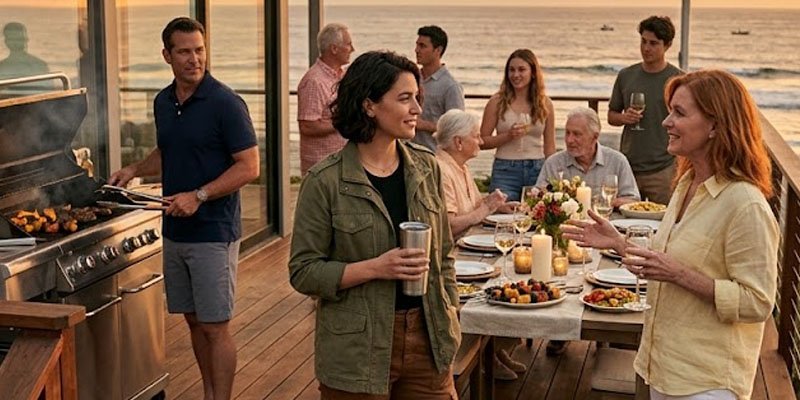
My parents’ beach house overlooked the South Carolina shoreline, with lanterns glowing across the deck, burgers sizzling on the grill, classic country music drifting from portable speakers, and cousins running around while the younger kids played across the yard.
Everyone appeared completely at ease.
Everyone except me.
I had only just finished putting food on my paper plate when my younger sister, Emily, spotted me standing near the patio.
“There she is!”
She lifted her drink with a playful, exaggerated smile.
“So…”
“I heard you’re teaching flight simulator classes these days.”
Several family members glanced in our direction.
I gave a polite smile.
“Not exactly.”
She cocked her head.
“Oh?”
“I fly.”
A few cousins chuckled.
One of my uncles quietly said,
“Sure you do.”
Emily wasn’t ready to stop.
“So what kind is it?”
“Corporate aviation?”
“Tour flights?”
She looked around the patio as if expecting everyone to agree with her.
“I mean…”
“You’ve always had quite the imagination.”
More laughter spread through the group.
Even our father smiled without saying anything.
I simply picked up my fork.
Working in aviation had taught me something most people never seem to understand.
Silence often carries far more authority than trying to argue.
Emily stepped a little closer.
“No, seriously.”
“If you’re really some mysterious pilot…”
“What do you fly?”
“I can’t talk about that.”
She laughed even louder.
“Oh, that’s priceless.”
“So now it’s classified?”
Someone standing near the grill gave a sarcastic clap.
“This just keeps getting better.”
Emily crossed her arms.
“Fine.”
“If you’re actually legitimate…”
“Tell us your call sign.”
For the first time that evening…
I looked straight at her.
“Sentinel Six.”
The entire backyard seemed to pause.
Not for everyone.
Only for one person.
Her husband.
Ryan.
A retired Marine helicopter crew chief who had served on several overseas deployments.
He had been reaching into the cooler for another soda.
His hand froze halfway.
The can stayed exactly where it was.
He slowly turned toward me.
The expression on his face had completely changed.
There was no amusement.
No confusion.
Only recognition.
He stared at me for several long moments.
“You said…”
“‘Sentinel Six?'”
I gave a single nod.
“Yes.”
Emily rolled her eyes.
“Ryan, don’t play along with this.”
He never took his eyes off me.
“What squadron?”
I answered quietly.
“Joint Special Operations.”
His jaw became tense.
“You flew the northern evacuation corridor?”
“I did.”
“Were you there during Black Ridge?”
I simply nodded once more.
Ryan closed his eyes for a brief moment.
When he opened them again…
He looked almost uneasy.
Emily let out an awkward laugh.
“Seriously?”
“So now you two know each other?”
Ryan ignored her completely.
Instead, he asked me one last question.
“Who gave you that call sign?”
“Colonel Mason.”
That alone was enough.
Ryan slowly placed his drink on the patio table.
Then he turned toward his wife.
“Emily.”
She looked at him impatiently.
“What?”
“You need to apologize.”
She blinked.
“For what?”
“For every joke you’ve made over the last five minutes.”
She laughed.
“Oh, come on.”
“You actually think—”
“I’m serious.”
His voice had become noticeably firmer.
“Right now.”
Every bit of laughter around the backyard disappeared.
Even my father looked completely puzzled.
Emily frowned.
“Ryan…”
“What’s gotten into you?”
He looked directly into her eyes.
“I’ve heard that call sign exactly once.”
“It was during an operational briefing.”
“There were no names.”
“No photographs.”
“Only the pilot everyone hoped would show up before it was too late.”
No one gathered around the barbecue said a word.
Ryan finally turned back toward me.
His expression carried the kind of respect that needed no explanation.
Then he quietly spoke the words that brought every conversation on the patio to a complete stop.
“You aren’t supposed to tell people who you are.”
I gave a faint smile.
“I usually don’t.”
Emily looked from him…
To me…
Then back again.
For the first time in her life…
She wasn’t laughing.
And suddenly, everyone standing in that backyard wanted to know why a single call sign had changed everything.
The Part Ryan Knew
My mother was the first to react.
She carefully placed the bowl of watermelon she had been carrying onto the table and said, with forced cheerfulness, “Well… the burgers are getting cold.”
No one moved toward the grill.
Ryan continued staring at me as though he’d just discovered a ghost standing beside the patio furniture.
Emily let out a brief, awkward laugh. “Okay… is someone going to explain whatever strange military performance is happening in my parents’ backyard?”
“It isn’t a performance,” Ryan replied.
His voice was calm and firm. There was no room for debate.
My father gave a small snort. “Now, wait a minute. Claire’s always kept to herself, but if you’re trying to tell me she was some kind of… what, secret operations pilot, that’s a little hard to believe.”
I looked at him.
At sixty-eight, he still wore the exact same half-smile I’d seen when I was fourteen and told him I wanted to become a pilot. The smile that said, that’s adorable. The same one he wore when he bought Emily a secondhand Jeep while telling me flight school was “too expensive to waste on a passing phase.”
He’d never really stopped looking at me that way.
Ryan rubbed the side of his mouth with his hand, taking a moment before speaking.
Then he said, “Sir, with all due respect, I don’t think you understand what she just told you.”
Emily folded her arms even tighter, almost like a stubborn child.
“Then explain it.”
Ryan didn’t answer immediately.
He looked at me first.
That meant something.
I gave him a slight nod.
Only then did he face everyone on the patio.
“A call sign like that isn’t earned flying on weekends. It doesn’t come from private charter work. And Colonel Mason…” He paused. “If we’re talking about the Mason I think we are, people never casually mentioned his name.”
One of my cousins, Derek, laughed because laughing was what Derek did whenever he felt uncomfortable.
“So what, she flew helicopters somewhere in the desert?”
Ryan shook his head.
“No.”
“Places much worse.”
That ended Derek’s joking.
Emily still refused to believe it.
“You can’t honestly be serious. She taught simulator courses in Savannah for, what, two years?”
“Three,” I corrected.
She immediately pointed at me.
“Exactly!”
“I taught there after I stopped deploying.”
Ryan turned toward her.
“Emily.”
“Stop talking.”
She actually stepped back a little.
He had never spoken to her that way in front of the family before.
The old country songs continued drifting from the speaker near the railing.
An Alan Jackson song played softly.
A seagull cried somewhere down by the beach, while one small child began crying after another kid grabbed a plastic shovel.
Everything around us sounded completely ordinary.
Yet right in the middle of it…
My carefully separated worlds had begun falling apart.
My mother looked back and forth between us.
“Claire, sweetheart… what exactly did you do?”
I could have lied.
I had better lies than anyone standing there.
Entire years of my life had been built upon stories approved by men who stood behind government flags.
But Ryan had already recognized the truth underneath.
So I answered.
“I flew extraction and insertion support.”
“Mostly at night.”
“Mostly in places where someone decided there wasn’t time to wait for daylight… or permission.”
Silence followed.
My Uncle Gene—the same one who’d muttered sure you do earlier—scratched his cheek and suddenly became very interested in watching the grill.
Emily forced another quick laugh.
It cracked halfway through.
“You’re all doing this because Ryan got carried away over some nickname.”
“Call sign,” Ryan corrected.
“Whatever.”
He stepped toward her.
“No.”
“Not whatever.”
Then he looked back at me.
“Black Ridge was January fourteenth?”
“January fourteenth.”
His expression shifted again.
It wasn’t fear.
It was memory.
What Happened at Black Ridge
“Then tell them,” Emily said, lifting her chin.
“If everyone’s going to look at me like I’m the fool, then explain it.”
I almost refused.
Not because I couldn’t.
Because once people hear one real story…
They immediately want ten more.
They expect a polished movie version, complete with a hero, a meaningful lesson, and dramatic music swelling in the background.
Real operations aren’t like that.
They’re filled with broken radio transmissions, blood in someone’s mouth, and a grown man repeating “please” because he already knows time has run out.
Ryan made the choice for me.
“I wasn’t there,” he said.
“I was stationed at Al Asad when we received the briefing afterward.”
“It was a closed session.”
“Crew chiefs.”
“Pilots.”
“Intelligence personnel.”
“We were told about an evacuation route that collapsed after two teams became trapped north of a river crossing.”
He was speaking to everyone gathered there now.
But every few moments his eyes returned to me, comparing my reactions to whatever classified memories still remained in his mind.
“There was a storm moving in,” he continued.
“Bad enough that fixed-wing support became limited, and people started using words like ‘unrecoverable.’”
My cousin’s wife quietly whispered,
“Jesus.”
Ryan continued.
“The briefing officer said one aircraft made the flight anyway.”
“Very low altitude.”
“No lights.”
“It took ground fire during the approach, extracted one team, then turned around and went back for the second team after being told not to.”
My father finally spoke.
“That’s impossible.”
I answered,
“No.”
“It was just reckless.”
Ryan looked at me.
“They said the pilot used the shadow of the ridge to stay below visual detection.”
“I got lucky.”
“You did it twice.”
The paper plate in my hand had become soft from the grease.
I placed it on the patio railing.
Emily was staring at me now.
Really staring.
As though she’d suddenly realized there might have been another version of my face she’d somehow never noticed during the past thirty-four years.
“Why wouldn’t anyone know about this?” she asked.
I nearly laughed.
“Because the people who made it home weren’t busy writing memoirs for your group chat.”
The words landed harder than I intended.
My mother flinched.
And there it was.
That small, ugly feeling of satisfaction.
I wish I could honestly say I was better than that.
I wasn’t.
Not then.
Maybe not even now.
My father finally asked,
“If everything you’ve said is true… why didn’t you ever tell us?”
I looked at him for a long moment.
“When?”
He frowned.
“What do you mean, when?”
“When I came home from Kandahar and you said Emily passing her realtor exam was the biggest family news, so we shouldn’t ‘ruin dinner’ by talking about work?”
“When I broke my wrist, told you it happened during a rough landing, and you asked if that was the reason I still wasn’t married?”
“Take your pick.”
His ears turned bright red.
He opened his mouth to speak.
Then closed it again.
My mother spoke softly.
“Claire…”
“No,” I replied. “It’s okay. You all created a version of me that was easier to understand. The strange oldest daughter. The one who was always gone. The one who never explained anything. That was much simpler than wondering why I disappeared every six months.”
Ryan cleared his throat.
“Black Ridge wasn’t the only mission, was it?”
“No.”
He gave a slight nod, as though he’d already known the answer.
Emily’s voice was quieter now.
“So… what was Sentinel Six?”
I answered because, for the first time that evening, she’d asked an honest question.
“It was the designation for my aircraft during that deployment. Sentinel flight. I happened to be the sixth pilot assigned during that rotation. Mason started calling me Six over the radio because it was quicker, and eventually it stuck.”
“That’s all?” she asked.
“That’s all.”
People usually imagine call signs come from ego or flashy stories.
Sometimes they’re simply the result of paperwork, convenience, and a commander shouting into your headset while tracer rounds streak beneath your left skid.
The Thing I Never Told Them
My mother asked whether anyone wanted iced tea.
No one responded.
She walked inside anyway.
Not to make tea.
Most likely to cry where nobody could see.
That was always her way.
Never let emotions become a spectacle that lingered over the dinner table.
The sun had sunk lower across the water.
The lanterns hanging around the deck glowed more brightly now.
Soft golden circles.
Moths had already begun fluttering against the glass.
Emily stepped a little closer.
More carefully this time.
“Did you kill people?”
There it was.
She went straight to the hardest question because she had no idea where else to place the person she’d just discovered.
“Emily,” Ryan said.
“No.”
“Let her answer.”
So I did.
“I fired when I had no other choice.”
She swallowed.
I could almost watch the version of me she’d carried in her mind being dismantled one piece at a time.
One of my aunts picked up two empty chip bowls and absentmindedly carried them from one table to another.
Not because they needed moving.
Her hands simply needed something to do.
My father finally spoke.
“You were in danger all that time.”
I let out one short laugh.
I couldn’t stop it.
“That’s the part you’re focused on?”
He looked directly at me.
“You’re my daughter.”
I almost answered, Only when the story is dramatic enough.
I didn’t.
Just barely.
Ryan asked,
“Is Colonel Mason still alive?”
“As far as I know, yes.”
“Living in Montana.”
“Doing a terrible job of raising horses.”
For the first time, the faintest trace of a smile crossed his face.
Then he said,
“He gave us the briefing after Black Ridge.”
“He said that if Sentinel Six hadn’t ignored the order to abort, eleven men would have been executed before sunrise.”
Around us, the backyard fell silent again.
But this silence felt different.
It wasn’t shock anymore.
It was weight.
Eleven.
Sometimes numbers carry more power than stories ever can.
Emily’s lips slowly parted.
She looked physically ill.
I leaned one shoulder against the deck post.
“Mason always had a talent for dramatic wording.”
Ryan met my eyes.
“Was he wrong?”
I didn’t answer.
Because there was one part I had never told Ryan.
The part that had never appeared in any official briefing.
Those eleven men weren’t the real reason I went back.
Not entirely.
The first extraction included a medic named Torres.
Twenty-six years old.
An Arizona kid.
An awful mustache.
In the rush to load the wounded, he’d left behind his trauma bag.
Then he realized his radio handset was still clipped to it.
The second team trapped on the ridge only had a weak backup radio and no surgical equipment.
Torres looked at me, his helmet half removed, someone else’s blood covering his chest, and said,
“My bag’s still up there.”
Then he said the sentence that stayed with me for years.
“My brother’s with the second team.”
That’s why I turned the aircraft around.
Not because of tactics.
Not because of heroics.
Because one man begged me to save his brother while rotor wash blasted dirt across his face.
No one in my family knew any of those names.
They’d never heard of Torres.
Or Mason.
Or Daugherty, the gunner who always chewed wintergreen and kept a picture of an ugly bulldog taped above the cabin light.
They’d never known Velez, who sang old sitcom theme songs during preflight whenever he was scared.
I finally said,
“There was a medic.”
“He’d left something behind.”
Ryan studied my face.
He understood immediately that there was far more to the story than anything included in the briefing.
He didn’t ask another question.
Good man.
The Other Reason Ryan Went Pale
Emily slowly lowered herself into one of the deck chairs, as if her legs had suddenly forgotten how to hold her up.
“I made fun of you for teaching simulator classes,” she said quietly.
“Yes.”
“And you just let me.”
“I did.”
“Why?”
I stared out across the water.
Because I was exhausted, I thought.
Because every visit home felt like walking into a play that had already started, pretending I still remembered my part.
Because if I’d told you the truth a decade ago, it would have become the only thing you ever saw when you looked at me.
Because some doors are simply easier to leave closed.
Instead, I said,
“Because I didn’t come here to convince anyone.”
Ryan had become silent again.
After a long moment, he asked,
“Did you ever fly with Harlow?”
The question landed like a heavy wrench hitting concrete.
I looked directly at him.
“How do you know that name?”
He hesitated before answering.
“My captain had a friend on one of the recovery teams after the crash near Shkin.”
“We only ever heard fragments.”
“A pilot named Harlow.”
“Maybe a co-pilot.”
“No one was completely sure.”
I shook my head.
“He was the lead pilot.”
“And yes… I flew with him.”
Ryan had already gone pale once that evening.
Now whatever color remained drained from his face.
Emily whispered,
“What?”
Ryan looked at me.
“They told us nobody ever went back for him.”
“I did.”
No one moved.
Not even the children.
I’m sure they were still running around the yard somewhere.
I simply stopped noticing them.
My father finally spoke.
“What are you talking about?”
I could still feel the familiar ache in my left shoulder where the harness had locked during that landing.
Rain.
Mud.
Fuel.
The smell of burned electrical wiring that lingered in my flight gloves for days afterward.
It’s strange what memories refuse to disappear.
“Harlow’s aircraft went down about twelve miles east of the border.”
“We were ordered to hold position because the crash site was too dangerous and daylight was almost here.”
“Mason decided losing another aircraft wasn’t worth recovering bodies.”
Ryan answered carefully.
“But they found him back in the States.”
“Alive.”
“That story circulated for months.”
“It wasn’t just a story.”
Emily looked from Ryan to me.
“I have no idea what’s happening.”
I met her eyes.
“Harlow wasn’t dead when they decided he was.”
What They Wrote Down, What Really Happened
By then my mother had returned outside.
She had repaired her mascara.
Not very successfully.
She stood in the doorway carrying a pitcher of iced tea covered in condensation that nobody had requested.
I continued speaking.
“We had already turned south.”
“Our fuel situation wasn’t good.”
“Then I caught a broken transmission on the guard frequency.”
“It could have been static.”
“It could have been him.”
“I asked for one pass over the grid.”
My father spoke.
“Against orders.”
“Yes.”
My mother set the pitcher onto the table harder than she intended.
The ice clattered loudly against the glass.
Ryan asked,
“Who was flying with you?”
“Daugherty.”
“Velez.”
“Chief Warren was in the back.”
“Warren?” Ryan repeated.
“The red-haired guy with the scar over one eyebrow?”
I blinked.
“You knew Warren?”
He gave a brief nod.
“I cross-trained with him in Yuma before my second deployment.”
That explained the expression he’d worn ever since hearing my call sign.
It wasn’t only recognition.
It was connection.
He was only one step removed from the men I’d fought beside.
I nodded.
“Then you know he hated me for about three minutes… and still backed my decision.”
Ryan almost smiled.
“That sounds exactly like him.”
My mother whispered,
“Claire.”
I turned toward her.
One hand rested against her throat as though she was struggling to keep herself together.
I answered more gently.
“We found the wreckage because of the smoke… and a little luck.”
“Harlow had crawled maybe forty yards away from the wreck before getting trapped against a washed-out section of ground.”
“Broken leg.”
“Burns.”
“One eye swollen completely shut.”
“He still had his sidearm drawn when we landed.”
Emily covered her mouth.
“Was he alone?” Ryan asked.
“No.”
“The co-pilot was dead.”
“So was the crew chief.”
I watched a moth strike the lantern glass…
Then hit it again…
And again.
“Harlow kept asking whether we were actually there. Warren smacked the side of his helmet and told him to stop talking and stay awake. We loaded him while taking fire. Daugherty caught a bullet through his calf climbing back aboard. And on the way out, I nearly struck the tail against a rock ledge because the landing zone wasn’t really a landing zone—it was just an awful idea covered in dirt.”
No one said a word.
Finally, my father searched for something familiar to hold onto.
“And all of this…” he said. “It was classified?”
“Most of it.”
He slowly shook his head, looking defeated.
“Why would your own family be shut out of your life like that?”
That question.
God.
I looked straight at him.
“You weren’t shut out.”
“You just never stepped in.”
His expression changed immediately.
Not the look of someone pretending to be hurt.
The look of someone who’d actually been hit by the truth.
Good.
Not generous.
But good.
Ryan asked the question that mattered to him.
“Why didn’t Warren ever tell anyone it was you?”
“Because he enjoyed keeping his pension.”
That earned a rough, quiet half-laugh from him.
Then I added,
“And because Harlow asked us not to.”
Emily looked up.
“Why would he care who rescued him?”
I answered.
“Because Harlow wasn’t supposed to be there in the first place.”
The Name Under the Name
A breeze rolled in off the water, sending one of the paper napkins skimming across the deck.
My mother pinned it beneath her sandal without even realizing she’d done it.
Ryan narrowed his eyes.
By now he was already several steps ahead of everyone else.
“Harlow wasn’t his real name,” he said.
“No.”
Emily looked completely confused again.
“Then whose name was it?”
I let the silence hang for four long seconds.
Then I answered.
“Congressman David Mercer.”
If I’d dropped a dinner plate onto the deck, it wouldn’t have stunned everyone more.
My father instinctively took a step backward.
My Uncle Gene muttered,
“Bullshit.”
Not loudly.
Ryan stayed silent.
He could already tell from my face that I wasn’t trying to prove anything anymore.
Before entering politics, Mercer had been known publicly as a decorated veteran—always standing in front of flags, speaking with polished confidence on television.
What nobody outside a handful of people ever learned was that, before his first campaign, he’d been involved in a disastrous overseas incident that included a private security operation, an unauthorized border crossing, and a helicopter crash that would have destroyed his future before it ever began.
He hadn’t been operating under his own name.
He’d been Harlow.
I continued.
“They buried the crash beneath two separate reports and one dead contractor.”
“Mercer made it home.”
“Six months later he was sitting on Sunday political talk shows discussing sacrifice.”
Emily stared at me as though I’d begun speaking another language.
“So… you’re telling us you saved a congressman.”
I shook my head.
“I’m telling you I rescued a man who later became one.”
“Did he ever thank you?”
I laughed again.
It sounded even harsher this time.
“He sent a letter through official channels.”
My mother frowned.
“What letter?”
I hadn’t planned to bring it up.
But after everything else, there wasn’t much point hiding it.
I walked to my overnight bag just inside the sliding glass door.
Front pocket.
Folded into thirds.
Still sealed inside the old plastic sleeve, with the classification stamp blacked out years earlier by some bored government clerk.
I carried it back outside.
Ryan watched the paper in my hand the way someone watches an old scar being uncovered.
He knew what something like that could mean.
I placed the letter on the table.
My mother looked at me.
“You’ve been carrying that all this time?”
“Sometimes.”
Emily reached toward it.
Then stopped.
“May I?”
I nodded.
She unfolded it carefully.
The patio had become so quiet I could hear grease crackling on the grill.
She began reading aloud.
“Captain Claire Bennett, your actions on the morning of May 22 preserved the life of someone whose future service to this nation may one day prove immeasurable. You understand why direct recognition cannot be given. History often rests upon those whose names remain unknown. On behalf of those who will never be able to thank you publicly… thank you.”
There was no signature.
Only an office stamp and a pair of initials.
Emily looked up.
“That’s all it said?”
“That was all.”
Ryan asked,
“What were the initials?”
I answered.
“D.M.”
My father dropped heavily into the nearest chair.
Not because of the missions.
Not because of the weapons.
Because, at last, he’d been handed proof in the only language he’d ever truly respected:
Being connected to someone important.
I hated that.
And I hated even more that a part of me still wanted him to sit with it.
Emily Finally Says It
By then the sky above the water had turned deep purple.
Parents were calling children inside for baths.
Someone switched off the music.
The fire beneath the grill had burned down until only a soft orange glow shone through the slats.
Emily folded the letter again.
Poorly.
Not along its original creases.
Then she handed it back to me as though it might scorch her fingers.
She stood.
Then she looked directly at me.
Really looked.
There was no audience left in her expression.
“I’m sorry,” she said.
I waited.
She tightened her jaw.
Then tried again.
“I’m sorry I turned you into a joke because it was easy.”
“And because everyone else laughed with me.”
“I’m sorry I decided who you were years ago… and never let that picture change.”
That one mattered.
She looked toward the dark yard.
“And I’m sorry I liked being the daughter everyone understood.”
My mother closed her eyes.
There it was.
The ugliest honest sentence spoken all night besides my own.
I answered simply.
“Thank you.”
Not warmly.
Not coldly.
Just honestly.
Ryan picked up the soda he’d abandoned much earlier, realized it had gone warm, and quietly set it back down.
Then, almost speaking to himself, he said,
“Warren once told me there was a pilot who went back for a ghost.”
“I thought he was making it up.”
I looked over.
“What else did he tell you?”
Ryan shook his head slightly.
“He said she turned down a medal because she didn’t want to stand in a room while politicians lied about what had really happened.”
I smiled despite myself.
“That’s close enough.”
My father stared at me.
“You refused a medal?”
“Two.”
“The second one even came with a photographer.”
Nobody seemed to know how to respond.
Good.
My mother finally poured the iced tea.
Her hands trembled just enough that some spilled over the edge of the glass and spread across the tabletop toward the old letter.
She hurriedly dabbed at it with a napkin and quietly muttered,
“Damn it.”
It was the most honest thing she’d said all evening.
I picked up the letter before it could get wet.
My father asked, much more softly this time,
“Is that why you stopped flying missions?”
I folded the letter carefully and slid it back into its plastic sleeve.
“No.”
Everyone looked at me.
I picked up my paper plate again.
The burger had gone cold.
I took a bite anyway.
Then I said,
“I stopped because one day I realized I’d become exceptionally good at bringing other people’s family members home… while not a single person standing on this deck would have known if I hadn’t come back myself.”
No one had a response.
We simply stood there overlooking the dark water, the scent of charred burgers hanging in the air, while an entire lifetime quietly shifted into a different shape.
After a long minute, Ryan walked over and handed me the fresh soda he’d finally taken from the cooler.
I accepted it.
And for the first time that evening…
Emily didn’t speak before anyone else.
Would you have told them the truth, or let them keep believing what they always had? If this story stayed with you, share it.