
The call came at exactly 5:42 on a Tuesday afternoon.
I was standing inside a briefing room at Fort Bragg, North Carolina, holding a laser pointer, when everything that had felt completely ordinary changed in a single moment.
Twelve seconds.
That was the full length of the recording.
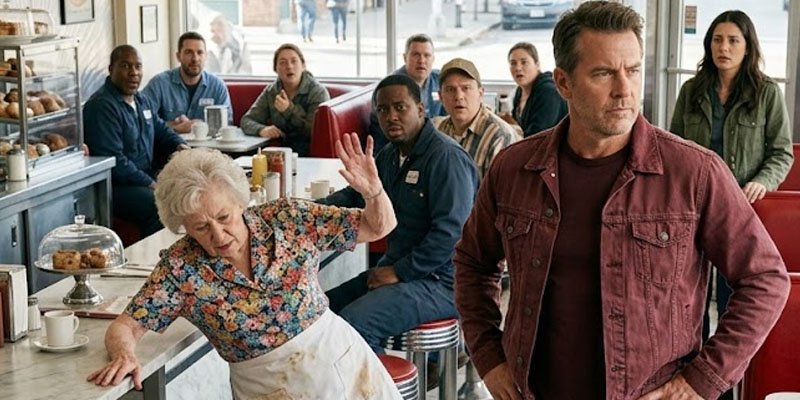
Just twelve seconds showing my seventy-five-year-old mother falling onto the diner’s linoleum floor after a confrontation. Her glasses slid beneath a red vinyl booth while a man stood over her wearing a satisfied smile, as if what had happened amused him.
Twelve seconds.
Before the video even reached the end, I understood that my life would never be the same.
People often talk about silence.
Real silence has weight. It settles over you until even taking a breath feels intentional.
I had known that kind of silence overseas—the stillness after danger revealed itself but before anyone knew exactly where it would strike. I had heard it in military hospitals during the middle of the night, when doctors pushed through swinging doors and families searched their faces for a trace of hope.
But I had never experienced silence the way I did that afternoon.
Twelve officers sat around the conference table as my phone vibrated across the polished surface. I glanced down and saw my neighbor Carol’s name on the screen.
I nearly ignored it.
We were in the middle of reviewing logistics. Colonel Renick was explaining supply-chain contingencies while I prepared to present readiness figures for the Ranger battalion under my command.
Then something inside me tightened.
Call it instinct.
Call it experience.
After more than twenty years in the United States Army, I had learned never to ignore the quiet warnings that arrive before your mind understands why.
I answered.
“Nicole.”
Carol’s voice trembled so badly I barely recognized it.
“Nicole, you have to watch this right now. It’s your mom.”
She never managed to finish the sentence.
The video came through while she was still speaking.
I excused myself and stepped into the hallway.
My hands remained steady.
They always did.
The Army had trained that steadiness into me until it felt less like discipline and more like second nature.
Inside, though, nothing felt steady.
I opened the recording.
The familiar diner appeared on my screen.
My mother’s diner.
Turner’s Family Diner sat just off Main Street in the small North Carolina town where I grew up. It still had the cracked red booths, chrome-edged tables, the pie display beside the register, and the old brass bell above the entrance that had welcomed customers since before I was born.
Behind the counter stood my mother, Evelyn Turner.
She was wearing the same faded apron with the coffee stain that somehow resembled the state of Ohio. I had tried throwing that apron away at least six different times over the years. Every single time she rescued it from the trash, insisting a perfectly good apron wasn’t ruined simply because it had gained “a little geography.”
A man stood on the opposite side of the counter.
He looked to be in his early thirties—broad-shouldered, well dressed, and built like someone who spent plenty of hours lifting weights but almost no time hearing the word no.
He leaned across the counter, pointing a finger only inches from my mother’s face.
At first, I couldn’t hear what he was saying.
The person filming appeared to be standing near the back of the diner, holding the phone low, as though even recording the confrontation felt dangerous.
My mother slowly shook her head.
Then she lifted both hands in a gesture I recognized better than almost anything else.
Those hands had braided my hair before school, flipped pancakes through countless shifts, and carried our family after my father passed away.
That gesture meant only one thing.
I won’t.
I won’t sign.
I won’t sell.
Without warning, the man swung his hand.
There was no hesitation.
No accident.
His palm struck her across the face.
Her head snapped to one side.
She lost her balance and crashed onto the floor before she could catch herself. Through the phone speaker, the impact sounded almost insignificant, but I felt it as though the blow had landed on me instead.
The diner wasn’t empty.
Customers occupied the booths behind them.
Regulars.
Neighbors.
People I had known since I was a child.
People who used to slip extra pancakes onto my plate whenever my mother wasn’t paying attention.
Not a single one of them moved.
Not one person spoke.
They simply watched a seventy-five-year-old widow hit the floor inside the restaurant she had spent forty years building through early mornings, unpaid bills, burnt coffee, and relentless determination.
No one stepped forward.
The man calmly straightened his jacket.
He didn’t appear angry.
He looked mildly inconvenienced, as though he had simply completed another routine task.
Then he spoke the sentence that echoed through my mind for the rest of that day, throughout the flight home, and long after.
“Around here, I do whatever I want.”
The recording ended.
I remained standing alone in the hallway at Fort Bragg, my phone still in my hand, while something deep inside me became completely still.
It wasn’t panic.
It was something colder.
The same feeling I had experienced only twice before.
The first time was during a convoy outside Kandahar when I realized we had entered a place we were never supposed to be.
The second was at my father’s funeral, when an honor guard folded the American flag into a perfect triangle and placed it into my mother’s trembling hands.
I requested emergency leave from that hallway.
I never returned to the briefing room.
I never delivered the presentation I had spent days preparing.
Twenty minutes later, Colonel Renick found me placing my files into my bag. He studied my face for only a moment before giving a quiet nod.
Some things never need words.
The drive to the airfield took eleven minutes.
I remember almost none of it.
What stayed with me instead was my father’s voice.
No matter how hard I tried to concentrate on the road ahead, that memory kept coming back.
One week before he died, we had been sitting together on the porch of the house he built on land our family had owned for three generations. His glass of iced tea left a damp ring on the wooden armrest while the Carolina sun slowly disappeared behind the trees.
“Nicole,” he had said.
Whenever he truly wanted me to listen, his voice became calm and deliberate.
“Whatever happens to this family—and something is coming, I can feel it—you do not use that uniform to settle scores with anyone. Do you understand me?”
I remembered frowning.
“That uniform isn’t a weapon for revenge,” he continued. “It’s a promise you made to something greater than yourself.”
Back then I was thirty-eight years old, newly promoted, and far more interested in operational reports than mysterious warnings about trouble he refused to explain.
Six years later, sitting in my car with the engine idling while those twelve seconds replayed in my mind, I finally understood exactly what he meant.
My hands began to shake.
Only a little.
Just enough to remind me that beneath the rank, the training, and the silver oak leaf on my collar, I was still a daughter who had watched someone strike her mother.
At that very moment, I made a promise to myself.
I would not answer violence with violence.
I would answer it through the law.
And I would keep going until everyone involved fully understood what they had done.
The flight home somehow felt both endless and over in an instant, the strange way grief twists your sense of time.
I watched the clouds outside gradually give way to the evening sky over North Carolina.
At some point during that flight, I stopped thinking like Lieutenant Colonel Nicole Turner, battalion commander and career officer.
I became something much simpler.
A daughter going home.
The plane landed shortly after ten that night.
I stepped onto the dark tarmac with my duffel bag slung over one shoulder.
Later, my driver admitted that whatever expression I wore frightened him.
I believed him.
For the first time in my military career, I wasn’t thinking about mission planning, troop readiness, or rules of engagement.
I was thinking about the brass bell above a diner door and the woman who deserved far better from the town she had spent her entire life serving.
The hospital smelled exactly like every hospital I had ever entered.
Disinfectant.
Old coffee.
Plastic.
Fear.
My mother’s room was on the third floor.
I paused outside the doorway for four seconds before walking inside.
I needed those four seconds to arrange my expression into something that wouldn’t make her worry.
She looked smaller than I remembered.
No one ever tells you that about seeing a parent in a hospital bed.
The bed seems too large, the thin blue gown makes them appear fragile, and suddenly the strongest person you have ever known looks impossibly vulnerable.
Her left arm rested in a sling.
The fall had fractured her shoulder.
A bruise in shades of purple and yellow stretched across her cheekbone.
My stomach tightened.
She looked up and saw me.
The expression on her face wasn’t relief.
It was something closer to concern.
“Nicole.”
Her voice was weaker than usual, yet it carried the same firmness that had once caught me sneaking out of my bedroom window when I was sixteen.
“You didn’t have to fly all the way home for this.”
I sat beside her and gently took her good hand.
“Mom, someone hit you. Someone knocked you to the floor inside your own diner.”
“I’m alright.”
She squeezed my fingers.
Even injured, her grip still held the strength built from forty years of lifting coffee pots, flipping hash browns, and working twelve-hour shifts.
“It looks worse than it really is.”
“It looks like an assault because that’s exactly what happened.”
She turned her eyes toward the parking-lot lights outside the window.
“Please, honey. Don’t make this into something bigger than it needs to be.”
I searched her face.
“What aren’t you telling me?”
She paused before answering.
“Don’t call down a storm.”
I knew that expression by heart.
Her own mother had taught it to her years before.
Don’t call down a storm.
In our family, it meant not inviting trouble that wasn’t yours to carry.
But this trouble had entered her diner, threatened her, and put hands on her.
I wasn’t about to let an old family saying stop me from doing what had to be done.
“I’m not calling down anything,” I replied softly. “I’m only going to find out what really happened.”
She closed her eyes and said nothing more.
I remained there another twenty minutes, listening to the monitor’s steady beeping and watching her chest rise and fall with each breath.
Before I left, I kissed her forehead and promised I would return first thing the next morning.
The diner looked like the scene of a crime everyone had silently agreed to pretend never happened.
Two elderly regulars sat together in a corner booth, slowly sipping their coffee.
The fluorescent lights hummed above us, sounding far louder than they should have in such a quiet place.
Kayla Moore was working the evening shift.
She had grown up nearby and used to babysit for the Henderson family down the road.
I asked her what she had witnessed.
“I didn’t see anything.”
She refused to meet my eyes as she kept wiping the same spotless section of the counter over and over.
“I was in the back.”
I questioned the cook.
He gave me exactly the same answer, only phrased differently.
At last, I walked over to the two older men.
They had eaten breakfast in that diner almost every morning throughout my childhood.
My mother had served them meals on credit whenever times were hard and their pride kept them from asking for help.
“Did either of you see what happened?”
One of them kept staring into his coffee.
“Didn’t see a thing, Nicole.”
His hand trembled around the mug.
I want you to understand what I was feeling.
It wasn’t anger.
Not yet.
It was something much colder.
The unsettling realization that you could stand in a place that had known you your entire life and suddenly discover everyone there had quietly chosen to look away.
I requested the security-camera footage.
Since my mother leased the building, the surveillance system belonged to the property owner.
He calmly explained that the cameras had experienced a technical malfunction that afternoon.
There were no recordings.
The explanation sounded tidy.
Convenient.
And about as convincing as fake money.
My next stop was the county sheriff’s office.
I was still wearing the same clothes I had traveled in.
My military identification remained tucked into my back pocket because I wasn’t ready to reveal that part of my life.
Sheriff Don Harper welcomed me with the polished smile of a man who had spent years sounding compassionate without actually offering anything useful.
“Ms. Turner.”
Not Lieutenant Colonel.
Not Colonel.
Just Ms. Turner.
That choice told me everything I needed to know.
He already knew exactly who I was.
He had simply decided to pretend otherwise.
“I understand you’re upset,” he said. “But based on what my deputy reported, it appears your mother may have simply fallen.”
“A fall?”
My voice stayed perfectly calm.
The words lingered between us.
He responded with a practiced shrug.
“Older people sometimes lose their balance. It’s unfortunate, but it happens.”
“There’s a video.”
“A short clip online. It doesn’t provide enough context.”
“It clearly shows a man striking my mother.”
“Without the original recording and without a witness willing to make a formal statement, there really isn’t much of a case.”
I looked at him without saying a word.
Eventually, he was the one who looked away first.
The Army teaches you how to read people.
You learn to notice posture.
Breathing.
The smallest changes in facial expression.
You learn the difference between someone who genuinely doesn’t know the truth and someone who has already decided not to tell it.
Sheriff Harper’s hands stayed folded a little too neatly on his desk.
His eyes avoided mine.
Every instinct sharpened through years of command, negotiations, and difficult decisions told me exactly the same thing.
This wasn’t incompetence.
It was intentional.
Someone had already chosen the version of events this town would accept.
And Sheriff Harper had decided to stand behind that version.
I walked into the parking lot beneath a sky stained with dark evening clouds.
For nearly thirty seconds, I simply stood there, letting the truth settle over me.
This wasn’t only about one arrogant man.
It was about an entire town that, over years I still didn’t fully understand, had learned to lower its gaze and remain silent.
That night I sat alone at my mother’s kitchen table with a cup of coffee that had long since gone cold.
A gentle knock interrupted the silence.
It was cautious—the kind of knock made by someone who already expected to regret showing up.
When I opened the door, Kayla stood beneath the porch light.
She had changed out of her diner uniform and pulled the hood of a gray sweatshirt low over her head, as though she hoped no one would recognize her.
She said very little.
Instead, she extended her phone toward me.
A video was already playing on the screen.
“I recorded more than the part everyone shared,” she whispered. “I was scared to show anybody. But your mother has always treated me well.”
We watched the longer recording together in the doorway.
The porch light stretched our shadows across the yard.
This time the camera captured something missing from the online clip.
Standing beside a rack of pie tins was a tall man dressed in an expensive gray suit.
His arms were crossed as he quietly watched everything happen.
There was no surprise.
No concern.
No reaction whatsoever.
He looked like someone calmly observing a plan unfolding exactly the way it was supposed to.
I didn’t recognize him.
Kayla gave me his name before she left.
“Wade Cain.”
She wrapped her arms around herself against the cool night air.
“He owns Cain Realty Group. Half the commercial property in this county belongs to him. People also say he owns most of the people who are supposed to uphold the law.”
“Including the sheriff?”
She glanced toward the road before replying.
“Especially the sheriff.”
I didn’t sleep that night.
Instead, I remained at my mother’s kitchen table with a legal pad and two cups of coffee that both eventually turned cold.
Then I did what the Army had trained me to do better than almost anything else.
I built an intelligence picture.
One piece at a time.
The next morning, I went to the county records office.
There’s a special kind of exhaustion that comes from spending six uninterrupted hours under fluorescent lights digging through property deeds, permit files, tax records, liens, zoning applications, and ownership transfers while a county clerk keeps watching you as though she’s trying to decide whether to help—or quietly warn someone that you’re asking questions.
Her name was Marjorie.
She had worked there for twenty-three years and carried the careful patience of someone who understood that even public records could become dangerous in the wrong hands.
Late that afternoon, the pattern finally revealed itself.
And once I recognized it, I couldn’t stop seeing it.
More than thirty families over the previous six years had transferred property to Cain Realty Group under remarkably similar circumstances.
Every case followed the same pattern.
A family turned down Wade Cain’s initial offer.
Then, within weeks, something suddenly went wrong.
A suspicious barn fire.
An unexplained vehicle failure.
A mysterious lien placed on property that had been paid off years before.
A failed inspection that made no sense.
A permit revoked without warning.
Within a few months, the property changed ownership.
Cain Realty Group bought it for only a fraction of its true value.
Every one of those incidents had gone through the sheriff’s department.
Each investigation was closed almost immediately.
No serious follow-up.
No unresolved questions.
Every zoning application Wade Cain submitted had also been approved with remarkable speed by Mayor Linda Brooks and the same small group of county commissioners.
I sat inside my rental car outside the records office as the sun slowly disappeared beyond the horizon.
My hands felt cold against the steering wheel.
Something shifted inside me.
This was no longer only about the assault on my mother.
I was looking at the town where I had grown up—a place filled with Fourth of July parades, Friday-night football games, church suppers, glowing porch lights, and my mother’s homemade apple pie.
Hidden beneath all of it, something corrupt had been growing for years.
My mother’s injuries weren’t the beginning.
They were simply the latest symptom.
Then I came across my father’s name.
County records from six years earlier documented a dispute over a narrow strip of land beside our family property.
My father had owned that land outright since before I was born.
Within four months, Wade Cain had attempted to purchase it three separate times.
My father turned down every offer.
Attached to the assessor’s report was a handwritten note.
Owner uncooperative. Recommend escalation.
Another person had written a date beside the note using different ink.
Three weeks later, my father died in a single-vehicle crash on Route 9.
He had driven that road thousands of times.
The weather had been clear.
No second vehicle was ever identified.
The official report blamed excessive speed, driver fatigue, or perhaps an animal crossing the road.
I remember the exact moment everything came together.
The coffee mug slipped from my hand and shattered across my mother’s kitchen floor.
I didn’t move.
I simply stared at a single word.
Uncooperative.
Everything I believed about my father’s death began to fall apart.
For six years I had accepted the official explanation.
Maybe a deer had crossed the road.
Maybe he looked away for just a second.
Maybe something mechanical had failed.
Maybe tragedy had arrived for no reason at all.
That was what my mother believed.
That was the story I repeated every year while standing beside his grave with flowers.
Now, for the very first time, I allowed myself to consider another possibility.
Maybe my father hadn’t died because of bad luck.
Two days later, a man I had never met knocked on my mother’s front door.
He appeared to be in his seventies, wearing a brown cardigan despite the warm weather and carrying a leather satchel that looked older than I was.
“My name is Harold Weiss,” he said. “I practiced law in this county for forty years.”
“Practiced?”
“Until Wade Cain made honest law impossible.”
I invited him inside.
He took a seat at the same kitchen table where the stain from my broken coffee mug still marked the wood.
Then he slowly opened his satchel.
It looked less like a briefcase and more like a burden he had been carrying for years.
“Your father came to see me,” he said. “About six weeks before he died.”
I kept both of my hands flat on the table.
“Why?”
“He discovered what Wade Cain was doing. Not just the land deals. The entire operation.”
Harold removed a thick folder.
“False appraisals. Fraudulent liens. Payments to people inside the sheriff’s department. Permits approved by Mayor Brooks in exchange for a share of every transaction. Your father had started documenting everything.”
He slid the folder across the table toward me.
Inside were photocopies comparing official property records with contracts that didn’t match.
Signatures had been altered.
Dates had been changed.
Payment records no longer matched the official filings.
Beneath the paperwork rested a small black digital recorder—the kind that used to be sold beside batteries and disposable cameras.
Its plastic casing was scratched from years of use.
“Your father recorded a meeting,” Harold said quietly. “The last meeting he attended before he died.”
I stared at the recorder.
“I kept it in a safe-deposit box for six years. I was waiting for someone from your family to come looking. Someone brave enough—or angry enough.”
“Why didn’t you take this to the sheriff?”
Harold answered with his expression before speaking.
“The sheriff was one of the men your father was investigating.”
“Why come now?”
“I saw the video from the diner.”
He paused.
“Then I saw your name connected to it. Lieutenant Colonel Nicole Turner.”
He looked straight at me.
“I decided the time had finally come.”
I picked up the recorder.
It weighed almost nothing.
Yet it seemed to carry six years of silence inside it.
“He knew,” I whispered.
It wasn’t really a question.
“He knew almost everything,” Harold replied. “I can’t prove his death was connected based on this evidence alone, but I believe what he uncovered is the reason he never made it home.”
People often imagine that rage pushes every other emotion aside.
It doesn’t.
I felt grief as fresh as the day we buried him.
I felt anger.
But I also felt relief.
For six years I had been staring at a puzzle with missing pieces.
Now, at last, the picture made sense.
My father hadn’t simply left us.
He had been trying to protect something.
Without telling either my mother or me, he had preserved evidence for whoever eventually chose to continue the fight.
I looked down at the recorder.
Then I made the decision that changed everything.
It was time to stop investigating only from the shadows.
For the time being, though, I kept my military rank to myself.
At first, it wasn’t even a strategy.
I wanted to see the town exactly the way my mother saw it—without the shield of a uniform, without anyone changing the way they behaved because they believed someone important was watching.
The next morning I walked into the diner wearing faded jeans and an old university sweatshirt.
My hair was tied back.
Nothing about my appearance suggested that I commanded an Army Ranger battalion.
I slipped into the corner booth closest to the register.
Then I waited.
And I watched.
My mother had ignored every instruction her doctor had given her.
Her arm was still resting in a sling, yet she was already back behind the counter, serving customers with the same stubborn determination I knew so well because I had inherited it from her.
She was refilling a truck driver’s coffee when the bell above the entrance rang.
Travis Cain walked in as though he owned the diner.
By then, I had begun to realize that, in his mind, he did.
Standing closer, he looked younger than I had expected.
Early thirties.
Well groomed.
Broad shoulders.
An expensive jacket.
The easy confidence of someone who had spent his entire life believing consequences happened only to other people.
“Well,” he said after spotting my mother. “Look who’s back at work.”
He settled onto a stool as casually as though it were any ordinary morning.
“Your daughter come home, Evelyn? I heard she flew in from wherever it is she plays soldier.”
My mother’s hand froze around the coffee pot.
“Order something or leave, Travis.”
“I hear she’s been asking questions.”
He watched her carefully.
“Talking to people down at the records office. Digging through things that don’t concern her.”
Every muscle in my body tightened.
I stayed exactly where I was.
For the moment.
“She’s worried about her mother,” Evelyn replied calmly. “Any daughter would be.”
Travis slowly looked around the diner.
I watched him study every face, noticing who dared to look at him and who suddenly became interested in something else.
Then his eyes settled on me.
To him, I was simply another woman sitting alone in a booth.
Someone not worth remembering.
I stood.
Crossing the room, I stopped beside the counter, forcing him to turn on his stool to face me.
“You must be Travis.”
My voice stayed calm.
Measured.
The same voice I used when briefing officers through difficult situations.
“I’m Nicole. Evelyn’s daughter.”
Something flickered across his face.
Recognition.
Or perhaps caution.
The expression vanished almost immediately.
He leaned back, resting one elbow on the counter.
“So this is her.”
He smirked.
“The soldier girl.”
He said the word soldier as though it left a bad taste in his mouth.
“Your mother has told me plenty about you.”
“I doubt that.”
His smile never faded.
“Let me give you a little advice now that you’re back in town.”
“I grew up here.”
“Then you already understand how things work.”
He leaned in closer, lowering his voice as though he were letting me in on a secret.
“Around here, I’m the law. If you keep asking questions and digging through records that aren’t your business, life may get difficult.”
He paused on purpose.
“Ask your father.”
The entire diner fell silent.
Inside me, something turned to stone.
“My father died six years ago,” I said. “In a car accident.”
“That’s right.”
His grin widened.
“Accidents happen. Especially to people who don’t know when to leave things alone.”
I didn’t raise my voice.
I didn’t clench my fists, even though every instinct inside me wanted to.
Instead, I studied him the way I had studied hostile men across negotiation tables overseas.
The kind who mistook fear for respect.
The kind who believed temporary power would last forever.
“No,” I said quietly.
He frowned.
“No, what?”
“This isn’t going to end well for you.”
I let the words settle between us.
“The law is coming.”
A brief silence.
“It’s just running a little late.”
He sprang to his feet so quickly that the stool scraped loudly across the floor.
Then he deliberately drove one shoulder into mine.
Not hard enough to knock me over.
Just enough to intimidate.
Just enough to stay barely inside the line he believed protected him.
“Watch yourself,” he said.
The amusement had vanished from his voice.
At that exact moment, the front door opened.
Sheriff Harper walked inside.
It almost looked as though someone had called him—or as though he had been waiting nearby until the confrontation reached exactly this point.
He never even looked at Travis.
Instead, his eyes went straight to me.
“Ms. Turner,” he said, “I think it would be best if you left the premises. We don’t want any trouble.”
I stared at him.
This was my mother’s diner.
She was the victim.
Yet the sheriff was telling her daughter to leave while the man who had assaulted her stood only a few feet away wearing a satisfied grin.
Then two black government SUVs pulled up outside.
Their engines remained idling along the curb.
Everyone inside the diner turned toward the windows.
A man wearing an Army service uniform stepped out of the lead vehicle.
I recognized him instantly.
Colonel James Whitfield.
He had been my commanding officer for the past six years.
He never made unexpected visits to small towns without a reason.
He had been attending an official meeting at a nearby installation and arrived with only his driver and two staff officers.
There were no soldiers forming ranks.
No weapons.
No effort to involve the military in a civilian matter.
He walked inside, removed his service cap, and addressed me with flawless military courtesy.
“Good afternoon, Colonel Turner.”
His voice carried clearly across the diner.
I watched every face change.
Kayla, who had insisted she hadn’t seen anything.
The two elderly regulars sitting in the corner booth.
Sheriff Harper, whose jaw dropped before he quickly recovered.
And Travis Cain.
For the first time since entering that diner, his confidence disappeared.
A soldier girl was easy to ridicule.
A lieutenant colonel commanding an Army Ranger battalion was something entirely different.
Colonel Whitfield stayed only a few minutes.
Outside the diner, while curious faces watched from behind the windows, he quietly explained that Fort Bragg had been informed one of its senior officers’ family members appeared to be facing continued intimidation.
Then he told me the second reason for his visit.
He had known my father.
Years earlier, when Colonel Whitfield had still been a young captain stationed nearby, my father found him stranded beside the highway late one evening.
He repaired what he could, refused any payment, drove Whitfield back to the installation, and invited him to breakfast at the diner the following Sunday.
The story affected me more deeply than I expected.
My father’s kindness had reached farther than I had ever realized.
But one thing mattered more than anything else.
I had never asked Colonel Whitfield to involve soldiers in this situation.
I did not want military influence entering a civilian investigation.
My father’s warning remained fixed in my mind.
The uniform is not a weapon for revenge.
And this would never become revenge.
It would become justice built properly—one document, one witness, and one piece of evidence at a time.
I made several phone calls, but none of them were to people who could deploy troops.
One call went to an old friend from officer training who now worked with the Army’s Criminal Investigation Division. I wasn’t calling because my mother’s case fell under military jurisdiction.
It didn’t.
I called because she knew investigators, and investigators often knew other investigators.
Sometimes that was exactly how a truth that had remained buried for years finally started moving.
She connected me with an FBI field office located two counties away.
Special Agent Renata Cole listened without interrupting for forty straight minutes.
When I finished, she spoke six words I have never forgotten.
“Send me everything that you have.”
I sent everything.
Harold Weiss’s recorder.
Property deeds.
Lien records.
Altered contracts.
Signatures that didn’t match.
The repeated pattern involving more than thirty families over six years.
Kayla’s complete recording.
My father’s files.
Every single piece.
Within a week, the Department of Justice opened a preliminary inquiry into possible coordinated corruption and financial coercion.
The appropriate oversight agency also began reviewing the sheriff’s department for misconduct stretching back nearly ten years.
I sat at my mother’s kitchen table reading messages from federal agents I had never met.
For the first time in days, anger and grief were no longer the only emotions I felt.
There was also the quiet satisfaction of watching a system larger than one wealthy family finally begin to move.
Investigators started following the county’s financial records.
They traced payments between Cain Realty Group and accounts connected to Sheriff Harper, Mayor Linda Brooks, two county commissioners, and several intermediaries.
Once people with genuine authority examined the records, the pattern became impossible to ignore.
Money moved regularly.
Payments appeared shortly after property transfers and zoning approvals.
Larger sums were repeatedly divided into smaller transactions, apparently to avoid normal reporting requirements.
Automatic safeguards only work when the people responsible for using them haven’t been paid to look the other way.
Meanwhile, something happened that none of us had expected.
The twelve-second clip spread beyond the boundaries of our town.
Someone uploaded it online.
A local television station aired it first. A regional network picked it up next. Eventually, a national program featured it in a report about suspected corruption in small communities and elderly business owners facing intimidation.
Within four days, nearly nine million people had seen it.
I had not arranged any of that.
I never contacted reporters or launched a publicity campaign.
The video simply existed.
It captured something ugly.
And people have always been drawn to the moment hidden ugliness is finally exposed to the public.
The attention created something far more valuable than headlines.
It gave other people courage.
That remains the part that still catches in my throat.
A woman named Dolores Fitch contacted investigators.
Four years earlier, her family farm had been transferred to Cain Realty Group under circumstances almost identical to the cases I had uncovered.
Dolores agreed to speak publicly and finally said what fear had kept hidden for years.
“They set fire to my barn to pressure me into signing.”
She didn’t exaggerate.
She didn’t raise her voice.
She sat quietly on her porch with her hands folded and simply told the truth.
Then Curtis Odom stepped forward.
After him came the Henderson family, the same family whose children Kayla had once babysat.
Four more families followed.
I recognized every single last name from the county records.
One by one, people emerged from the isolation that silence had built around them.
I had spent much of my adult life leading soldiers through dangerous environments, yet I realized fear had taught me something I had never completely understood.
Fear isolates.
It convinces every victim they are alone, that no one else has witnessed the same pattern, and that speaking out will only invite more suffering.
Sometimes that isolation ends because one person finally has the courage to go first.
For a while, I believed Kayla had been that first domino when she came to my mother’s porch and placed her phone in my hands.
But the truth was, my mother had gone first.
She refused to sign.
She refused to sell.
Even after the threats, the pressure, and the public humiliation, she returned to the diner with her arm still in a sling and kept pouring coffee.
Some acts of courage arrive with great fanfare.
My mother’s never did.
Without any of us fully realizing it, her refusal had been supporting the weight of an entire corrupt system.
Sheriff Harper began to panic.
Two weeks after the federal inquiry began, one of his deputies was working the overnight shift when he saw Harper carrying boxes from the evidence room to the trunk of his personal car.
It was eleven o’clock at night.
Before fear had a chance to stop him, the deputy snapped several photographs.
The next morning, he anonymously sent them to Agent Cole.
Fortunately, many of the most important records had already been copied.
Harold Weiss had made three complete sets of every document he possessed.
He stored them in separate safe-deposit boxes across two different states.
“Paper only disappears,” he told me, “when you keep just one copy.”
He had adopted that rule decades earlier after watching critical evidence vanish in another case involving powerful people.
On Thursday morning, federal agents arrived at the sheriff’s office carrying a search warrant.
My mother and I stood across the street watching.
Her sling had finally been removed, although she still held her injured arm close to her body.
Agents carried computers, files, boxes, and storage devices out of the building.
Sheriff Don Harper stood in the parking lot wearing his uniform, unable to stop them.
The color had drained from his face.
My mother reached for my hand.
She held it exactly the way she had when I was a child and the world seemed too big for me to handle.
“Your father would be proud of you,” she said.
I couldn’t trust myself to speak.
I squeezed her hand and watched justice arrive in its true form.
There was nothing dramatic about it.
Nothing fast.
There were no grand speeches, no angry crowds, and no violence.
There were warrants.
Evidence labels.
Signed affidavits.
Professionals carefully carrying out the work they were authorized to do.
Justice was slow, methodical, and almost painfully ordinary.
But finally, it had arrived.
The arrests took place on a Monday.
For some reason, I had imagined that something so important would happen on a more dramatic day.
I learned that justice has no interest in drama.
It arrives whenever the paperwork is complete.
Federal agents arrested Travis Cain shortly after seven that morning at the gym he visited every weekday.
His predictable routine made him easy to locate and allowed the arrest to happen without a public confrontation.
I later learned he offered no resistance.
He stood there in workout clothes while an agent read him his rights.
People who witnessed it said they had never seen his face look so empty.
Wade Cain proved far more difficult.
He kept several attorneys on permanent retainer.
For three frantic hours, they tried to negotiate a delayed and private surrender so he would not be escorted from his office in front of his employees.
Federal prosecutors had no interest in protecting his dignity.
By ten o’clock, Wade Cain—the man who had developed half the town while quietly destroying the other half—was led out of his real-estate office in restraints.
A small crowd had gathered outside.
For two decades, many of them had watched his black Cadillac Escalade drive through town while he looked straight past them.
That morning, he had nowhere else to turn his eyes.
Sheriff Harper was arrested at his home.
The search of his office uncovered financial records, messages, and altered investigative files that made denial almost impossible.
Two county commissioners were also charged.
I recognized both names from years of zoning approvals.
They had signed nearly every development permit and variance Wade Cain requested.
In return, payments appeared with disturbing consistency around the middle of every month.
Cain’s longtime attorney—the same man responsible for many of the suspicious contracts preserved in Harold’s files—was indicted on charges related to fraud and obstruction.
Mayor Linda Brooks resigned later that afternoon.
She stood outside the county courthouse wearing a navy suit and read from a prepared statement.
She used the word misunderstanding four separate times.
She never once said accountability.
Two days later, federal agents charged her anyway.
Resigning, it seemed, did not erase criminal responsibility.
Harold’s small black recorder became more valuable than anyone had expected.
The recording captured my father calmly asking direct questions about manipulated property appraisals, unexplained payments, and landowners pressured into selling.
It also captured Wade Cain.
His voice was unmistakable.
He spoke openly about percentages, public officials, methods, and financial arrangements with the confidence of someone convinced no one in the room would ever challenge him.
Six years earlier, my father had created what prosecutors would later describe as the single most important piece of evidence in the entire case.
I saw it differently.
It was his final act of love for a family he would never live to see protected.
The week the formal charges were announced, I sat inside a federal building two counties away while an agent reviewed the allegations.
Financial fraud.
Coercive property acquisitions.
Obstruction.
Corruption involving elected officials and members of law enforcement.
Then I reached one paragraph that made my hands turn cold.
Authorities had officially reopened the investigation into my father’s death.
It was not a criminal charge.
Not yet.
It was an investigation.
But after six years of being told he had died because of random misfortune, that single word felt like a locked door finally opening inside me.
Travis Cain was released on bond while waiting for his arraignment.
He confronted me one final time in the courthouse parking lot.
The sky was gray, and three news crews were setting up their cameras roughly thirty yards away.
He looked smaller than he had inside the diner.
His body had not changed.
His confidence had.
“This is all because of one slap,” he said.
His voice cracked on the final word.
Disbelief and confusion were written across his face.
“You did all of this because I hit an old woman.”
I looked at him without speaking.
I thought about my mother’s hands trembling around a coffee pot.
I thought about more than thirty families losing their property while officials dismissed every incident as coincidence.
I thought about my father driving along a familiar road on a clear night only three weeks after someone had labeled him uncooperative.
“No,” I said. “This is not because of one slap.”
He waited.
For the first time since I had met him, I saw genuine fear in his eyes.
“This happened because, for years, people like you and your father convinced yourselves that you were above the law. You believed the rules existed only for everyone else.”
He glanced toward the courthouse.
“My mother refused to sell her diner,” I continued. “Instead of accepting no like a decent human being, you decided her answer didn’t matter.”
I never stepped toward him.
My voice remained calm.
“That isn’t one slap, Travis. It’s an entire philosophy built on cruelty. And eventually it met someone who refused to look away.”
He had nothing to say.
He turned and followed his attorney toward the courthouse doors.
His shoulders no longer carried the arrogance I remembered from the diner.
I stayed in the parking lot after he disappeared inside.
Reporters tested microphones.
Camera operators adjusted their equipment.
People crossed the courthouse steps carrying folders and paper cups of coffee.
In almost every visible way, it was an ordinary Monday.
Yet it became the day an entire corrupt system began to collapse because a twelve-second recording traveled farther than the frightened young woman who filmed it could ever have imagined.
My mother called that evening.
She had watched the arrests on the local news while sitting in the living room of the house my father had built.
When I answered, I heard something in her voice that had been missing for years.
Relief.
Real, unguarded relief.
“It’s over,” she said.
I didn’t correct her.
After spending two decades watching institutions work through difficult situations, I knew it wasn’t truly finished.
There would be hearings.
Trials.
Motions.
Negotiations.
Appeals.
The reopened investigation into my father’s death could take months, perhaps even years. It might uncover the complete truth, or it might only deepen the questions we had carried for so long.
Even so, something important had ended that Monday.
The silence was over.
The fear that had taught an entire town to look away had finally begun to break.
And for the first time in years, hope started to return.
A year passes differently when you spend it watching broken things being rebuilt piece by piece.
There were months filled with testimony.
Interviews.
Court filings.
Hearings.
Families fought to reclaim their land, businesses, money, and dignity.
Not every loss could be restored.
Some properties had already been transformed beyond recognition. Certain damages could be measured in dollars.
Others never could.
The investigation into my father’s death continued.
A new forensic review uncovered inconsistencies in the original crash report. Investigators examined maintenance records, old telephone logs, and financial documents.
No one responsible promised my mother or me a particular outcome.
But for the first time, people were asking the questions that should have been asked six years earlier.
That alone mattered.
Yet the day I remember most didn’t take place inside a courtroom or a federal office.
It came almost one year after the twelve-second video.
Turner’s Family Diner closed for six weeks during the spring for renovations.
The building didn’t truly need them.
Its foundation was still solid, and the cracked red booths probably could have lasted another twenty years if my mother had been the only one making the decision.
But the town had quietly reached an agreement without ever officially announcing it.
The diner deserved to become something more than it had been before.
Donations arrived from three different states.
Some came from people who had watched the video online. Others were sent by former residents who remembered stopping at Turner’s during long drives through North Carolina.
A contractor from two towns away completed the framing work without charging a single dollar.
“I grew up eating Evelyn’s pancakes every Sunday morning,” he told me. “This is the least I can do.”
Strangers mailed letters with checks tucked inside.
Some enclosed five dollars.
Others sent five hundred.
Nearly every note carried the same message in one form or another.
Thank you for refusing to stay silent.
I flew home for the reopening.
That day, I wore my Army service uniform.
Not because I wanted attention.
My mother had asked me to wear it, and there were very few things Evelyn Turner could ask of me that I could refuse.
The entire town showed up.
Literally.
Main Street had been temporarily closed. Folding chairs lined the sidewalks. Red, white, and blue bunting decorated the storefronts while small American flags fluttered in the warm afternoon breeze.
A local band played music that sounded perfectly suited for a county fair.
My mother stood at the center of the gathering wearing a new blue dress she had bought for the occasion.
In one hand, she held an oversized pair of ceremonial scissors.
Her injured arm had healed, although it still rested a little stiffly at her side.
Someone had commissioned a bronze plaque and mounted it beside the diner entrance beneath the old brass bell.
I read the inscription three separate times before the ceremony began because I wanted to remember every word before my mother saw it.
Justice begins when one person refuses to stay silent.
When she reached the entrance and read the plaque, her chin trembled once.
Only once.
Then she turned toward me.
For a brief moment, I saw the woman lying in the hospital bed who had begged me not to gather a storm.
But I also saw the woman who had returned to work with one arm in a sling and refused to surrender the diner she and my father had built together.
She lifted the scissors.
The ribbon fell.
The crowd erupted the way small towns always do—loud, heartfelt, and just a little unpolished.
Then everyone went inside for pie and coffee.
The place that had witnessed one of the darkest moments of my mother’s life became something entirely different.
It became a landmark.
A public promise.
Several people asked me to give a speech.
A local reporter followed me with a microphone for nearly thirty seconds.
I politely declined every request.
It wasn’t my day to speak.
I sat down in the corner booth—the very same booth where I had once sat wearing an old sweatshirt while Travis Cain walked in as though the diner belonged to him.
I ordered a slice of my mother’s apple pie.
Then I ate slowly and let the sounds of the celebration surround me.
Coffee cups touched saucers.
Forks scraped softly across plates.
The bell rang each time the front door opened.
People who had once avoided one another now shared crowded booths.
Some offered apologies.
Others still hadn’t found the words.
But they came.
Sometimes that is where healing truly begins.
A little girl wandered over to my booth while her mother was busy talking with someone else.
She looked about seven years old, with two uneven ponytails and the kind of open curiosity children possess before the world teaches them to hide it.
She studied my uniform.
“Are you a police officer?” she asked.
I smiled.
“No.”
“Are you a soldier?”
“I am.”
Her eyes moved across my ribbons and insignia.
“But that isn’t really why I’m here today,” I added.
She tilted her head.
Children know how to wait when they sense an answer isn’t finished.
“Then who are you?”
I thought about the question.
I remembered my father sitting on the porch, his glass of iced tea leaving a damp ring on the wooden armrest.
The uniform is not a weapon for revenge. It is a promise you made to something bigger than yourself.
I thought about Harold Weiss and his worn leather satchel.
Three complete copies of the evidence hidden inside safe-deposit boxes across two states because he understood that documents disappear only when there is just one copy.
I thought about Kayla standing beneath the porch light in her half-zipped hoodie, frightened but no longer willing to carry the truth by herself.
I thought about Dolores Fitch, Curtis Odom, the Henderson family, and more than thirty families who found courage after seeing someone else speak first.
I thought about my mother lifting a coffee pot with one hand and refusing to give in.
“I’m just somebody’s daughter,” I said.
The little girl considered my answer.
Then she nodded, completely satisfied with words that sounded simple even though they carried something much greater beneath them.
She ran back to her mother.
I remained in the booth.
Behind the register, my mother had hung a photograph of herself and my father taken during the diner’s opening week.
They were decades younger.
Dad wore a white shirt with the sleeves rolled up to his elbows. Mom stood beside him in a checked dress, holding a coffee pot.
Both of them were smiling as though they had no idea what that little diner would one day come to represent.
I looked at my father’s face.
I kept my promise, Dad.
I never spoke the words aloud.
Something inside my chest that had remained unsettled for six long years finally settled into place.
If a camera had continued following the story beyond those original twelve seconds, it might have slowly pulled back at that moment.
It would have drifted through the diner entrance beneath the old brass bell that still rang every time someone stepped through the doorway.
It would have moved past the bronze plaque and onto Main Street, where people sat in folding chairs, ate slices of pie from paper plates, and laughed beneath the clear Carolina sky.
It would have shown a town slowly—and imperfectly—learning how to stop living in fear.
Because that had always been the true story.
It was never only about the hand raised against my mother.
It wasn’t even only about our family.
It was about what happens when ordinary people become so used to intimidation that silence begins to feel like the safest way to survive.
It was about the danger of mistaking power for justice.
And it was about the moment one person finally decides that staying silent costs more than speaking the truth.
A single voice may not seem powerful.
One frightened waitress holding a phone may not look capable of changing an entire town.
One elderly diner owner refusing to sign a document may not appear to be resisting anything.
One retired attorney protecting an old recorder may not seem especially brave.
One daughter returning home may not look like the beginning of a larger story.
But courage rarely understands how far it will travel when it first leaves the heart.
It passes from one person to another.
It turns isolation into testimony.
It transforms hidden files into evidence.
It changes frightened people into witnesses.
And sometimes, when enough people refuse to look away, it turns a twelve-second video into the first crack in a wall that has stood for years.
My mother had once warned me not to gather a storm.
In the end, I never needed to.
The storm had already been growing inside every person who had been forced into silence.
Someone simply had to open the door.
That afternoon, the bell above the diner entrance rang once again.
My mother looked up from behind the counter and smiled at the customers walking inside.
For the first time in years, no one lowered their eyes.
No one pretended not to notice.
And at last, I understood what my father had been trying to teach me all along.
Strength is not measured by how much force a person can command.
Real strength is knowing when not to use it.
It means choosing truth over retaliation, evidence over anger, and justice over revenge.
A uniform may cause people to pay attention.
A rank may make them listen.
But neither one creates courage.
Courage is a seventy-five-year-old woman saying no when everyone expects her to surrender.
Courage is a frightened witness finally pressing Send.
Courage is a neighbor speaking the truth after years of silence.
Courage is a daughter coming home—not to punish, but to make certain the law remembers who it was always meant to protect.
That was the legacy my father left behind.
It was the legacy my mother defended.
And as long as the bell above Turner’s Family Diner continues to ring, our town will remember that justice does not always begin inside a courtroom.
Sometimes it begins in a small American diner, with one quiet person refusing to look away.
If this story reached you, tell us where you’re reading from tonight.
Stories like this deserve to travel far beyond one town, one family, and one daughter keeping a promise to her father.
There are many more stories of quiet courage still waiting to be told.
Let’s keep listening.