PART 1: THE ROOMS THEY THOUGHT THEY OWNED
“Your children can stay downstairs. The upstairs bedrooms should be reserved for my actual grandchildren.”
My mother-in-law, Judith, gestured toward the basement as if the matter had already been settled.
My fourteen-year-old son, Noah, instinctively stepped closer to his younger sister. Lily kept her eyes fixed on the floor, trying to stop the tears from spilling.
My husband, Mark, remained standing by the fireplace without saying a word.
His silence hurt far more than Judith’s comment.
The mountain home outside Asheville belonged solely to me. I had bought it using the proceeds from the townhouse my parents left me when they passed away. My name was the only one listed on the deed, the mortgage had been paid off in full, and the property was protected under the prenuptial agreement that Mark’s family had insisted we sign before our wedding.
I had intended the house to be a place where Noah and Lily would always feel secure.
Instead, Mark had invited Judith, his sister Brooke, and Brooke’s three children to stay for two weeks without asking me first.
They arrived in several vehicles packed with luggage and immediately started deciding who would sleep where.
Brooke walked through the house as though she were managing a resort.
“Mom and I will take the master suite,” she declared. “My kids can have the two upstairs bedrooms. Rachel’s children can manage with sleeping bags downstairs.”
“Noah and Lily have names,” I answered. “And those bedrooms are theirs.”
Judith let out a laugh.
“This house belongs to Mark’s family now. He welcomed you after your first marriage ended and accepted responsibility for another man’s children. You should appreciate that.”
Noah quietly positioned himself in front of Lily.
I looked at Mark, expecting him to stand up for us.
He started to speak, but Judith lifted a single finger.
“Don’t make a fool of yourself, Mark. Blood family comes first.”
At that moment, an unexpected sense of calm settled over me.
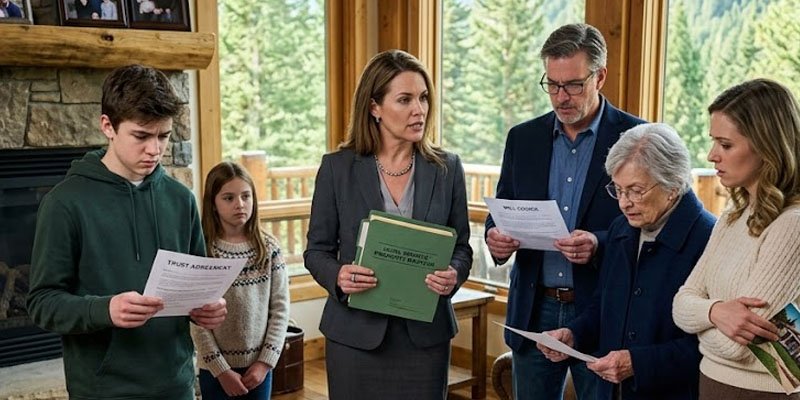
I walked over to the writing desk, opened the bottom drawer, and took out a dark green folder.
“If ownership is going to be discussed,” I said as I placed it on the coffee table, “then we should rely on paperwork instead of assumptions.”
The colour drained from Mark’s face immediately.
Judith picked up the folder and looked at the first document.
“Why is Rachel the only person listed on the deed?”
“Because she purchased the house before we got married,” Mark confessed.
“You told me this was your mountain house.”
“I said it was our family home.”
Brooke folded her arms.
“You’re married. That means half of it belongs to Mark.”
I took out the prenuptial agreement.
“No, it doesn’t. The agreement your family insisted on clearly states that inherited assets and anything bought before the marriage remain separate property.”
Judith’s face became even more rigid.
Next, I placed several printed screenshots on the coffee table.
They showed an online vacation rental advertisement promoting my house as an exclusive venue for weddings, family gatherings, and private retreats.
Brooke was identified as the property manager.
Judith was listed as the emergency contact.
The professional photos displayed my kitchen, the bedrooms, the garden, and even the treehouse Noah had built with my father before he passed away.
“You put my home up for rent?” I asked.
Brooke’s confidence began to fade.
“The house sits empty most of the time. We thought bringing in passive income would help everyone.”
“You advertised my children’s bedrooms for complete strangers.”
“You’re overreacting.”
I turned to Mark.
“When did you find out about this?”
He rubbed the back of his neck.
“Mom showed me a draft two weeks ago. I figured we could talk about it after we saw whether anyone actually booked it.”
Lily could no longer hold back her tears.
They had tried to turn the one home connected to her grandparents into a rental business while telling her she belonged in the basement.
“Pack your things and leave,” I said.
Judith turned to her son.
“Tell your wife to settle down.”
At last, Mark stepped forward. He grabbed the printed rental agreement and ripped it into pieces.
“My family is Rachel, Noah, and Lily. You’ve gone too far.”
Judith slapped him across the face.
“If you choose them over your own blood, then you’re no longer part of this family.”
Mark looked at me, seemingly expecting appreciation.
All I felt was complete exhaustion.
“Destroying one printed copy changes nothing,” I said. “It doesn’t remove the online listing or explain who forged my signature on the property management authorization.”
Then Noah quietly pulled out his phone.
“I think I know the answer to that.”
PART 2: THE SECRET BUSINESS
Noah showed everyone a photograph he had taken in our Charlotte kitchen the night before.
Mark and Brooke were seated at the table with a document covered in multiple attempts to copy my signature.
Judith stood behind them, holding one of my old holiday cards and apparently using it to compare my handwriting.
“I came downstairs to get a glass of water,” Noah explained. “Aunt Brooke said Mom would never notice as long as the signature looked close enough.”
Judith reached toward his phone.
“Hand it over.”
Noah stepped backward.
“No.”
“I’m your grandmother.”
“You’ve spent the last six years reminding me that I’m not your grandson.”
The entire room fell silent.
Brooke stepped toward him, but I moved in front of her.
“Don’t touch my son.”
Mark lifted both hands.
“I never forged your signature. Brooke was only practicing.”
“You sat right beside her while she worked on fraudulent documents involving my property.”
“I believed it was only a proposal.”
PART 2: THE SECRET BUSINESS
I opened another section of the folder and pulled out the bank statements.
Three customers had already paid deposits totaling £18,500. One engaged couple had booked the garden for their wedding, while two different families had reserved the house for graduation weekends.
Judith insisted the money was intended for landscaping and repairs to the swimming pool.
“There isn’t even a pool,” I replied. “And Noah planted that garden with my father.”
Brooke reached for her handbag.
“No one has actually stayed here yet. We can just cancel all the bookings.”
“You accepted payments while pretending to manage a property that isn’t yours.”
I phoned my attorney, Karen, and put the call on speaker.
Karen explained that the forged documents, false claims of ownership, and collection of customer deposits could support legal claims involving fraud, identity misuse, and deceptive business practices.
She instructed Brooke to transfer every remaining deposit into her client trust account so each customer could receive a full refund.
Brooke opened her banking app.
Only £14,000 was left.
“Where’s the rest?” I asked.
Judith admitted they had already spent part of it on advertising, professional photography, and travel expenses.
Brooke transferred the remaining funds and signed an agreement promising to repay the missing balance within twenty-four hours.
Then Judith pulled her suitcase toward the front door.
“Mark, if you stay here, you’re choosing strangers over your own mother.”
He looked at Noah and Lily.
“They aren’t strangers.”
“They’ll never be Callahans.”
“Then the Callahan name means far less than I thought it did.”
After they walked out, Mark came over to me.
“I finally stood up to her.”
“You only stood up after Noah showed everyone the evidence.”
His shoulders slumped.
“I was scared she’d cut me off.”
“Cut you off from what? Her approval?”
He admitted Judith had spent years controlling him through guilt, rejection, and threats.
I understood where that came from.
But understanding the reason someone failed us didn’t undo the harm they caused.
“You need to leave tonight,” I told him.
His eyes grew wide.
“I chose you.”
“You chose us only after letting your family insult my children and plan to rent out my property without my permission.”
“Are you ending our marriage?”
“I’m ending the belief that good intentions matter more than actions.”
Mark packed a small suitcase and drove back to Charlotte.
That evening, Noah, Lily, and I sat on the porch eating pizza.
“Are we going to lose the house?” Lily asked.
“No. No one is taking it away from us.”
Noah looked toward the trees.
“Can Mark ever come back?”
“That depends on whether he changes when no one is there to watch.”
The following week, the investigation revealed that the rental listing had been online for nearly seven months.
Several private events had already taken place while I believed the property was sitting empty. Digital lock records showed repeated entries. The security footage had been erased. A cleaning company produced invoices for corporate retreats and a birthday party.
Furniture had been rearranged, the garden had suffered damage, and several belongings that had once belonged to my parents were missing.
The total revenue exceeded £63,000.
This had never been an innocent proposal.
Brooke and Judith had been running a secret business.
Mark insisted he had known about only one or two rentals. However, the records showed he had received booking schedules and payment summaries.
He hadn’t taken part directly.
But he had stayed silent.
And that silence protected them.
PART 3: CHANGE WITHOUT APPLAUSE
I filed for a legal separation instead of seeking an immediate divorce because I wanted my decisions to come from a place of stability rather than shock.
Mark moved into a furnished apartment, started therapy, and joined a support group for adults raised by controlling parents.
In the beginning, he sent me lengthy apologies every single day.
I told him to stop explaining how he felt and start showing me his decisions.
He did exactly that.
He handed my attorney every relevant message. He removed Judith and Brooke from shared calendars, emergency contact lists, and property-related accounts. He also offered to pay for all the damage using his own savings.
Most importantly, he apologized directly to Noah and Lily.
“I let my fear of disappointing my mother become more important than protecting you,” he told them. “That was wrong. None of this was your fault.”
Noah remained careful.
“Are you saying this because Mom told you to?”
“No. Your mother told me that an apology without real change is simply another form of pressure.”
When Judith continued sending messages blaming the children, Mark responded only once.
“Noah and Lily are children. Every harmful choice was made by adults, including me.”
Then he blocked her.
Brooke signed a civil settlement requiring her to repay the rental income, pay for the property damage, remove every online listing, and formally acknowledge that she had no ownership rights to the house.
Because every customer received a refund and all the money was returned, I decided not to pursue criminal charges. However, any future misuse would be reported immediately.
For six months, Mark met with the children only in neutral places or while I was present.
He attended therapy consistently. He contributed financially without using money to gain influence. He stopped asking when he could move back home.
That lack of pressure mattered.
He gradually understood that reconciliation was not a reward for completing a list of tasks. It depended on whether the people he had hurt could eventually feel safe with him again.
Eight months later, my attorney prepared a postnuptial agreement along with a strict family boundary plan.
The mountain house would remain entirely mine and would eventually pass to Noah and Lily through a protected trust.
Mark gave up every claim to its value, income, management, and occupancy.
No relative could enter, photograph, advertise, or rent the property without my written permission.
Judith and Brooke would never have unsupervised contact with the children. Any insult involving bloodlines, legitimacy, or family status would immediately end the interaction.
Mark carefully read every condition.
“I agree.”
“Signing this doesn’t guarantee reconciliation.”
“I know. It guarantees clarity, and I should have protected that years ago.”
Eventually, I allowed him to return to our home in Charlotte. The mountain house remained off-limits until Noah and Lily felt ready.
Almost a year after the confrontation, Noah suggested we spend a weekend there together.
When we arrived, the locks had been replaced, the garden restored, and the property officially placed under the trust.
Mark and Noah repaired a section of the fence. Lily painted symbols for the bedroom doors: a telescope for Noah, a fox for herself, and a mountain branch for the guest room.
No one was sent to the basement.
That evening, Lily handed Mark a glass of lemonade.
“Mom says anyone who visits has to get permission from all four of us.”
“That should always be the rule,” he answered.
Noah looked at him.
“Even Grandma?”
Mark didn’t hesitate.
“Especially Grandma.”
Our marriage never became what it had been before.
That turned out to be a good thing.
The old marriage had been built on silence, avoidance, and the belief that keeping the peace mattered more than protecting the people who were being hurt.
We created something entirely different.
Two years later, Lily transformed the basement recreation room into an art studio. The space Judith had once assigned to the children as punishment became a place Lily freely chose for creativity.
The mountain house was never turned into a rental property.
It became exactly what my parents had hoped it would be—a home where Noah and Lily never had to question whether someone else’s bloodline made them less worthy.
Judith believed blood gave her authority.
Brooke believed access automatically meant permission.
Mark believed silence was the same as peace.
All of them were mistaken.
Love does not eliminate boundaries, and peace is never created by expecting the quietest person to tolerate disrespect.
The deed proved ownership.
The evidence exposed betrayal.
The boundaries safeguarded our future.
And Mark returned not because he defended us once during a crisis, but because he gradually learned to choose us in ordinary moments, when no one was watching and forgiveness was never guaranteed.