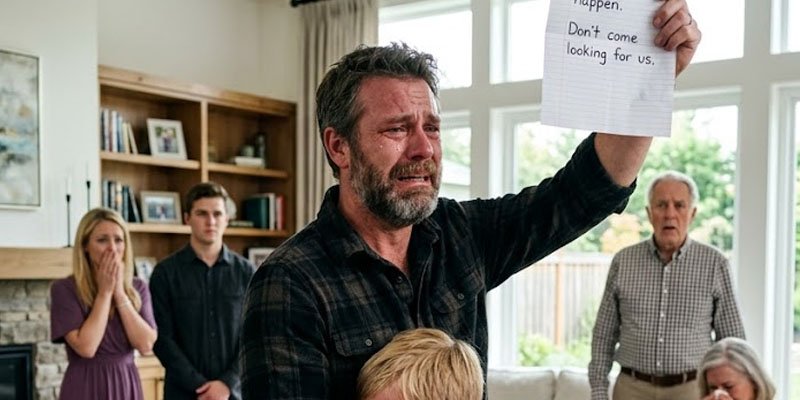
I took my nine-year-old son on a short hike during a family cabin trip. When we came back, the cabins, vehicles, food, and everyone we trusted were gone. Only one note remained:
“This had to happen. Don’t come looking for us.”
My name is Daniel Mercer. I was thirty-eight when my parents invited us to what they called a “family reset weekend” in Colorado’s San Juan Mountains.
They had rented two cabins, brought three vehicles, and packed enough food to feed twelve people for four days.
There was my father, Richard, and my mother, Elaine.
My older sister, Melissa, her husband, Troy, and their two daughters.
Then there was me and my nine-year-old son, Noah.
My wife, Claire, had been killed by a drunk driver eighteen months earlier. Ever since then, my family had treated my grief like an inconvenience they were tired of dealing with.
Melissa constantly said I was “too sensitive.”
My father insisted I needed to “start acting like a man again.”
My mother only seemed to cry when someone else was there to watch.
Even so, I accepted the invitation.
Not for myself.
For Noah.
On the second morning, Noah asked if we could hike down to a creek we’d spotted from the road the day before.
I told everyone we’d be back in less than an hour.
Melissa stood over a skillet making pancakes.
Troy was outside splitting firewood.
My father sat on the porch with a mug of coffee.
“Don’t get lost,” he called after us.
Those were the last ordinary words I would ever hear him speak.
The trail was simple, but Noah stopped every few minutes to collect interesting rocks or ask me about animal tracks in the dirt.
By the time we returned, ninety minutes had passed.
The clearing was empty.
Not quiet.
Not abandoned.
Empty.
Both cabins were gone.
At first, my brain refused to process what my eyes were seeing.
Where the cabins had stood, there were only flattened patches of earth, deep tire tracks, and scattered pine needles.
The vehicles were gone.
The coolers were gone.
The camp chairs, lanterns, blankets, sleeping bags, firewood—everything had vanished.
“Dad?” Noah whispered.
I sprinted toward the larger clearing, dropped to my knees, and clawed at the ground.
Fresh drag marks cut across the dirt.
The cabins hadn’t been destroyed.
They had been prefabricated rentals mounted on skids.
Someone had deliberately hauled them away.
Then I noticed an envelope nailed to a nearby pine tree.
My name was written across the front in my mother’s neat handwriting.
Inside was a single sheet of paper.
Daniel,
This had to happen. Don’t come looking for us. Noah is your responsibility now. You have taken enough from this family. We are done paying for your mistakes.
There was no signature.
No apology.
No explanation.
No map.
No food.
No water.
And no phone signal.
Noah began crying without making a sound.
His mouth trembled as he fought to stay brave because he didn’t want to scare me.
That broke something inside me.
I searched the clearing until my hands bled.
The only things I found were half of a crushed plastic bottle beneath a bush and a granola bar wrapper Melissa’s youngest daughter had dropped the night before.
The access road looked identical in both directions.
We were far deeper into the mountains than I had realized.
Troy had driven the final stretch while I simply followed his dust cloud and brake lights.
When evening fell, the temperature dropped fast.
I built a crude shelter from branches and gave Noah my jacket.
Then I made him a promise.
“We’re going to survive.”
Nine days later, a rescue helicopter finally spotted us.
By then, I had lost thirty pounds.
I had a fever.
The skin on my feet had been torn open.
But Noah was alive.
And the people who had abandoned us were about to learn exactly what our survival would cost them.
PART 2
The deputy who reached us was named Carla Reyes.
She jumped from the helicopter before the rotors had fully stopped, ducking beneath the blades with a medical bag in one hand.
Noah was wrapped in my shirt, shivering so hard that his teeth clicked together.
I remember trying to warn Deputy Reyes not to give him too much water too quickly.
I’d read somewhere that it could be dangerous.
Or maybe I only imagined I had.
My lips were cracked.
My tongue was swollen.
Every word felt like stone scraping across concrete.
“He’s nine,” I managed to say. “His name is Noah. His mother was Claire. Please… don’t let him die.”
Deputy Reyes looked me straight in the eyes.
“He is not dying today.”
It was the first thing anyone had said in nine days that I truly believed.
The hospital in Durango smelled of disinfectant and warm plastic.
Doctors treated Noah for dehydration, exposure, malnutrition, infected cuts, and early signs of kidney stress.
I was diagnosed with an infection in my calf, two fractured ribs from a fall, and nerve damage in two toes.
For the first twenty-four hours, I couldn’t fully understand what had happened to us.
I assumed my family had left after some terrible argument or unexpected emergency.
I believed they had gone home and lied about why we’d disappeared.
Then Sheriff Andrew Voss walked into my hospital room with Deputy Reyes and a representative from Child Protective Services.
He quietly closed the door.
“Daniel,” he said, “we found the company that moved the cabins.”
My throat tightened.
The sheriff placed a printed receipt on the rolling table beside my bed.
The relocation had been scheduled three weeks before the trip.
Paid in full by my brother-in-law, Troy Whitaker.
Collection time: 10:30 a.m. Saturday.
Special instructions: Remove all structures and refuse from site. No customer contact necessary.
“Refuse,” I repeated.
No one corrected me.
The vehicles hadn’t mysteriously disappeared either.
My family had driven away together in a carefully planned convoy.
Before Noah and I returned from the creek, they had loaded every bit of food, water, and emergency supplies into Troy’s truck and my father’s SUV.
The only fingerprints found on my mother’s note belonged to her.
Sheriff Voss finally asked the question.
“Do you have any idea why your family would do something like this?”
I looked toward the curtain separating my bed from Noah’s.
He was asleep, one small hand wrapped around a stuffed fox that a nurse had given him.
“Yes,” I answered quietly.
Claire had left me a life insurance policy after she was killed by a drunk driver.
Most of the money went toward medical bills, therapy, and paying down our mortgage.
My parents believed I should have sold the house and given them part of the insurance money because they had loaned me twenty thousand dollars while I was in college.
Melissa agreed with them.
Troy had bigger problems.
Gambling debts.
A failing business.
Unpaid taxes.
Looking back, he had smiled far too much that entire weekend.
“They wanted people to believe I was unstable,” I told the sheriff. “They wanted rumors that I might hurt myself. If I died out there, even better. And if Noah died too, they could say I wandered into the wilderness with him.”
Sheriff Voss didn’t show any reaction.
By my third day in the hospital, Troy had been arrested.
The following day, police took Melissa and my father into custody.
My mother surrendered through her attorney.
They expected sympathy.
They believed people would accept their story—that I was grieving, emotionally unstable, reckless, and possibly suicidal.
What they didn’t expect was Noah remembering Troy whispering into his phone before breakfast.
“They’re leaving now. Be ready.”
They didn’t expect my mother’s handwritten note to survive.
And they never expected me to keep walking.
PART 3
The trial began eleven months later in La Plata County District Court.
By then, Noah and I had moved to Oregon, close to Claire’s sister, Mara.
We lived in a small blue house three blocks from an elementary school and five blocks from the ocean.
Noah still slept with a light on.
I kept bottled water in every room of the house.
Neither of us handled silence very well anymore.
Prosecutors charged my father, Richard Mercer; my mother, Elaine Mercer; my sister, Melissa Whitaker; and my brother-in-law, Troy Whitaker, with attempted murder, felony child abuse, conspiracy, reckless endangerment, evidence tampering, fraud, and making false statements.
Their defenses were insulting from the very beginning.
Troy claimed it had only been meant as “a lesson.”
Melissa insisted she believed Noah and I had a satellite phone.
My mother argued that her note had been “misinterpreted.”
My father claimed I had always exaggerated everything.
But every excuse collapsed under the evidence.
The cabin relocation company testified first.
Their records showed that Troy had repeatedly called to confirm the pickup schedule.
He specifically asked whether both cabins could be removed as quickly as possible and stressed that “no one would be on-site except authorized family.”
He had even paid an additional fee for weekend service.
Next came the trailer rental company.
Their records showed Troy had rented a flatbed trailer through his landscaping business and used it to remove supplies before the cabin movers arrived.
A security camera at a nearby gas station captured my father’s SUV, Troy’s pickup, Melissa’s van, and my mother’s sedan leaving the mountain road together at 11:46 a.m.
Noah and I returned to the clearing at approximately 12:12 p.m.
Twenty-six minutes.
That was all the time that separated abandonment from attempted murder.
The prosecutor, Helen Park, never needed to raise her voice.
Her calm precision was far more powerful.
She walked the jury through the timeline minute by minute until every excuse sounded meaningless.
“At 8:57 a.m.,” she began, “Daniel Mercer and his nine-year-old son left for a short hike. At 9:03, Troy Whitaker sent a text message reading, ‘They’re gone. Start now.’ At 9:14, Richard Mercer loaded the first cooler into the truck. At 9:31, Elaine Mercer wrote the note. At 10:28, the cabin removal crew arrived. By 11:46, all four defendants had driven away.”
She paused beside an enlarged photograph of my mother’s note.
“This had to happen. Don’t come looking for us.”
She let the words hang in the courtroom before turning to face the jury.
“Those are not the words of people who expected a father and his child to safely find their way out of the wilderness.”
My mother cried during that testimony.
Not quietly.
Not sincerely.
She dabbed at perfectly timed tears while stealing glances toward the jury, arranging sorrow across her face as carefully as makeup.
Then Noah took the stand.
He was ten years old by then, still smaller than most children his age after everything those nine days had done to him.
He wore a navy blazer Mara had bought for him and held a smooth gray stone tightly in his left hand.
It was one he had picked up beside the creek on the morning we were abandoned.
The judge spoke gently.
Helen Park spoke even more softly.
Noah answered every question with calm, unmistakable clarity.
He remembered the pancakes.
He remembered Aunt Melissa acting nervous.
He remembered Uncle Troy walking behind the cabin, talking quietly on his phone.
He remembered Grandpa saying, “Once it’s done, it’s done.”
Then Helen asked, “What happened when you and your dad came back?”
Noah looked over at me.
Every instinct inside me wanted to stand up, take his hand, and lead him out of that courtroom.
I wanted to shield him from the lawyers, the cameras, and the strangers watching our suffering become evidence.
But Noah had chosen to tell the truth.
So I stayed where I was.
“When we came back,” he said, “everything was gone. At first, I thought we were in the wrong place. But then I saw my pile of rocks. I made it before we left. That’s when I knew.”
“What did your father do?”
“He looked everywhere for everyone. Then he found the note.”
“What did he tell you?”
Noah swallowed hard.
“He said nobody was coming right then, but he was with me… and he wasn’t going to leave me.”
The courtroom fell completely silent.
“And did he leave you?”
“No.”
“What did he do during those nine days?”
Noah tightened his fingers around the smooth gray stone.
“When we found berries, he always let me eat first. When we found water, he made sure I drank before he did. He let me sleep against him because I was cold. And every night he told me stories about my mom so I wouldn’t forget what her voice sounded like.”
Melissa lowered her head.
For the first time, I saw something that looked like shame on her face.
It didn’t matter.
Shame wasn’t justice.
And it certainly wasn’t restitution.
The hardest day of the trial came when prosecutors played Troy’s recorded police interview.
After his arrest, he had talked freely, convinced he could explain everything away.
On the recording, he sounded annoyed rather than afraid.
“Look,” Troy said, “Daniel always lands on his feet. He’s dramatic. Ever since Claire died, he’s wanted everyone to feel sorry for him. This was supposed to snap him out of it.”
One of the detectives asked, “By removing shelter, transportation, food, and water from a remote mountain location?”
“He knew which direction the road was.”
“Did Noah?”
There was a long silence.
Finally, Troy answered.
“That wasn’t my problem.”
Beside me, Noah’s breathing changed.
I slipped an arm around his shoulders.
Without taking his eyes off the screen, he leaned against me.
The detective continued.
“Why leave the note?”
Troy laughed once.
“Elaine wanted closure.”
Closure.
My own mother wanted “closure” from her son and grandson.
When it was my turn to testify, the defense attorney tried to paint me as emotionally unstable.
He questioned me about my grief after Claire’s death.
He asked about my therapy sessions.
He even brought up a Thanksgiving argument where I had shouted at my father.
Then he asked whether I might have misunderstood my family’s intentions.
“No,” I answered.
Finally, he asked, “Do you hate your family?”
I looked across the courtroom at all four defendants.
My father stared back with the same cold expression that had frightened me since childhood.
My mother looked wounded, as though I had somehow embarrassed her.
Melissa looked empty.
Troy looked irritated that justice was taking so long.
“I don’t know what I feel for them anymore,” I said quietly. “But I know exactly what they did.”
Later, the prosecutor asked me to describe the ninth day in the mountains.
I told the jury the truth.
By then, hunger no longer felt like hunger.
It had become a constant vibration deep inside my bones.
Noah had developed a fever.
When he became too weak to walk, I tied branches together with my belt so I could drag him across the ground.
We kept moving downhill because I believed that following water might eventually lead us to people.
On the eighth night, rain finally came.
I tilted my face toward the sky and drank straight from the falling water.
Noah could barely sit up, so I soaked my shirt and squeezed the rainwater between his lips.
The next morning, we heard the helicopter.
“At first, I thought I was hallucinating,” I told the jury. “Then Noah heard it too. He tried to wave, but he couldn’t lift his arm. So I took off my shirt and climbed onto the highest rock I could find.”
Earlier in the trial, the defense had suggested that I might have found help sooner if I had made different decisions.
Helen looked at me.
“Why didn’t you leave Noah behind and search for help by yourself?”
I answered before she even finished the question.
“Because I promised his mother I would protect him,” I answered. “Because he was nine years old. Because people had already abandoned him once.”
Two jurors wiped tears from their eyes.
Six weeks after opening statements, the jury returned with its verdict.
Guilty.
On nearly every count.
My father was sentenced to twenty-eight years in prison.
Troy received thirty-five years after prosecutors proved he had orchestrated the entire plan.
Melissa was sentenced to twenty-two years.
My mother received eighteen.
Before sentencing, each defendant was allowed to address the court.
Troy blamed financial pressure and mounting debt.
Melissa blamed Troy.
My mother blamed confusion.
My father blamed me.
“You destroyed this family,” he said, pointing at me with a trembling hand.
For the first time in my life, his anger held no power over me.
When the judge invited me to give my victim-impact statement, I stood.
“No,” I said. “You destroyed this family the moment you watched your grandson walk into those woods and decided he was acceptable collateral damage.”
My father looked away.
I continued.
“For nine days, Noah kept asking me why. I couldn’t give him an answer that wouldn’t shatter him. I still can’t. But I can tell him this: what happened to us was real, what you did was deliberate, and the law recognized the truth.”
Then I turned toward my mother.
“You wrote, ‘This had to happen.’ You were right about one thing. Something did have to happen.”
I paused.
“It just wasn’t what you expected.”
The judge imposed every sentence without sympathy.
Outside the courthouse, reporters crowded around us, shouting questions from every direction.
I ignored them all except one.
A young reporter asked, “Mr. Mercer, do you feel you got justice today?”
I looked down at Noah, whose hand was wrapped tightly around mine.
He wasn’t watching the cameras.
He was staring toward the distant mountains.
“No,” I replied. “Justice would have been my son never learning what betrayal feels like. What happened today is accountability.”
Then we went home.
Life didn’t suddenly become perfect after the trial.
Stories like ours don’t truly end when a verdict is read.
Noah still woke from nightmares.
I still reached for emergency supplies that weren’t there.
Neither of us handled unexpected goodbyes very well.
But little by little, our lives became our own again.
Noah joined a robotics club.
He learned to surf—with more enthusiasm than skill—and loved every minute of it.
The smooth gray stone from the creek stayed on his desk beside a photograph of Claire.
Every year on the anniversary of our rescue, we talked about the mountains only if Noah wanted to.
Some years he did.
Other years we ordered pizza, curled up on the couch, and watched old monster movies.
I returned to work as a civil engineer.
It suited me.
Bridges.
Drainage systems.
Foundations.
Structures that failed only when people ignored pressure or lied about what they could carry.
Mara became family in every way that truly mattered.
She showed up.
She listened.
And she never once told us to “move on.”
Three years after the trial, Noah asked if we could go hiking again.
My first instinct was to refuse.
Instead, I packed enough food and water for days.
Emergency blankets.
Two maps.
A satellite messenger.
Whistles.
A first-aid kit.
And enough backup supplies for an entire week.
Noah watched me loading the car.
“Dad,” he said with a grin, “we’re only going for two hours.”
“I know.”
He laughed.
“Mom would’ve laughed at you too.”
“She definitely would have,” I said.
This time, we chose a coastal trail instead of a mountain path.
The ocean stayed in view through the trees the entire way.
Noah walked ahead of me, taller now, stronger, carrying his own backpack.
When we reached an overlook, he stopped and stared across the gray water.
“Do you think they’re sorry?” he asked quietly.
I knew exactly who he meant.
For a moment, I thought about giving him the comforting lie adults sometimes tell children.
The kind that’s meant to make the world feel safer than it really is.
But Noah had survived because I’d always given him the truth in pieces he could carry.
“I think they’re sorry they got caught,” I answered. “I don’t know if they’re sorry for what they did to us.”
He thought about that for a long moment.
Then he nodded.
“I’m glad we came back.”
I looked at my son standing there, alive, the wind lifting his hair as sunlight broke through the clouds.
“So am I,” I said.
Those nine days in the mountains took things from us that no prison sentence could ever return.
Our trust.
Our sense of ease.
The simple belief that family always meant safety.
But they also revealed something far stronger than the people who abandoned us.
Noah survived.
I survived.
And the people who left us there to die had spent every day since wishing we hadn’t.