
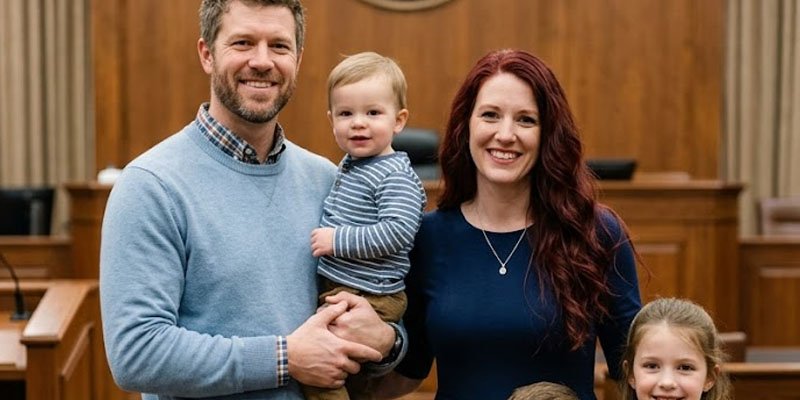
Everyone in the courtroom expected the judge to separate five young siblings that morning.
Then a quiet carpenter stood up, and one heartbreaking truth changed everything in the courtroom in a way no one could have predicted.
The hallway outside the family courthouse carried the scent of old paperwork mixed with freshly polished floors.
It was the kind of smell that clung to your clothes long after you had gone home.
I sat on a hard wooden bench, traces of sawdust still caught in the creases of my work boots, while a borrowed tie felt stiff and unfamiliar around my neck.
Across from me, five small children sat side by side in a row that seemed far too calm for kids their age.
Eli, the oldest at six years old, carefully used the edge of his shirt to wipe away the tears from his little sister’s face.
“It’s okay, Lila,” he whispered. “We just have to wait a little longer.”
I gripped the folder filled with receipts and court papers against my knee, quietly willing my trembling hands to become steady.
Farther down the hallway, another child sat beside a caseworker, absentmindedly swinging his feet against the bench.
The social worker glanced in my direction, caught my eye, and offered the kindest, most sorrowful smile I had ever received.
For some reason, that hurt even more than being yelled at.
“Carter?”
I looked up.
A woman in her late fifties stood in front of me, holding a stack of paperwork beneath one arm.
“I’m Margaret, one of the court clerks,” she said gently. “You’re here for the ten o’clock hearing?”
“Yes, ma’am.”
“How are you holding up?”
“I haven’t slept in three weeks,” I admitted. “So, if I’m being honest, not very well.”
Her face softened with an expression that somehow made me feel she understood things about me that I had never spoken aloud.
“You brought all five children with you?”
“I couldn’t leave them behind,” I answered. “They’ve already been abandoned more times than any child should.”
She slowly nodded, as though every word I had spoken truly mattered.
Then she looked over at the children, and I noticed her lips press together before she quietly walked away.
I turned my attention back to them.
Lila, barely three years old, rested her head against Eli’s shoulder.
The four-year-old twins held each other’s hands so tightly it almost looked as if they had never let go.
The youngest child, wrapped in a padded coat that was at least two sizes too big, sat in Eli’s lap while hugging a stuffed rabbit with only one ear left.
Only three weeks earlier, I hadn’t known any of them existed.
I had been working in my woodshop, sanding a dining table for a customer from the next town while the radio played in the background.
Then I saw their faces listed on the emergency placement registry, and something buried deep inside me tightened so suddenly that I struggled to catch my breath.
That same night, I emptied every dollar from my savings account.
“Sir?” Eli looked over at me, speaking so quietly it was almost impossible to hear. “Are they going to send us to different homes?”
“Not if I have anything to say about it, buddy.”
“Do you promise?”
I parted my lips, but for a moment, no words came.
I had never made a promise that important out loud before.
“I promise I’ll fight harder for you than I’ve ever fought for anything in my life.”
He gave a small nod, as though that answer was enough, then turned his attention back to his sister.
A few moments later, the bailiff stepped into the hallway and called our case number.
As soon as the court paused for recess, my attorney, Diane, led me into a small room off to the side.
“They moved fast, Carter,” she said. “Everything was arranged overnight.”
“How fast?”
“Three transport vans are already scheduled for Friday. The children will be sent to three different counties.”
I set the folder of receipts on the table, though my fingers hesitated before letting go.
Five days. That was all the time they were giving me.
“Diane, tell me honestly. What are my chances in there?”
“To be truthful, they’re very slim. This judge rarely approves single applicants, especially younger ones who have no experience raising children.”
Before I had the chance to respond, the door opened and Beverly, the senior caseworker, walked in carrying her clipboard.
“Carter, may I sit with you?”
“Of course.”
She took a seat and folded her hands together in the familiar way that experienced social workers often did.
I had seen that exact posture across a desk many years earlier, and before I realized it, my stomach had already tightened.
“I want you to understand that I’m not here to work against you,” she said gently. “I’ve been doing this job for twenty-two years. I’ve watched kind-hearted people take on more than they could realistically handle, and I’ve seen children pay the price.”
“I understand, Beverly. I really do.”
“You don’t have a spouse or a co-guardian. At this time, you also don’t have health insurance that would cover five dependent children. In addition, you converted part of your workshop into living space, Carter. The court needs evidence that it provides a safe environment for young children.”
“I built solid oak bunk beds. I insulated the walls, installed smoke detectors, and had the wiring professionally inspected. Last week I installed five car seats in my van. I also reached out to a pediatrician on Elm Street, and she agreed to accept all five children as patients.”
Her face remained composed, but for a brief moment, I noticed a hint of warmth in her eyes.
Then she lowered her gaze to the clipboard in her hands.
“I’d like to speak with Eli privately, if that’s alright.”
Before I could answer, Diane gave a quiet nod.
A moment later, a court assistant escorted Eli into the room.
His eyes immediately found mine, looking for reassurance the same way he had every single hour over the past three weeks.
“It’s alright, buddy,” I said gently. “Just tell her the truth.”
He nodded once before taking a seat.
Beverly leaned forward and asked him questions about school, meals, and whether he felt safe when he was with me.
Eli answered so quietly I could barely make out his words, absentmindedly rubbing the ribbon with his thumb in small circles.
When the court aide escorted him back into the hallway, the room somehow seemed even heavier than before.
Beverly rose to her feet, thanked me with genuine kindness, and quietly left.
Diane waited until the door had fully closed.
“Carter, there’s something we need to talk about.”
“What is it?”
“The state’s attorney is going to ask you some very personal questions. He’ll want to know about your past and why you chose to do this.”
I felt my jaw tighten.
“He’s free to ask whatever he wants.”
“Carter, listen carefully. I’ve gone through your file twice. There are gaps that the state’s attorney is almost certain to notice. If there’s anything you haven’t shared with me, this is the time.”
I fixed my eyes on a water stain across the ceiling while struggling to catch my breath.
“I’ve carried this for twenty years, Diane. I haven’t even told my closest friends. I don’t know if I can say it out loud in a room full of strangers.”
“You might have to. More than anyone else, the judge may need to hear it.”
Before I had the chance to answer, the bailiff’s voice echoed from outside the door, announcing our case.
At the far end of the hallway, the courtroom doors slowly swung open.
Daniel, the state’s attorney, rose from his table with the calm confidence of someone who had handled hundreds of hearings like this.
Without looking at me, he calmly arranged his files across the podium.
“Your Honor, I’d like to begin by acknowledging that Carter appears to have sincere intentions,” he said. “But good intentions alone are not enough to raise five children who are all under the age of seven.”
“His home consists of a converted section of his workshop that has not yet received final approval for foster placement. He has no spouse, no co-guardian, no existing medical insurance capable of covering five dependent children, and, with all due respect, no experience as a parent.”
The judge peered at me over the top of his glasses.
I could feel every person in the courtroom staring at the borrowed tie around my neck.
“The state already has three licensed foster homes prepared to receive these children by Friday,” Daniel continued. “While separating them is unfortunate, our responsibility is to place stability first.”
Diane leaned toward me.
“Stay calm,” she whispered. “Only answer the questions he asks.”
I stepped into the witness stand.
My hands suddenly felt oversized resting against the polished wooden rail.
“Carter, you work as a carpenter, correct?” Daniel asked.
“Yes, sir. I’ve worked at the same shop for eleven years.”
“And you converted part of that property into bedrooms for five children?”
“I built bunk beds along the north wall. I insulated the rooms, completed the safety upgrades, and scheduled all the required inspections. I also arranged for a pediatrician before today’s hearing.”
“That’s certainly commendable. However, you have no wife, no partner, and no surviving parents listed anywhere in your file. Why would a young man at this stage of his life willingly take on such enormous responsibility and financial burden?”
“Because they need someone.”
“There are many children who need someone, Carter. Yet you didn’t file a petition for other children. You specifically petitioned to adopt these five. Why?”
I looked past him.
Eli sat quietly in the back row with the youngest child asleep in his lap.
One of his small hands rested gently against his sister’s back, making sure she stayed secure.
“Because they belong together,” I answered.
“Every year, many sibling groups are separated throughout this state,” Daniel replied. “That fact alone does not constitute a sufficient legal argument.”
“It should be.”
A faint smile almost crossed his face.
“Carter, there are periods in your history between the ages of nine and seventeen that remain unexplained. Before this court places five children in your care, it deserves to understand what happened during those years.”
The courtroom became so quiet that I could almost hear the silence settling inside my chest.
I lowered my gaze to my hands.
“I’d rather not talk about that, sir.”
“I’m sure you would rather not,” Daniel replied calmly. “But this court is being asked to entrust five young lives to you. It has every right to know who you are.”
“Objection,” Diane said. “That question is overly broad and infringes on my client’s privacy.”
The judge lifted a hand.
“I’ll allow the question only in a more limited form.”
Daniel faced me once again.
“Carter, why these children? Why at this moment? Why are you willing to spend everything you own—and possibly everything you’ll ever earn—for five children you’ve never known?”
I opened my mouth, but no words came.
I watched Eli lean over and quietly say something to the younger children.
The tenderness on his face reminded me of the way a mother comforts her child, and my throat tightened.
“Please answer the question,” Daniel said.
“I…”
“Carter.”
The judge leaned slightly forward.
As his hand lowered, the harsh atmosphere in the room seemed to ease with it.
“Daniel, have a seat for a moment,” the judge said gently.
Daniel hesitated for a second before returning to his chair.
The judge looked directly at me instead of the paperwork in front of him.
“Son,” he said, “I’ve served on this bench for twenty-eight years. I’d like to hear the real reason from you, in your own words. There’s no rush.”
I gripped the edge of the witness stand until my knuckles began to ache.
Then I forced myself to speak.
“Twenty years ago,” I began.
The words caught somewhere deep inside me, trapped in a place that felt impossible to reach.
I drew another breath and tried again.
“Twenty years ago, in this very courthouse, I was sitting exactly where those children are sitting today.”
The judge slowly set his pen down.
His eyes drifted toward the file beside him before lifting back to meet mine.
A quiet look of recognition slowly appeared across his face.
“I was one of five children,” I continued. “Our parents were killed in a house fire.”
I paused again.
I could feel Diane watching me, but I made myself continue.
“A judge signed an order separating us and placing us in homes across three different counties. It happened inside this building. It may even have happened in this very courtroom. I honestly don’t know.”
My hand remained tightly wrapped around the wooden rail.
“My little brother had a red plastic toy truck that he wouldn’t let anyone else touch. One of its wheels was missing. He was still holding it when they put him into the second car.”
My voice began to tremble.
“The door shut on his hand, and someone had to reopen it. He was screaming my name through the back window. I was only nine years old. I ran after that car until I collapsed.”
The judge remained completely still.
“I never saw him again, Your Honor. I’ve written countless letters, searched public records, and even paid investigators to help me find my brothers and sisters. After twenty years, there are still two of them I’ve never been able to locate.”
Daniel slowly lowered his notepad onto the table.
“When I saw the faces of those five children on the emergency placement registry,” I said, “something deep inside me came undone. In that moment, I promised myself that if I had any chance to stop another family from being torn apart, I would.”
Daniel quietly returned to his seat without asking another question.
The judge turned his attention toward the back of the courtroom.
“Eli, would you step up here, please?”
The little boy cautiously made his way forward, still clutching his sister’s pink ribbon in one hand.
“Son,” the judge said gently, “tell me what it is you want.”
Eli glanced at each of his brothers and sisters before answering.
“I just want us to stay together, sir.”
For a long moment, the judge said nothing.
He removed his glasses, rubbed the bridge of his nose, and then looked toward Beverly.
“Ms. Beverly,” he said quietly, “after everything you’ve observed over these past three weeks, do you believe this placement deserves an opportunity?”
Every eye in the courtroom shifted toward her.
Beverly slowly lowered the clipboard she was holding.
“When I first reviewed Carter’s application, I had serious reservations,” she admitted. “Caring for five young children is an enormous responsibility for anyone.”
She looked first at me and then at the children.
“But I’ve watched these children interact with him every day since the emergency placement began. They run to him whenever they’re frightened. They trust him. They’ve finally begun sleeping through the night. Most importantly, they’ve remained together.”
She paused before turning back to the judge.
“After everything I’ve witnessed, I truly believe these children are best served by remaining together in Carter’s care. Separating them now would only deepen their trauma.”
The judge gave a single nod.
“The state’s request to place these children into separate foster homes is denied.”
For a brief moment, no one in the courtroom moved.
“Due to the emergency circumstances, this court grants Carter temporary custody effective immediately, pending continued supervision, a successful home inspection, and completion of the remaining licensing requirements.”
Then he looked directly at me.
“I will personally oversee this case until a permanent placement decision is finalized.”
For one heartbeat, absolute silence filled the courtroom.
Then I heard a quiet gasp.
Lila slipped free from the court aide’s hand and ran straight toward me.
I dropped to one knee just as she threw her arms around my neck.
“Are we going home?” she whispered.
My throat tightened with emotion.
“Yes, sweetheart,” I managed to say. “We’re going home.”
The twins rushed over and wrapped themselves around my shoulders a moment later, and even Eli, who had fought so hard to stay strong, finally allowed his tears to fall.
“I told them you wouldn’t stop trying,” he said as he wiped his eyes. “I told them.”
“You helped me keep that promise,” I whispered back.
When I looked up, Beverly was standing beside us.
She placed the temporary custody papers into my hands.
“Take good care of them,” she said softly.
“I will.”
“I know you will.”
As we walked out of the courtroom, Diane rested a hand on my shoulder.
“You were the one who did the hard part,” she said. “I simply helped the court hear your story.”
Outside, the afternoon sunshine felt warmer than I remembered.
One by one, I buckled each child safely into a car seat.
This time, no one asked where we were going.
They already knew the answer.
The drive home was almost completely quiet.
Lila was asleep before we even reached the first traffic light, her stuffed rabbit tucked gently beneath her chin.
The twins leaned against each other in the back seat, and for the first time since I had met them, they weren’t holding on because they were afraid. They were simply worn out.
Eli caught my eye in the rearview mirror.
“We’re really going to stay together?” he asked.
I smiled.
“Yeah, buddy. We are.”
He nodded once before turning back to look out the window.
It was the very first time I had ever seen him smile.
“I kept my promise,” I whispered to the brother I hadn’t seen in twenty years.