PART 1
I was standing by myself near the edge of my parents’ grand ballroom when my father lightly tapped his champagne glass.
The conversations stopped instantly.
“Friends and distinguished guests,” Edward Thompson said, “Victoria and I are thrilled to celebrate Jason and Charlotte’s engagement—and the coming together of two remarkable families.”
My younger brother stood proudly beneath the sparkling chandelier beside his graceful fiancée.
Then my father launched into another speech praising him.
Harvard.
His dedication.
His accomplishments at Thompson Luxury Properties.
His promising future as the company’s next leader.
Every family gathering eventually turned into a celebration of Jason, and after years of it, I had learned how to keep my face completely blank.
I was wearing a simple black dress I had picked up from a thrift store in Brooklyn. It had seemed elegant in my apartment, but surrounded by designer gowns and glittering diamonds, it suddenly felt like proof of everything my parents disapproved of.
Then Dad revealed their engagement gift.
“To help Jason and Charlotte begin married life the right way, we’re giving them $1.3 million toward the purchase of their first home.”
Applause filled the ballroom.
For a brief moment, I was honestly happy for my brother.
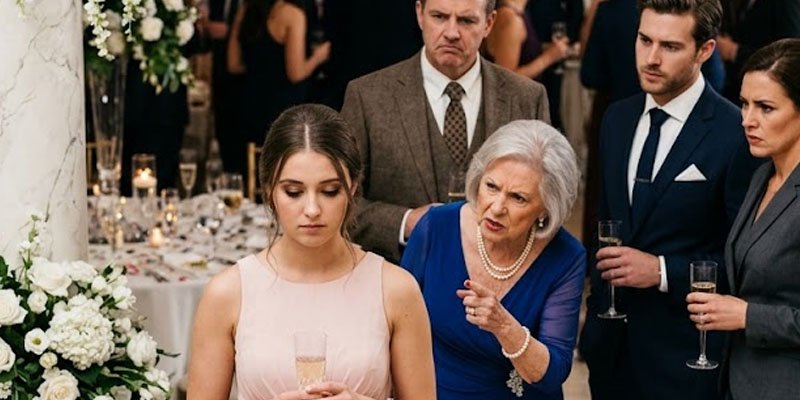
Then my father turned his eyes toward me.
“Of course,” he continued with a smile, “we only wish all of our children gave us the same reason to be proud.”
Every person in the room looked my way.
“If only you weren’t such a failure, Morgan. Maybe one day you’ll finally learn how to manage your own life.”
The ballroom fell into an unbearable silence.
He had humiliated me before, but never through a microphone in front of more than a hundred guests.
My mother said nothing.
Jason looked uneasy, but he stayed silent.
Someone standing near the dessert table quietly murmured, “That’s the artist daughter, right?”
The artist daughter.
The one who walked away from finance.
The one living in Brooklyn.
The one who taught children to paint instead of chasing money.
With shaking hands, I set my glass on a nearby table and walked out with whatever dignity I still had.
Inside the powder room, I locked the door and silently cried over the polished marble sink.
My father’s words kept echoing in my mind.
Failure.
Growing up as a Thompson, love was almost always measured by success.
My parents had built one of the most successful luxury real estate companies on the East Coast. Jason excelled in sports, academics, and business.
I spent my childhood filling notebooks and walls with drawings.
When I won a regional art competition at the age of twelve, my mother simply described it as “a nice hobby.”
The only person who ever truly understood me was Grandma Rose.
Although she belonged to our wealthy family, she chose to live modestly. Her house was filled with books, handmade quilts, mismatched coffee mugs, and the comforting scent of lavender tea.
When I proudly showed her my award-winning painting, she held it gently in her hands.
“Your artwork speaks the truth,” she told me. “Never forget how uncommon that is.”
Even so, the love of one person could never completely drown out the expectations of everyone else.
At eighteen, I earned a scholarship to the Rhode Island School of Design. My parents convinced me that artists lived in poverty and that choosing art would bring embarrassment to the family.
I turned down the scholarship and enrolled in business school instead.
The next three years were spent unhappily working in an investment firm.
Eventually, I walked away, moved to Brooklyn, and found my way back to painting.
Eight months before the engagement party, I started Art Access, a small program that offered free art classes to neighborhood children.
My father dismissed the entire idea with a single sentence.
“You’re not going to change the world with finger paints.”
A gentle knock on the door interrupted my thoughts.
“Morgan? It’s Grandma Rose.”
I unlocked the door.
She stepped inside, locked it again, and gently took both of my hands.
“Your father has always had a gift for disguising cruelty as honesty.”
“He’s not wrong by this family’s standards,” I whispered. “I really am a failure.”
“Their standards are what’s broken.”
Then she revealed something she had never told me before.
When she married my grandfather, the Thompson family had looked down on her because she was a public-school teacher without wealth or influential connections.
She had spent years being judged by the very same values my father now used against me.
Then her expression became more serious.
“I have a serious illness,” she said. “The doctors believe my time is limited.”
My stomach tightened.
My father had already known.
He had deliberately chosen not to tell me.
Grandma Rose reached into her handbag.
“There’s something else. Your grandfather left me far more than anyone ever realized. I’ve quietly managed those investments for the past forty years.”
Then she looked directly into my eyes.
“Three weeks ago, I revised my estate plan.”
PART 2
Grandma Rose asked me to walk back into the ballroom with her.
“I’ve remained silent long enough,” she said. “Tonight, that changes.”
By the time we returned, the celebration had resumed. Guests were laughing once more while my parents behaved as if nothing hurtful had taken place.
Grandma Rose walked straight to the stage and picked up the microphone.
“As the matriarch of this family,” she said gently, “I would like to share my own definition of success.”
The ballroom fell silent.
“Many people judge success by wealth, prestige, or possessions. I judge it by integrity, authenticity, compassion, and the courage to pursue the path you truly believe in.”
My father started walking toward her.
“Mother—”
She gave him a single look.
He stopped immediately.
“My grandson Jason has built an impressive professional career, and I am genuinely happy for both him and Charlotte.”
Then she turned toward me.
“But Morgan’s accomplishments are no less meaningful simply because they have taken a different form.”
Every face in the room shifted toward me.
“She has cultivated extraordinary artistic ability and created a program that provides children with access to art education.”
For the first time in my life, someone publicly spoke about my work as though it truly mattered.
Grandma Rose continued.
“That is why I have made changes to my estate plans.”
A look of panic crossed my father’s face.
“The majority of my estate will be used to create the Rose Thompson Foundation for Arts Access, with Morgan appointed as its director.”
A wave of shocked gasps swept across the ballroom.
“The foundation will finance permanent art studios, scholarships, partnerships with schools, and the expansion of Morgan’s program throughout New York City.”
She paused briefly.
“The initial endowment will be approximately fifteen million dollars.”
The announcement hit the room like a clap of thunder.
My father’s face flushed a deep shade of red.
My mother’s wine glass remained suspended halfway to her mouth.
“Real success,” Grandma Rose concluded, “is not measured by how perfectly we fulfill someone else’s expectations. It is measured by the lives we improve and the honest legacy we leave behind.”
She gently set the microphone down and calmly walked off the stage.
My mother immediately insisted that I come with my father to his study.
Grandma Rose tightened her grip on my arm.
“No. Morgan is coming outside with me.”
For the first time, my mother had no response for someone who simply refused to comply.
Before we could leave the ballroom, Jason stopped me.
“I had no idea Dad intended to embarrass you,” he said. “What he did was wrong.”
His apology caught me completely off guard.
Then he confessed something else.
“I’m unhappy, Morgan. I never wanted to run the company. I wanted to study marine conservation, but Dad made it clear that wasn’t a choice.”
For the first time, I realized Jason had never actually won our parents’ game.
He had simply surrendered to it in a different way.
Inside the study, my father accused Grandma Rose of turning private family matters into a public spectacle.
She answered without raising her voice.
“That was exactly what I thought when you called your own daughter a failure in front of one hundred people.”
“I only stated the truth,” he replied.
At that moment, something inside me finally broke free.
“No. You were trying to humiliate me.”
My father stared at me as though an inanimate object had suddenly begun speaking.
My mother insisted that the fifteen million dollars belonged to the family and should not be squandered on art.
“It isn’t your money,” I replied. “And this isn’t a hobby. It’s an educational program.”
Grandma Rose explained that the foundation had already been legally established.
“There’s nothing left to debate,” I added. “It’s an honor to carry out her vision.”
Then Grandma Rose and I left together.
Three months later, I stood inside a bright former textile factory in Chelsea as construction crews transformed it into the Rose Thompson Foundation for Arts Access.
The building included art studios, classrooms, galleries, and enough room for dreams that no longer needed to be confined to my small apartment.
Grandma Rose sat near the entrance in a wheelchair, overseeing every decision.
Her health had deteriorated quickly, but her mind remained as sharp as ever.
She was determined to see the beginning with her own eyes.
PART 3
Jason and Charlotte started spending time at the foundation on a regular basis.
At first, I assumed they were only trying to protect their inheritance or pass information back to my parents.
Over time, however, it became obvious that their reasons were sincere.
Charlotte accepted a position on the board and used her background in art history to build relationships with museums, donors, and public schools.
Jason continued working at Thompson Luxury Properties, but he started advocating for sustainable developments and affordable housing initiatives.
Little by little, he was finding his way back to the person he used to be.
My parents attempted to contest Grandma Rose’s estate plans, but they were unsuccessful.
In public, they spoke about the foundation with measured politeness. Behind closed doors, they remained distant.
Six weeks after the party, my father unexpectedly came to visit my apartment in Brooklyn.
His eyes wandered across the children’s artwork, paintbrushes in glass jars, folding tables, and unfinished canvases.
“Your grandmother has always been stubborn,” he remarked.
Then he turned toward me.
“Just like you.”
It was not an apology.
But he stayed for fifteen minutes.
In the Thompson family, that carried its own meaning.
As the grand opening drew closer, Grandma Rose’s health continued to decline.
Her doctors strongly advised her not to attend.
She refused.
“I may not live to see everything this grows into,” she told me, “but I will be there when those doors open.”
She arrived in a private ambulance accompanied by two nurses and took her seat in the center of the gallery, wrapped in a soft navy shawl.
The building was filled with artists, teachers, journalists, children, neighbors, and generous supporters.
My parents made a brief appearance.
My mother spent several quiet minutes standing in front of a child’s painting showing a city stretching toward a giant orange sun.
Later, after nearly everyone had left, Grandma Rose and I remained seated together in front of the children’s exhibit.
The wall overflowed with paintings, sculptures, drawings, and bursts of impossible color.
“What do you see?” I asked.
“Endless possibility,” she answered. “Still untouched by other people’s expectations.”
Then she reached over and held my hand.
“That’s what I always saw in you, Morgan.”
One week later, Grandma Rose passed away peacefully in her sleep.
She lived long enough to witness the opening, read the first article written about the foundation, and know her legacy would continue for years to come.
Her funeral was simple, exactly as she had requested.
Jason spoke about the afternoons they spent collecting seashells together and the marine biology books Grandma Rose kept buying him long after everyone else forgot how much he loved the ocean.
“She truly saw us,” he said, his voice trembling. “Not as people expected us to be, but as we really were.”
That was the moment I finally cried.
In the years that followed, the foundation expanded far beyond anything I had ever imagined.
We established scholarships for talented young artists from low-income families, partnered with public schools, and organized exhibitions for people whose voices might otherwise have remained unseen.
Jason and Charlotte postponed their wedding while they reconsidered the kind of future they wanted together.
When they eventually married, they chose a quiet ceremony on the beach with close friends instead of a grand celebration in a marble ballroom.
My parents never completely changed.
But something inside them softened.
Not long ago, my mother visited the foundation, claiming she wanted to discuss donating a property.
She remained much longer than she needed to.
Before leaving, she paused in front of one of my paintings.
“Your grandmother would be proud,” she said.
It still wasn’t exactly approval.
But it was closer than anything she had ever given me.
As for me, I finally stopped judging my value by the ballroom where I had once been humiliated.
The same Chelsea gallery that had rejected my work years earlier eventually invited me to hold a solo exhibition.
I accepted—not because I still needed their approval, but because the exposure could now help support something greater than myself.
A portrait of Grandma Rose now hangs in the foundation’s main hall.
I painted her sitting peacefully in her garden beneath the warm afternoon sunlight, surrounded by blooming roses.
Every day, children walk beneath that portrait on their way to class.
One little boy once pointed to it and asked whether she was the queen of the building.
I smiled and told him she was.
In many ways, she truly was.
Sometimes the experience that almost breaks you becomes the very thing that transforms your future.
Sometimes the room where you are humiliated becomes the place where the truth finally comes to light.
And sometimes, when everyone who should recognize your worth refuses to see it, the courage of one person is enough to bring every light back into your life.