
PART 1: THE CHILD OUTSIDE THE DOOR
My name is Claire Bennett, and until last summer, I truly believed the greatest hurt my family could cause was treating me as though I barely mattered. I was mistaken. The reality revealed itself during what should have been a relaxing five-night getaway at a beachfront hotel in South Carolina. My parents joined the trip, along with my older sister, Vanessa, her husband, Mark, their two boys, and my six-year-old daughter, Lily. My husband, Daniel, had been killed in a construction accident two years earlier, and this vacation marked the first time I had agreed to travel with my family since laying him to rest.
I covered every one of my own expenses, including my hotel room, Lily’s meals, her pink swimsuit, her seashell bucket, and even the rental car that my parents borrowed again and again throughout the trip.
On the second afternoon, Lily was exhausted and had gotten a little too much sun, so I brought her upstairs for a nap. When we entered my room, Vanessa was already sitting on my bed while her sons watched television in the adjoining room.
“This isn’t a daycare,” she said without even lifting her eyes.
“It’s my room,” I answered.
Vanessa gave me a cold smile.
“Mom said we could stay here while housekeeping finishes cleaning ours.”
Before I had the chance to respond, my father called from the hotel lobby, saying the front desk needed my credit card because there was a problem with the bill. I left Lily with a juice box, reminded her to stay inside, and went downstairs. When I reached the lobby, I learned there had never been any issue with the bill. My father had simply made up the story to lure me away from the room.
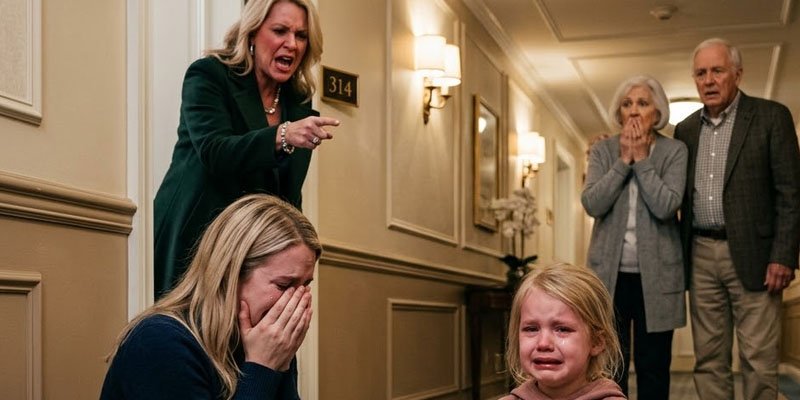
When I returned, Lily was nowhere inside. I found her standing in the hallway near the ice machine, barefoot, shaking, and clutching her stuffed rabbit tightly against her chest. Tears covered her face, and she had cried so much that her voice was barely audible. One of the housekeepers told me she had been left there for nearly three hours. Lily had knocked on the door again and again, but Vanessa opened it only once.
“The room is for family,” she had told her.
My parents had remained inside the room the entire time, and neither of them had stepped in to help.
I picked Lily up and carried her back. Vanessa folded her arms while my mother’s expression showed annoyance instead of guilt.
“Claire, don’t turn this into something bigger than it is,” my father said. “She was fine.”
My six-year-old daughter had been forced to stand barefoot in a hotel hallway surrounded by strangers while the adults inside relaxed and watched television. Even then, I didn’t yell. I quietly took Lily into the bathroom, cleaned her feet, helped her change clothes, packed everything we owned, and checked into another hotel on the opposite side of town.
That night, Lily refused to sleep unless every light in the room stayed on. I remained beside her and made three phone calls—one to hotel management, one to my attorney, and one to Mark’s business partner. Vanessa had overlooked one important detail. For years, I had tolerated her cruelty, manipulation, and dishonesty without saying a word. The moment she decided my daughter wasn’t welcome behind a family door, my silence came to an end.
Three days later, Vanessa received a formal letter from the law firm handling Daniel’s estate. Shortly after Daniel’s death two years earlier, Vanessa and Mark had asked me to lend them $85,000. Mark insisted his construction company only needed temporary financing for a commercial project. My father claimed contracts weren’t necessary between relatives, but Daniel had always taught me to protect myself financially. Before I transferred the money, I quietly required Mark to sign a promissory note.
He never paid back a single dollar. Instead, Vanessa renovated her kitchen, leased a Mercedes, and told family members that I had become financially irresponsible because grief had affected my judgment. The attorney’s letter demanded complete repayment, along with accumulated interest, within thirty days.
By that point, the hotel had already launched its own investigation. I requested security camera footage, statements from witnesses, and a formal incident report. The evidence spoke for itself. An adult had intentionally taken a child out of a paying guest’s room, left her barefoot in the hallway, locked her out for hours, and ignored her while two grandparents watched without intervening.
Then I opened one of Daniel’s storage boxes filled with old business records. Before he passed away, he had suspected Mark was spending company money on personal purchases. The files revealed payments tied to Vanessa’s Mercedes, their home remodeling project, private-school tuition, and even a family vacation disguised as a business retreat. Mark’s business partner, Eric, had long believed something wasn’t right, but he had never been able to prove it.
“Now you do,” I told him.
Vanessa left me a furious voicemail.
“You’re ruining my family because Lily cried for a few hours. You’ve always been jealous of me.”
I saved the recording and forwarded it to my attorney. This wasn’t revenge over a single cruel afternoon. It was the beginning of accountability for years of behavior that my family had always chosen to excuse.
PART 2: THE TRUTH ON CAMERA
Vanessa had always managed to stay ahead by being the first to speak and the loudest voice in the room. When we were children, she would damage my belongings and convince everyone I was responsible. She shared pages from my diary with her friends, then dismissed me as overly sensitive whenever I cried. During family dinners, she criticized my marriage and later claimed I was the one spoiling the evening. My parents consistently valued keeping the peace over acknowledging the truth, and keeping the peace always meant letting Vanessa have her way.
When the hotel investigator interviewed Vanessa, she insisted that Lily had wandered into the hallway on her own. She claimed the door had probably shut by accident and suggested I had misinterpreted the situation because I had been emotionally fragile since Daniel passed away.
Then the investigator brought up the security camera footage.
The recording showed Vanessa opening the door to my hotel room while carrying Lily’s shoes and backpack. It captured her pointing down the hallway as Lily stepped backward in tears. Vanessa then went back inside and locked the door behind her. For the next three hours, Lily remained near the ice machine, knocking over and over before eventually sliding down the wall from exhaustion. At one point, my mother came out, looked directly at Lily, and quietly returned inside. Later, my father stepped into the hallway, handed Lily her stuffed rabbit, and closed the door once again.
After reviewing the hotel’s official written report, I requested a protective order to prevent Vanessa from having any contact with Lily. I also reported the incident to child welfare authorities because having everything documented mattered. My family had spent years disguising cruelty as misunderstanding and neglect as discipline. This time, every fact would be recorded in writing.
The following morning, my father came to my house and pounded on the front door. I spoke to him through the security camera while Lily sat behind me eating breakfast.
“You actually called child services on your own family?” he shouted.
“I reported what happened to my daughter.”
“She’s perfectly fine.”
“She’s afraid to sleep by herself.”
“Only because you’re putting fear into her head. You’ve always been weak.”
Then he brought Daniel into the conversation, accusing him of making me too sensitive. At that moment, something inside me became completely calm. Daniel had always believed love was measured by thousands of steady actions, not by empty words. My father had no right to speak his name.
“Leave,” I told him.
“You’re going to regret this.”
I saved the security recording and forwarded it to my attorney. When my mother later texted that I was tearing the family apart, I replied only once.
“No. I’m protecting mine.”
After that, I blocked her number.
Meanwhile, Mark’s company continued examining the financial records I had turned over. The investigators uncovered even more than Daniel had suspected, including duplicate reimbursements, falsified invoices, and personal purchases disguised as business expenses. Mark called me, pleading for me to convince Eric that everything was simply a family misunderstanding.
“If the company falls apart, my children will suffer,” he said.
“Your children were sitting inside watching television while mine cried alone in the hallway.”
“I never expected Vanessa to do something like that.”
“But you knew what happened afterward. And you stayed in that room.”
He had nothing left to say.
Not long afterward, Vanessa posted online, claiming she was the victim of attacks from a bitter family member. Instead of receiving support, people started asking why a six-year-old child had been locked outside a hotel room. She quickly deleted the post, but screenshots had already been shared widely. Soon after, she was removed from the parent leadership committee at her sons’ private school.
Eventually, my aunt Rebecca reached out and asked me what had really happened. I sent her a copy of the hotel’s official written summary. After reading it, she posted a message in the family group chat.
“I’ve read the official report. This was not a misunderstanding. A six-year-old child was intentionally locked out and ignored by the adults who were supposed to protect her. Don’t ask me to defend that.”
For the first time in her life, Vanessa was no longer believed automatically.
PART 3: FAMILY IS WHO OPENS THE DOOR
Two weeks later, we met for mediation regarding the unpaid loan. I arrived with Daniel’s financial records, the signed promissory note, proof of the bank transfer, and the repayment schedule that Mark had completely ignored. My attorney explained that, after adding interest and penalties, the total balance had grown to $103,450.
Vanessa struck the table with her hand.
“She’s using Daniel’s death as an excuse to punish us.”
The person I used to be would have tried to explain myself, softened every sentence, and apologized for making the room uncomfortable. Instead, I remembered Lily sitting barefoot beside the hotel ice machine.
“No,” I replied. “You used Daniel’s death to take money from a widow.”
My father leaned across the table.
“Claire, that’s enough. You don’t even need that money.”
“I needed my daughter to be safe. That didn’t matter to you either.”
My mother quietly admitted they had made a mistake.
“Forgetting sunscreen is a mistake,” I answered. “Leaving a crying six-year-old outside a hotel room for three hours is a decision.”
Then Vanessa finally exposed what she had truly believed all along.
“She was being irritating. She wouldn’t stop asking for you. She isn’t really part of this family the way—”
Mark grabbed her arm and told her to stop talking, but it was already too late. In that instant, I realized there had never been any misunderstanding waiting to be resolved. Vanessa had intended every cruel thing she had done. In her eyes, Lily wasn’t family. From that moment on, Vanessa would no longer be family to us.
Three days later, Mark signed a settlement agreement requiring him to repay the entire debt through scheduled payments secured by a lien against their home. The court also extended the protective order against Vanessa. I notified my parents in writing that they were not allowed to contact Lily unless I chose to initiate communication first.
Neither of them ever offered a sincere apology. Later, my mother mailed me a card saying she hoped we could leave everything in the past. I placed it inside the same folder as all the legal documents. You cannot move forward without honesty, and they were still hiding behind vague words instead of accepting responsibility.
Lily started therapy that September. At first, she spoke only in whispers and filled pages with drawings of long hallways, closed doors, and a little girl without shoes. One afternoon, her therapist asked what the child in the picture needed. Lily picked up a blue crayon and drew a woman standing beside the little girl.
“She needs her mommy to come back,” Lily said.
Recovery took time. At first, Lily could only sleep if her bedroom door stayed completely open. Later, she was comfortable leaving it halfway open. Eventually, she slept with the door closed and only a small night-light beside her bed. She even began walking barefoot across the kitchen floor again. That Thanksgiving, we invited Aunt Rebecca, Daniel’s brother, and the people who made Lily feel secure and loved.
Before dessert, Lily asked everyone at the table to share one true and kind thought. When my turn came, I looked around the room. No one mocked my feelings, criticized my emotions, or treated Lily as though she were an inconvenience.
“Family isn’t always defined by the people who share your last name,” I said. “Sometimes family is simply the person who opens the door.”
Nearly a year after everything happened at the hotel, I took Lily back to the beach, this time in a different town. As the sun began to set, she slowly slipped off her sandals and pressed her bare feet into the damp sand.
“Barefoot is safe here,” she said.
“Yes,” I answered. “Barefoot is safe here.”
Laughing, she ran toward the ocean. Just then, my phone buzzed with a text from my mother asking me not to keep Lily away forever as a way of punishing them.
I typed only one response.
“Lily isn’t a punishment. She’s a child. You forgot that.”
Then I blocked the number.
A few moments later, Lily came back carrying a small white seashell.
“Mommy, look. It isn’t broken.”
I knelt beside her and carefully took the shell into my hand.
“No,” I said. “It isn’t.”
She slipped her small hand into mine, and together we continued walking along the shoreline as the tide slowly washed away our footprints—not because they had never mattered, but because we were finally moving forward.