
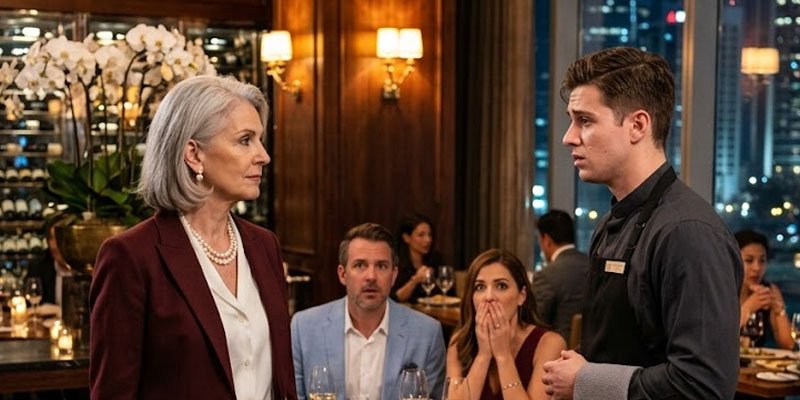
The invitation arrived on a calm Monday afternoon.
My son, Ethan, called while I was watering the herbs growing on the tiny balcony of my apartment in Charleston, South Carolina. Lately, phone calls from him had become uncommon. Most of our communication had been reduced to brief text messages squeezed into his busy schedule.
Hope you’re doing well.
Busy week.
We’ll catch up soon.
So when his name appeared on my screen, I answered before the second ring.
“Mom, Olivia and I would like to take you out for dinner on Friday,” he said.
For the first time in many months, his voice carried warmth. It sounded familiar. Almost like the young man I had spent years raising.
“Just the three of us?” I asked with quiet hope.
He hesitated for a moment.
“Her parents are coming too. We thought it would be nice if everyone could spend some time together.”
Everyone.
I clung to that single word much longer than I should have.
Recently, I had started feeling as though I was slowly fading from Ethan’s life. Holiday invitations only reached me after someone reminded him I existed. Time with my granddaughter had become increasingly rare. Whenever I called, Olivia always seemed to have already planned every free moment on their calendar.
Even so…
I let myself believe this dinner might be the beginning of something better.
“I’d be happy to come,” I replied.
“Perfect. Seven-thirty. The Grand Magnolia House.”
I knew that restaurant well.
Almost everyone in Charleston did.
It was housed inside a beautifully restored nineteenth-century mansion overlooking the harbor, complete with crystal chandeliers, gleaming hardwood floors, and reservation lists that filled weeks in advance. Politicians celebrated election victories there. CEOs entertained important clients there. Families gathered beneath its hand-painted ceilings to celebrate life’s biggest milestones.
What Ethan never realized…
Was that I knew The Grand Magnolia House better than nearly anyone else.
Because I had spent close to fifteen years helping build it.
My name is Margaret Hayes, and throughout most of my life, there was only one title I truly valued.
Ethan’s mother.
His father walked away when Ethan was six.
There wasn’t a dramatic argument.
No emotional goodbye.
One ordinary morning, he placed two suitcases in his truck, said he needed a different life, and drove away before breakfast.
From that day on…
It was only Ethan and me.
I cleaned vacation rentals during the day, prepared dinners at a retirement community every evening, and handled bookkeeping for a neighborhood bakery every weekend. Sleep became whatever time I could steal between responsibilities.
Ethan never had the newest sneakers.
But they were always spotless.
He never went to expensive summer camps.
But I made sure he never missed a science competition.
The day he received his college acceptance letter, I celebrated right beside him…
Then cried quietly after he went to sleep because I had no idea how I would pay the tuition.
Somehow…
I managed.
Extra shifts.
Selling my mother’s bracelet.
Taking out a loan against my old car.
Working until every part of me ached.
When Ethan graduated, he hugged me so tightly I could barely breathe.
“I’ll spend the rest of my life making you proud,” he whispered.
For many years…
I believed every word.
Then he married Olivia Brooks.
She came from one of those families where social status quietly shaped every conversation.
Her father, Richard, owned several commercial real estate developments.
Her mother, Diane, served on charity boards and judged people by their ZIP codes before learning anything else about them.
At first, Olivia was genuinely kind.
She brought flowers whenever she visited.
Asked me to share family recipes.
Told Ethan how fortunate he was to have a mother who had sacrificed so much.
After the wedding…
Everything changed.
She corrected the way I pronounced French dishes.
Suggested I replace my furniture before they invited guests into my home.
At my granddaughter Lily’s birthday party, she quietly moved the homemade cake I had baked to a side table because it didn’t match the professionally catered dessert display.
“We’ll cut yours later,” she said with a smile.
Later never happened.
Friday evening finally arrived.
I wore a navy dress I had owned for years, freshly pressed and paired with the pearl earrings Ethan had given me after earning his first promotion.
I reached the restaurant at 7:34.
Olivia noticed immediately.
“You’re late.”
She never once called me Mom.
Not even once.
“There was traffic on the bridge,” I explained.
“Of course there was.”
Her tone made it sound as though even the traffic had somehow become my responsibility.
Ethan sat beside her in a perfectly tailored charcoal suit, wearing the exhausted expression of a man hoping no one would create unnecessary conflict.
Richard and Diane were already halfway through their wine.
Five chairs surrounded the table.
Mine was placed at the very end…
Right beside the service station.
Even so, I smiled and quietly took my seat.
A young waiter named Daniel approached carrying our menus.
The instant he saw me, recognition crossed his face.
I recognized him as well.
He had been working there for several years.
Our eyes met.
Almost without thinking, I gave him the slightest shake of my head.
Not yet.
Olivia hardly glanced at the menu.
“We’ll take four butter-poached lobster entrées,” she said confidently. “Seasonal vegetables. Reserve Chardonnay.”
Daniel hesitated.
“Four, ma’am?”
She finally turned toward me as though she had only just remembered I was sitting there.
“Yes,” she answered calmly. “Only four.”
Then she closed her menu and offered a polite smile.
“Oh… and for Margaret?”
She paused just long enough for every eye at the table to settle on me.
“A glass of water will be enough.”
Silence filled the table.
Daniel remained where he stood.
He looked toward Ethan.
Waiting.
Hoping.
Expecting him to correct the order.
Instead…
My own son leaned back in his chair, looked directly into my eyes without the slightest hint of shame, and quietly said,
“Mom… just know your place tonight.”
No one else spoke.
Richard slowly raised his wineglass.
Diane smiled behind her folded napkin.
Olivia looked pleased.
Daniel stayed motionless beside the table.
I didn’t argue.
I didn’t try to explain myself.
I didn’t even touch the glass of water after he reluctantly placed it in front of me.
Instead…
I simply folded my hands together and waited.
Exactly thirty seconds later…
The kitchen doors swung open.
And the person who stepped into the dining room drained every bit of color from the faces around that table.
The Man From The Kitchen
It was Thomas Bell.
White chef’s jacket. Black tie. Still tall at seventy-two, broad-shouldered, with silver streaks at his temples. In his younger years, women had found excuses just to start conversations with him. Time hadn’t taken that away—it had only refined it.
Before he even reached our table, nearly half the dining room noticed him.
At The Grand Magnolia House, people always noticed Thomas.
He had opened the restaurant back in 1989, when the building was nothing more than a decaying harbor mansion with termites in the beams and three raccoons living in what eventually became the upstairs bar. He liked to joke that the raccoons had enjoyed the best seats in the house. People laughed, partly because successful men could make almost anything sound funny.
Thomas stopped beside me.
Then he leaned down and gently kissed my cheek.
“Margaret,” he said warmly. “You should have called me the moment you arrived.”
Olivia’s fingers slipped against the stem of her wineglass.
Richard blinked.
Twice.
Diane’s mouth stayed hanging open just a little too long before she quickly composed herself.
And Ethan.
Ethan froze in the exact way I had seen only once before—when he was nine years old, accidentally broke the neighbor’s window with a baseball, and heard a police cruiser pull into the driveway.
Thomas straightened and turned toward Daniel.
“Why is Ms. Hayes sitting here with only water while everyone else is ordering dinner?”
Daniel swallowed nervously.
“Sir… I was simply following the order I was given.”
“Given by whom?”
No one answered.
Thomas never raised his voice.
He didn’t need to.
The entire dining room had fallen into that special kind of silence where people slowed their forks halfway to their mouths and pretended not to watch while watching every second.
Then Olivia finally spoke.
“I think there’s been a misunderstanding,” she said, wearing the same polished smile she reserved for charity events, school interviews, and moments of quiet cruelty. “Margaret is our guest tonight, but this is really a private family dinner. I’m sure she wouldn’t want unnecessary attention.”
Thomas slowly turned toward her.
“A misunderstanding?” he repeated.
“No. I don’t believe that’s the problem.”
He rested one hand lightly on the back of my chair.
“This woman helped me build this restaurant during the years when I couldn’t even make payroll. During the kitchen fire in 1994, she slept three nights in the upstairs office because she knew contractors were cutting corners and didn’t trust them. She uncovered a manager stealing from me in 1997. She even wrote our very first employee handbook because the one I created looked like it had been typed by a drunk.”
A quiet, nervous laugh drifted over from two tables away.
Thomas continued.
“And because of Margaret Hayes, every employee here—including the dishwashers—still receives a holiday bonus every year. So no, Ms. Brooks. I’m not the one who’s confused.”
Something disappeared from Olivia’s face in that moment.
Not only the color.
Her confidence.
She opened her mouth, but nothing meaningful came out.
Richard tried to step in.
“Mr. Bell, with all due respect, this is our table.”
Thomas looked at him the way someone might look at finding a paper clip floating in a bowl of soup.
“Then behave like people deserving of sitting at it.”
Daniel was still standing there, clutching his order pad tightly against his chest.
Thomas nodded toward him.
“Cancel the lobster orders.”
That finally got their attention.
Olivia turned sharply toward him.
“Excuse me?”
“You heard exactly what I said.”
She let out a short, sharp laugh.
“You can’t cancel our meals over some simple misunderstanding.”
Thomas glanced back at Daniel.
“Not cancel.”
“Replace them.”
Then he looked down at me.
“Margaret, what would you like to eat?”
Every person at that table fixed their eyes on me.
None of them had paid me that much attention when I first arrived.
For a brief moment, I almost said I didn’t mind.
Old habits are difficult to break.
I had spent years shrinking myself to fit into rooms where people were more than willing to make me invisible.
Then I looked at my son.
“Shrimp and grits,” I answered.
“The original recipe.”
Thomas smiled.
“There she is.”
He turned to Daniel.
“Chef’s table service. And start with the she-crab soup—the authentic batch, not the one made for tourists.”
“Yes, sir.”
Daniel almost ran back toward the kitchen.
Olivia stared at me.
“You knew him?”
I folded my napkin once.
Then folded it again.
“Yes.”
“How?”
Thomas answered before I could.
“Because your mother-in-law was my business partner.”
The words shattered the silence like breaking glass.
Fifteen Years Nobody Asked About
When people hear the words “business partner,” they picture polished boardrooms and executive meetings.
It wasn’t anything like that.
When I first met Thomas Bell, I was thirty-eight years old, abandoned by my husband, carrying an extra pair of grocery-store pantyhose in my handbag because the ones I was wearing had a run in them, and looking for a second shift serving lunch at a restaurant on East Bay. Thomas was in the back office muttering at a fax machine and a stack of unpaid invoices. The hostess told me they weren’t hiring.
Then Thomas walked out and asked whether I knew bookkeeping.
I replied, “Enough to stop a bakery owner from fooling himself.”
He laughed so hard that he hired me on the spot.
In the beginning, I worked the lunch shift and handled payroll after closing. Then I took over inventory. After that came vendor negotiations, repair scheduling, staff rosters, permits, liquor license renewals, health inspections. If it involved paperwork, numbers, or someone trying to overcharge us, it eventually landed on my desk.
There were plenty of weeks when Ethan sat in booth fourteen doing homework while I balanced the books.
He loved drawing sailing ships on the backs of old menu printouts.
Thomas kept those sketches in a folder for years.
I never owned part of the building, and I certainly wasn’t wealthy. Let me make that clear. But when Thomas expanded into private events and renovated the upstairs rooms, he offered me a share of the profits instead of a raise because cash was tight, and he was honest enough to admit it.
That profit share covered Ethan’s first semester of college.
Then the second.
Later, once business was thriving, Thomas offered to buy my share. I turned him down twice. On the third offer, I accepted part of it—just enough to eliminate my debts and put away a little savings. He kept me on as operations director because, as he always joked, nobody else knew where all the skeletons were buried.
I finally retired five years ago.
Lily had just been born. My knees constantly hurt. My back complained every time rain rolled in from the harbor. I wanted a slower life. A balcony. Basil growing in clay pots. Mornings that weren’t already stressful before eight o’clock.
Thomas hugged me upstairs in his office and cried as though smoke had gotten into his eyes.
At my retirement dinner, every member of the staff stood and applauded. Daniel was there too—much younger then, skinny as a broomstick, fresh out of culinary school and intimidated by everyone.
Ethan had been invited.
He said he had a client dinner and couldn’t make it.
I should have recognized what that meant.
Instead, I found excuses for him.
I had become very good at doing that.
The Real Reason For The Invitation
The she-crab soup arrived in elegant white porcelain bowls, topped with a drizzle of sherry cream and a single perfect sprinkle of paprika.
Daniel placed mine in front of me first.
Then he served Thomas, who had already pulled up a sixth chair without asking anyone’s permission, because men like Thomas never wait for permission inside buildings they own.
Olivia never touched her spoon.
“We had no idea,” she said.
Thomas looked mildly entertained.
“Didn’t you?”
Richard interrupted.
“Ethan never told us any of this.”
I turned toward my son.
“Didn’t you?”
His jaw tightened.
There it was.
The very first crack.
“I knew you worked here,” he said. “I just didn’t know… all of this.”
Worked here.
As though I had spent fifteen years simply folding napkins in a hallway.
For a moment, I almost corrected him.
Almost.
Then Diane, who had remained unusually quiet, dabbed the corner of her mouth with her napkin and finally asked the question she had clearly been holding back ever since Thomas walked into the room.
“So what exactly is Margaret’s connection to the business now?”
Straight to the money.
As always.
Thomas leaned back comfortably.
“It’s still a direct one.”
I quietly said, “Thomas.”
He ignored me.
“She still receives quarterly distributions from the profit-sharing arrangement I insisted she keep when she retired. She also continues to own a very small advisory interest in the event division, although she constantly forgets about it because she has an irritating habit of not caring about money.”
Diane’s spoon struck the edge of her bowl with a soft clink.
Olivia became completely rigid.
Richard straightened in his chair, as though sitting taller would somehow help him hear more clearly.
And Ethan’s expression shifted into something painful to watch.
It wasn’t guilt.
Not yet.
It was calculation.
More than anything Olivia had done that evening, that hurt.
“You own part of this place?” he asked.
It was the wrong question.
It sounded less like a son speaking to his mother and more like an investor hearing unexpected financial news.
“A little,” I answered.
“How much?”
Thomas let out a short laugh.
“Now you’re interested in family business?”
“I’m only asking.”
“No,” I replied quietly.
“You’re only beginning to understand why your wife wanted this dinner.”
That finally hit Olivia.
She turned sharply toward me.
“Excuse me?”
I gently set my spoon down.
“You can stop pretending. We’re all adults here.”
Richard frowned.
“Stop pretending about what?”
I looked at Ethan.
He was the first one to look away.
Not Olivia.
Not her parents.
My own son.
Two weeks before that dinner, I had received a phone call from a junior associate at a downtown law office. His name was Peter Coyle. He spoke with the nervous tone of someone handed bad news and told to deliver it anyway.
He explained that my name had surfaced during a preliminary asset review connected to a proposed family trust. Then he asked whether I intended to transfer or assign any business interests to my son, Ethan Hayes, or to Ethan’s wife.
At first, I assumed he had contacted the wrong Margaret.
He had not.
The proposal had originated through Richard Brooks’s office.
I stayed silent at the table just long enough for Olivia to realize exactly what I knew.
Her face changed instantly.
It wasn’t quite fear.
It was the look of someone suddenly exposed.
“You had someone investigate my finances?” I asked Richard.
He drew himself up, almost insulted that I had seen through him.
“That’s standard due diligence for a family estate structure.”
“For a structure I was never invited to discuss?”
Ethan spoke far too quickly.
“Mom, it wasn’t like that.”
“Then tell me exactly what it was like.”
He pressed his lips together without answering.
Olivia answered instead.
“We were simply trying to make smart decisions for Lily’s future.”
I almost laughed.
Lily’s future.
That was always the shield they used. Whenever they wanted the knife to look harmless, they placed the child in front of it.
“So,” I said, “what you really wanted was to find out whether the old woman you barely make time for owned anything worth inheriting.”
“That’s not fair,” Ethan replied.
“Isn’t it?”
After that, no one touched their soup.
What Ethan Didn’t Know About His Own Mother
There was one more thing Ethan had never been told.
I updated my will back in March.
Not because I was angry.
Because I had started recognizing a pattern.
People rarely reveal who they are all at once.
It comes in small pieces.
A careless comment here.
A forgotten invitation there.
A school recital I discovered through Facebook instead of from my family.
A picture of Lily smiling with her front tooth missing that no one bothered to send me.
Then there were Olivia’s strange questions over Christmas.
“Have you thought about moving somewhere smaller?”
“Are all your retirement papers organized?”
“Who takes care of everything if you ever become… confused?”
That word.
Confused.
I wasn’t confused.
I was paying attention.
So I scheduled a meeting with Janice Pruitt, an estate attorney known for her practical shoes and her complete lack of patience for wealthy people who believed polite voices could disguise greed.
I told her I wanted Lily protected.
Directly.
Not through Ethan.
Not through Olivia.
And certainly not through any carefully designed “family structure” dreamed up over lunch at some private club.
Janice created a trust that covered Lily’s education, medical care, and a distribution schedule that would only release funds once she was old enough to understand both the value of money and the price attached to it. If I died tomorrow, that money would never pass through anyone else’s eager hands.
I never told Ethan.
I intended to.
Just not over a lobster dinner.
And definitely not after hearing, “Know your place, Mom.”
Thomas already knew about the trust because Janice was his cousin on his mother’s side. Charleston has always been that kind of city. Drive ten minutes in any direction, and somehow everyone is connected through family, church, divorce, or lawsuits.
So when Thomas glanced at me over the soup course, I immediately understood what he was asking.
Do you want me to tell them?
I answered with the smallest nod.
Not out of revenge.
Out of honesty.
Thomas gently set down his spoon.
“Ethan, since everyone seems so interested in Margaret’s affairs, this seems like an excellent time to mention that none of her assets are available for you or your in-laws to include in any financial arrangement.”
Olivia’s face turned completely pale.
Richard’s grew dangerously red.
Diane quietly whispered,
“Richard.”
He ignored her.
“That’s completely inappropriate.”
Thomas smiled, but there wasn’t a trace of warmth in it.
“Then you’ve chosen exactly the right dinner table.”
Ethan looked directly at me.
Really looked at me.
“You created a trust?”
“Yes.”
“For Lily?”
“Yes.”
His shoulders sank ever so slightly.
“Then why didn’t you tell me?”
I looked at him for several long moments.
“If you believed I was living in a rented apartment with only forty dollars to my name, would you have called to ask how I was before tonight?”
He said nothing.
Because there was no answer he could honestly give.
Just then, the shrimp and grits arrived, still steaming, with butter slowly melting across the surface. Stone-ground grits. Tasso gravy. Shrimp perfectly curled with a light char around the edges. Daniel placed the plate in front of me with both hands, treating it as though it truly mattered.
It did.
Thomas received the same meal.
A few moments later, replacement entrées arrived for everyone else.
Not lobster.
Redfish.
Because Thomas meant every word he said.
Olivia stared at her plate as though it were some form of punishment.
I simply ate.
Slowly.
My son watched me finish three bites before finally speaking again.
“Mom… I was wrong.”
A simple sentence.
Far too late.
But it was finally spoken.
Olivia whipped around so quickly that her chair scraped loudly across the floor.
“Ethan.”
He never looked at her.
“I was wrong,” he repeated, this time speaking directly to me.
“What I said was… God.”
He rubbed his hand across his mouth.
Richard snapped,
“You don’t owe anyone an apology for protecting your family.”
That was enough.
Ethan turned toward his father-in-law with something that looked remarkably close to disgust.
“Protecting my family from what?
My own mother ordering dinner?”
“From being manipulated.”
By then, I had heard enough.
I laid my fork on the table.
“Manipulated,” I repeated.
“That’s an interesting choice of words.”
Richard leaned toward me.
“With all due respect, Margaret, women don’t end up with influence around successful men by accident.”
Thomas burst into laughter so loudly that a couple dining at the next table jumped in surprise.
And that was when everything shifted again.
Still smiling, Thomas wiped his mouth with his napkin.
“You actually believe Margaret built her life around me?”
Richard spread his hands.
“I believe arrangements like this are often misunderstood by people on the outside.”
“Then allow me to explain,” Thomas replied.
He turned toward Ethan.
“When your mother retired, I invited her to remain on the board of the event company.
She declined.
So instead, I included a provision in my succession documents stating that if I ever died or sold this business, she would have the first opportunity to review staffing protections and legacy operations.
Do you know why?”
Nobody said a word.
“Because when I suffered a heart attack in 2016, your mother kept this entire business afloat while I was lying in the ICU,” Thomas said. “She handled payroll from my hospital room, stopped my brother from taking control, and told three bankers exactly where they could go in language I’ve admired ever since.”
I hadn’t expected him to tell that story.
Warmth rushed into my face.
He still wasn’t finished.
“And because I trust her more than anyone I’ve ever signed a contract with.”
Richard leaned back heavily in his chair.
Diane looked at me as though she had just learned the woman she assumed checked coats actually owned the theater.
Olivia had lost every trace of composure. The polished smile was gone. What remained was anger, and somehow it suited her more honestly.
“So what?” she snapped. “Are we supposed to fall at Margaret’s feet because she used to be important here?”
Used to.
Thomas almost seemed glad she had finally spoken the words aloud.
Before he could answer, I did.
“No,” I said. “You’re supposed to realize that the waitress you imagined in your mind is actually the woman who approved the chandeliers hanging over your head and rejected the first staircase design because it was hideous.”
Red blotches spread across Olivia’s cheeks.
I continued.
“You’re supposed to understand that every time you patted my hand and spoke to me like I couldn’t keep up, you were speaking to someone who built far more than you ever cared to ask about. And you,” I said, turning toward Ethan, “should have known that long before tonight.”
That one landed.
He lowered his eyes to the white tablecloth.
The Last Course
People imagine public humiliation as something loud and dramatic.
Most of the time, it isn’t.
It’s simply a room becoming perfectly still while someone’s version of themselves quietly falls apart.
Dessert menus arrived.
No one wanted one.
Thomas ordered pecan pie for me anyway because he remembered that during twelve-hour holiday shifts, I always ate it standing in the office.
Daniel brought fresh coffee.
After a while, Richard muttered something about an early meeting and pushed back his chair.
Diane stood with him, looking shaken and strangely fragile. Before leaving, she gave me a look I still can’t fully describe.
It wasn’t kindness.
Not exactly.
It was something close to surrender.
Olivia remained seated.
Naturally.
She waited until her parents were halfway across the dining room before leaning toward Ethan and hissing,
“Are you coming?”
He answered quietly.
“Not yet.”
She stood.
For a moment I expected her to throw her napkin, burst into tears, or deliver one of those carefully practiced cutting remarks people spend a lifetime perfecting.
Instead, she looked at me with open contempt.
“Did you enjoy this?”
The uncomfortable truth?
A little.
Not seeing my son hurting.
Not that part.
But watching her lose control of the social ladder she had spent years climbing in heels sharp enough to tear through carpet?
Yes.
A little.
Even so, I answered honestly.
“I enjoyed discovering exactly who was sitting at this table.”
She gave one tight nod, as though somehow she had won the exchange, then turned and walked away.
Her heels echoed all the way to the front entrance.
Fast.
Angry.
Small.
Ethan remained seated with both hands resting flat on the table.
Thomas stood, squeezed my shoulder once, and said,
“I’m giving your son ten minutes. If he wastes them, I’ll send him the bill for the redfish.”
That finally pulled a sound from me.
Not quite laughter.
Close enough.
Then Thomas walked away.
Daniel quietly cleared the dishes, moving carefully around us the way people move near hospital beds or sleeping babies.
Ethan stared at the untouched glass of water Olivia had ordered for me.
“I don’t know when I became this person,” he said.
Before answering, I looked through the long windows toward the harbor lights.
“Yes, you do.”
He flinched.
“You ignored small things because it was easier,” I said. “Eventually you convinced yourself that avoiding conflict was the same thing as keeping peace. Then one day your wife orders your own mother a glass of water, and you tell yourself it’s better not to make a scene.”
He rested his elbows on the table and buried his face in his hands.
I hadn’t seen him do that since his college final exams.
“I should have stopped it.”
“Yes.”
“I should have called you more often.”
“Yes.”
“I should have brought Lily to see you.”
I offered him nothing on that one.
After a long minute, he lowered his hands.
“Was tonight planned?”
Under different circumstances, that question would have offended me.
But he looked too broken to mean it that way.
“No,” I answered.
“I honestly thought maybe you missed me.”
That turned out to be the hardest thing I had said all evening.
I knew it the instant the words left my mouth because something inside his face broke in a simple, vulnerable way that had nothing to do with money, expensive suits, or Olivia’s family.
“Mom.”
I gently shook my head.
“Don’t.
Not if you’re only trying to stop the bleeding.”
He sat there with tears filling his eyes and made no effort to hide them.
Good.
Let them stay.
“I did miss you,” he whispered.
“I just kept convincing myself there would always be more time.”
“Time for what?”
He looked down again.
“To fix everything before it became this bad.”
It was a foolish answer.
It was also the truth.
I reached for my purse.
Panic flashed across his face.
“Please don’t leave like this.”
“Like what?”
“Like this is the end.”
I stood, my knees protesting, the pearls cool against my neck.
“I honestly don’t know what we are tonight.”
That was true as well.
He stood so quickly that he bumped the table.
“Can I come see you tomorrow?
Just the two of us.
Please.”
I studied him carefully.
My son.
Forty years old.
Bright enough to earn every degree he had ever worked for.
Weak in exactly the places that matter most when nobody else is watching.
“Tomorrow,” I said.
“My apartment.
Ten o’clock.
No Olivia.”
He nodded immediately.
“Okay.”
“And Ethan.”
He looked at me.
“If you ever tell me to know my place again, you’ll find out just how small your own world can become.”
He closed his eyes for a moment.
“I know.”
“No,” I replied.
“You know now.”
Then I picked up the glass of water, took a single sip, placed it back in front of his empty chair, and walked away.
By 9:52 the following Saturday morning, he was already standing outside my apartment building.
If this story stayed with you, share it with someone who will understand why.
For more unforgettable family drama, don’t miss “My Father-in-Law Threw Us Out Before the General Arrived” or the unexpected twists in “He Married Me Dying, Then His Lawyer Opened the Box.” And if you’re looking for another powerful confrontation, be sure to read “She Took Me to the Hallway to Explain My ‘Place’.”
If family drama is your favorite kind of story, you’ll also enjoy the one about a cousin reading a shocking headline aloud at Thanksgiving, another about a woman being thrown out of her own home by her family, and the unbelievable tale of a husband’s furious mistress showing up outside his hospital room.