I married Jonah for money while he was serving a twelve-year prison sentence. At first, I told myself it was nothing more than a legal agreement to protect my younger brother. But the day Jonah finally came home and placed a black box on my kitchen table, I learned his mother had chosen me for a reason far greater than I ever imagined.
I agreed to marry Jonah for $2,000 a month while he was locked away for twelve years, convincing myself it was about survival—not romance.
I was twenty-seven years old, raising my younger brother, Owen, and that morning our landlord had taped a final eviction notice to our apartment door.
Three years later, Jonah walked out of prison, set a black box on my kitchen table, and exposed the real reason his mother had selected me.
That was the moment I understood that being poor had never made me invisible.
It had only made me useful.
Owen noticed the eviction notice before I could tuck it away.
He was seventeen, too tall for his old, worn sneakers, and far too proud to ask why every pot of soup I cooked seemed to last longer than it should.
“Is it serious, Sadie?” he asked.
I folded the notice in half. “It’s just a piece of paper. Paper likes to pretend it has power.”
Owen didn’t laugh.
A few hours later, I got a phone call from a woman who worked for Celeste, the mother of a prisoner named Jonah. She explained that Celeste had found my name through legal aid records after I applied for rental assistance and guardianship documents for Owen.
That alone should have made me hang up.
Instead, I kept listening because desperation always convinces you to wait just a little longer.
My landlord demanded rent, Owen needed a new pair of shoes, and pride had never paid an electricity bill. I truly had no other option.
So I agreed to meet her.
Celeste’s office carried the scent of lemon polish and old money.
“I have to be at work in an hour,” I said.
“I won’t keep you long, Sadie.” She folded her hands neatly. “I’m prepared to pay you $2,000 every month.”
“For what exactly?”
“For your name.”
I simply stared at her.
“My son, Jonah, is serving a twelve-year sentence,” she explained. “He needs a wife, legally speaking. Visit him twice each month, write him letters, and let the court see that he still has family. Judges like stability. A wife gives him that.”
“You’re asking me to marry someone in prison?”
“I’m asking you to make a practical choice.”
“Is he dangerous?”
“No. Spoiled, reckless, and immature? Yes. Dangerous? No.”
“Why choose me?”
Her smile was kind enough to hurt. “Because you know what responsibility looks like.”
I should have walked away.
Instead, I imagined Owen acting as though he wasn’t hungry after school.
“I want the first payment before the wedding,” I said.
Celeste smiled. “Naturally.”
When I broke the news to Owen, he looked at me like he no longer knew who I was.
“You’re actually getting married?”
“Only on paper.”
“To a man in prison?”
“Yes.”
“You’re selling yourself just so I can stay in school?”
“I’m doing it so we can keep a roof over our heads.”
“That’s not really an answer.”
“It’s the only answer I have.”
The anger in his face slowly disappeared, replaced by something even more painful.
“I can get a job.”
“You’re going to finish school, Owen. That’s what matters.”
“Sadie, please.”
“No. You’re graduating. You’re getting out of this life. And you’re becoming someone no wealthy woman will ever be able to put a price on.”
He turned his head away before I could.
That was how I knew he finally understood.
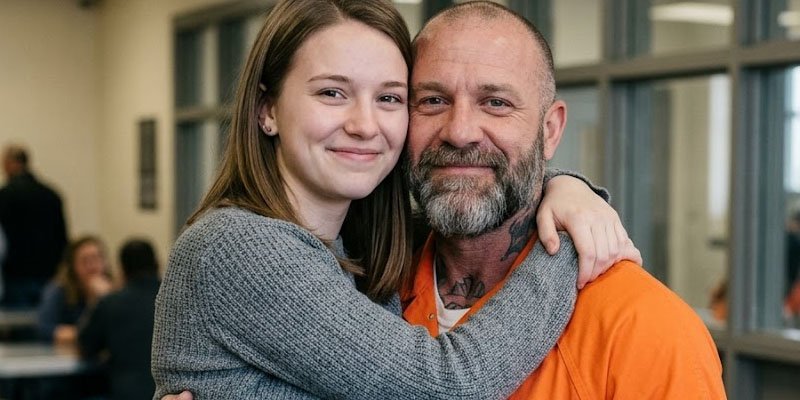
The wedding ceremony happened through a sheet of scratched prison glass.
Jonah sat across from me wearing a beige prison uniform, looking thin and completely worn down.
“You don’t have to act like I’m a good person,” he said.
“That’s fine, because I wasn’t planning to.”
I had expected confidence, anger, or resentment.
Instead, all I saw was regret.
“I did steal money,” he admitted. “Eighteen thousand dollars from a restricted foundation account. My trust fund was frozen after my father became ill, and I convinced myself I was only borrowing from my future.”
“That’s a polished way of saying you stole it.”
“Yes,” he replied. “It is.”
“But I didn’t steal the $600,000 they blamed me for,” he continued. “Dean did.”
“Who’s Dean?”
“My cousin,” he said quietly. “He transferred the larger amounts, forged my signature, and used my smaller mistake to make me the perfect person to blame.”
“Then why did you let everyone believe it was all your fault?”
Jonah looked briefly toward the correctional officer.
“Because I already despised myself enough to think I deserved every bit of it.”
So I signed the documents.
He signed them too.
Just like that, I had a husband—and enough money to keep a roof over our heads.
At first, I was simply pretending.
I visited him twice every month because Celeste’s payments continued to arrive. I mailed letters that sounded warm enough to seem genuine, yet distant enough to keep my feelings out of them.
Jonah answered every single one.
His handwriting was neat, with tiny drawings tucked into the margins. A steaming coffee cup. A worn-out waitress. Owen dressed as Captain Algebra after I mentioned he had failed a math test.
When I visited again, Jonah asked, “Did Owen get another chance to take the test?”
I stared at him. “You actually remembered that?”
“You wrote about it.”
“I write about a lot of things.”
“And I read every one.”
For some reason, that irritated me more than I expected.
Kindness is much harder to push away than cruelty.
One evening after finishing a double shift, I sat on the kitchen floor reading through Jonah’s case file.
Owen stepped around the scattered papers with a bowl of cereal in his hands.
“Please tell me that’s something entertaining and not prison-husband research.”
“It’s prison-husband research. Look at this date.”
He knelt beside me. “October fourth.”
“Jonah was already locked up on October fourth.”
“So there’s no way he could’ve signed this transfer authorization.”
“Exactly.”
Owen leaned closer. “Dean?”
“I think Dean forged Jonah’s signature.”
“Can you prove it?”
“Not yet.”
Owen set his cereal bowl on the floor.
“What do you need?”
For the first time in years, I realized I wasn’t fighting by myself anymore.
“A timeline.”
Women who grow up with very little remember dates: rent due dates, utility shutoff notices, court appearances, and the day school expenses increase.
So I rebuilt Jonah’s entire case using dates.
Owen helped me tape pages across the apartment walls. We charted every transfer, every signature, every witness statement, and every date Jonah was already behind bars while documents falsely claimed he had signed them.
I brought the completed timeline to a legal aid attorney who already looked exhausted before I even sat down.
“He admitted taking some of the money,” she said.
“I know exactly what he did. I’m not asking you to make him innocent. I’m asking you to prove who made his crime much worse.”
She finally lifted her eyes to mine.
“Families like this are experts at burying their mistakes.”
“Then bring a shovel.”
It took three years of prison visits, courthouse corridors, a pro bono appeals lawyer, missed work shifts, vending-machine meals, and begging people to read just one more page.
Twice, Celeste warned me.
“You’re mistaking loyalty for intelligence, Sadie.”
“No,” I answered. “I’m finally learning the difference.”
Even Jonah begged me to stop.
“You’re throwing your life away, Sadie. If you need more money, I’ll ask my mother.”
“It’s my life,” I replied through the scratched prison glass. “I get to decide what I do with it.”
His eyes filled with tears.
That was the moment I realized I loved him—not because he was completely innocent, but because he had finally chosen honesty.
When the judge overturned the conviction tied to the larger theft, Jonah walked out wearing an oversized gray suit.
Dean’s forged documents and missing records had finally been uncovered. Jonah still had restitution to pay for the money he admitted taking, but he was no longer the criminal everyone believed he had been.
I stood outside the courthouse expecting a celebration.
Instead, Jonah looked terrified.
“Come home with me,” I said. “It’s small, and Owen leaves cereal bowls everywhere, but tonight it’s ours.”
“Are you sure?”
“You’re my husband.”
For one week, we tried to live like an ordinary family. Jonah hardly slept. Owen asked careful questions. I shopped for groceries without having to count every dollar over and over.
On the eighth night, Jonah walked into the kitchen carrying a black box.
“What’s that?” I asked.
He set it gently on the table.
“Now it’s my turn to tell the truth.”
My hand froze on the dish towel.
“Unless that box is filled with back rent money and a functioning nervous system, I’m not interested.”
He didn’t laugh.
“Sadie, when you married me, you agreed to something much bigger than my last name.”
“I married you because Owen needed shoes and the rent was overdue. Don’t try to make it sound more noble.”
“My mother chose you for a reason.”
A knot formed in my stomach. “What did she do?”
“Open it.”
“No. Tell me first.”
“What’s inside that box is the reason she chose you—and the reason I was too afraid to tell you after I discovered the truth.”
My hands shook as I released the latch.
Inside was a cream-colored notebook.
Across the first page, I recognized Celeste’s handwriting:
No active parents.
Minor brother dependent.
Behind on rent.
Likely compliant if payments remain consistent.
For a few seconds, I couldn’t catch my breath.
“She investigated me,” I whispered.
Jonah lowered his eyes. “She did.”
“She examined my empty refrigerator, my work schedule, my brother’s worn shoes. She looked at my life and saw someone she could use.”
Under the notebook rested a trust document with my name printed on it.
I read the same paragraph three separate times before it finally made sense.
“Co-trustee?”
“My father created a safeguard,” Jonah explained. “If I married while I was incarcerated and my conviction was later overturned, my legal wife would automatically receive emergency co-trustee authority. He knew far more than he ever admitted while he was sick.”
“Because he didn’t trust Celeste or Dean.”
“That’s right.”
“And Celeste knew about it?”
“Yes.”
“So she deliberately chose someone poor enough to manipulate.”
“Yes.”
“And you knew?”
Jonah flinched. “Not in the beginning.”
“But you found out eventually.”
“Six months before the appeal hearing.”
Owen stood silently in the hallway.
“You let me spend three years waiting in prison lines,” I said, “without telling me I was caught in your family’s battle.”
“I convinced myself I was protecting you.”
“No. Say what really happened.”
He swallowed hard.
“I lied by allowing you to stay in the dark.”
“There,” I replied. “That’s the first completely honest thing you’ve said tonight.”
“Sadie, please.”
“I married you because I needed the money. I can admit that. But I loved you because I chose to—and you betrayed that.”
I gathered the notebook and the trust documents.
“Sadie,” Jonah asked. “Where are you going?”
“Nowhere,” I answered. “You are.”
Owen stepped up beside me.
Jonah looked from one of us to the other, lowered his head, and quietly walked out.
After Jonah was gone, Owen read through Celeste’s notebook twice.
“She wrote about us like we were stains on a piece of furniture,” he said.
“She has wealth, attorneys, board members, and people willing to believe every word she says.”
Owen tapped the trust papers.
“And you have her signature.”
“That doesn’t mean I know how to fight someone like her.”
“No,” he replied. “But it means she knows you can.”
Those words stayed with me the following morning when Celeste called.
“Sadie, dear,” she said smoothly. “We have unfinished business.”
Her office looked exactly the same, but everything else had changed.
Celeste opened a folder.
“You’ve accomplished more than anyone anticipated.”
“I know.”
One eyebrow rose before she slid a check across the desk.
$100,000.
For a brief second, I imagined Owen’s college tuition, a reliable car, and six months of rent already paid.
“What do you want me to sign?” I asked.
“A resignation as trustee. You’ve already been compensated generously, Sadie. Let’s not confuse survival with romance.”
I pushed the check back toward her.
Celeste’s smile became thinner.
“Women like you survive by recognizing when it’s time to step aside.”
“No,” I said as I stood. “Women like me survive by remembering every person who expected us to disappear.”
Her smile vanished.
“Be careful.”
“I spent three years being careful,” I replied. “Now I’m fully awake.”
The donor luncheon was supposed to repair Celeste’s reputation.
Instead, it became my stage.
She stood behind the podium in a cream-colored suit while Dean wiped sweat from his forehead near the front. Jonah and Owen sat quietly in the back. When I rose from my seat, Jonah started to stand too.
I gave him a small shake of my head.
This part was mine.
Celeste forced a polite smile as I approached with the black box.
“Sadie, dear, this isn’t the right time.”
“That’s exactly what you were counting on,” I answered. “You expected I’d never know when to speak.”
Dean barked, “Sit down.”
“No.”
I placed the black box on top of the podium.
“You paid me two thousand dollars every month to marry Jonah while he was in prison,” I said. “That part is true.”
Whispers rippled across the room.
“But you didn’t choose me because I was loyal. You chose me because I had nothing.”
I lifted her notebook into the air.
“No active parents. Minor brother dependent. Behind on rent. Likely compliant.”
Celeste reached for it.
“That’s confidential.”
“No,” I replied. “It’s evidence. You used a trust, a charitable foundation, and me to hold onto power that never belonged to you. You wanted Jonah blamed while you and Dean worked behind the scenes.”
Dean stood up.
“She’s lying.”
I turned to face him.
“You transferred money using Jonah’s name after he was already in custody. His eighteen thousand dollars hid your six hundred thousand.”
One of the board members rose.
“Dean, stay where you are.”
I looked back at Celeste.
“You believed I was poor enough to rent and exhausted enough to erase. You were wrong on both counts.”
The board member stepped forward.
“Celeste, step away from the podium. Counsel, call an emergency vote to suspend her pending review and notify the attorney general’s charity division.”
Several months later, Dean was facing criminal charges, Celeste had been removed from the foundation, and Jonah had completed every restitution payment.
One afternoon, Jonah found me reviewing scholarship applications and paused in the doorway.
“You belong here,” he said.
“I know.”
“I should have trusted you.”
“Yes.”
“I’m sorry.”
“I know.”
“I’ll never try to control you again.”
I looked up at him.
“You don’t get to prove that with one promise. You prove it every single day.”
He nodded.
“Then I’ll spend every day proving it.”
Owen appeared in the doorway.
“Are we eating dinner, or is emotional accountability the main course tonight?”
For the first time in months, I laughed.
I didn’t forgive Jonah overnight.
The first time I married him, fear made the decision for me.
The second time I chose him, I did it standing confidently at the center of my own life.