
The Shirt They Used Against Me
The family courtroom in Knoxville, Tennessee, felt even colder than the icy January weather outside.
I sat at a narrow wooden table with my eight-year-old son, Nolan, beside me.
His feet were too short to reach the floor, so his legs gently swayed beneath the chair whenever he grew nervous.
That morning, I had dressed him in his cleanest pair of jeans, a navy-blue shirt with a tiny embroidered moon stitched near the pocket, and the winter shoes I had carefully wiped clean with a damp kitchen towel.
The shirt was far from new.
Its collar had softened from being washed so many times, and a faint stain remained near the bottom hem.
I had tried twice to scrub it away, but some stains simply refused to disappear.
Across the courtroom, my ex-husband, Grant Bellamy, sat next to his attorney.
Grant wore a charcoal-gray suit, polished dress shoes, and the silver watch he had purchased not long after claiming he could not afford to send child support on time. He looked calm, successful, and fully prepared.
I wore a cream-colored blazer I had bought secondhand over a simple black dress.
I had no attorney representing me.
The only thing I brought was a folder filled with school records, medical appointment summaries, rent receipts, work schedules, and messages proving how many promises Grant had failed to keep.
His lawyer, Preston Carroway, rose from his seat and approached the judge.
“Your Honor, this case is not about whether Mrs. Bellamy loves her son,” he said in a measured voice. “The question is whether love alone can provide the stability every child deserves.”
My hands tightened around the edge of the table.
Judge Harlan looked down through his glasses.
“Go on, Mr. Carroway.”
The attorney held up a printed photograph.
It showed Nolan leaving school three days earlier.
He was wearing that same navy-blue shirt.
“This photograph reflects our concern,” Carroway said. “The child is repeatedly seen wearing worn-out clothing. His mother works unpredictable hours, lives in a modest apartment, and depends heavily on an elderly family member for childcare.”
Nolan stopped swinging his legs.
Carroway pointed toward the faint stain near the bottom of Nolan’s shirt.
“She cannot even provide her son with consistently respectable clothing.”
Several people in the courtroom turned to look at us.
Nolan lowered his eyes to his shirt.
In that moment, I understood Grant was not merely asking for more parenting time.
He wanted the court to believe that because I struggled financially, I somehow loved our son less.
The Story Behind That Photograph
Grant walked away from our marriage two years earlier.
He packed his clothes, his coffee maker, the television from our bedroom, and nearly everything else he considered valuable. Then he moved into a newer townhouse across the city and assured me we could handle child support without involving the courts.
“We’re adults, Audrey,” he had told me. “There’s no reason to make this more complicated.”
Within three months, he had stopped replying to most of my messages.
Not long afterward, my mother, Ruth, moved into our apartment.
She arrived with one suitcase, a slow cooker, and enough determination to carry all three of us through.
She never asked if I needed help.
She simply stepped in and started helping.
“You can cry later,” she told me on her very first evening there. “Right now, your son needs dinner, and you need some sleep.”
Our apartment sat above a small bakery and a dental office. The windows rattled whenever delivery trucks drove by, the heater only worked when it felt like cooperating, and the kitchen was barely large enough for two people to stand side by side.
Even so, it was our home.
I worked morning shifts at a neighborhood diner and cleaned office buildings three evenings each week.
On weekends, I delivered groceries whenever my aging sedan agreed to start.
Some mornings, I left before Nolan woke up.
Other nights, I returned after he was already asleep.
But I never missed a parent-teacher meeting. I packed his lunches the night before. I tucked little notes beneath his sandwiches on folded napkins. I checked his homework after midnight, even when my eyes struggled to stay open.
Nolan noticed much more than I ever wanted him to.
He knew when I ate cereal for dinner because there was only enough chicken for him and my mother.
He knew why I kept turning the thermostat down.
He knew the nicest apple always went into his lunchbox while I kept the bruised one for myself.
One evening, he found me sitting alone at the kitchen table with several unpaid bills spread out in front of me.
“Are we in trouble?” he asked softly.
I quickly turned the papers upside down.
“No, sweetheart. I’m just deciding which one I should deal with first.”
He climbed onto the chair beside me.
“Sometimes I finish the easiest homework first,” he said. “Maybe bills work the same way.”
I smiled, even though tears filled my eyes.
That was Nolan.
He had a way of finding hope, even in a pile of overdue bills.
The Shirt With the Moon
I bought the navy-blue shirt about four months before the custody hearing.
Nolan had become completely fascinated by the night sky after his school took a trip to a science museum. He could spend hours talking about planets, faraway stars, and how light travels across space for years before reaching Earth.
One evening, after finishing a shift cleaning an office building downtown, I walked past a department store that was getting ready to close for the night.
The shirt was hanging on the clearance rack.
It was plain, comfortable, and had a tiny silver moon stitched near the pocket.
I had only eighteen dollars left before my next paycheck.
The shirt was priced at twelve.
I knew that money should probably have gone toward groceries instead.
But I pictured the smile on Nolan’s face when he opened it, and for once, I wanted to give him something that had never been handed down from another child.
So I bought it and carried it home in a small paper shopping bag.
When I quietly entered Nolan’s room, he looked as though he was already asleep. I carefully folded the shirt and placed it on the chair beside his bed.
I stayed there for a few extra moments, watching him sleep beneath his faded green blanket.
I was completely worn out.
I was anxious about how I would cover the rent.
Yet I also felt proud because, despite everything, I had managed to bring home something that would make my son genuinely happy.
I smiled.
Then, without making a sound, I cried.
I never knew Nolan had been awake the entire time.
When Nolan Rose
Back inside the courtroom, Mr. Carroway continued presenting his argument.
“This is not about judging income,” he said. “It is about determining stability. Mr. Bellamy is able to provide a private bedroom, dependable transportation, structured activities, and a consistent home environment.”
Grant sat perfectly still, his hands calmly folded on the table.
Judge Harlan glanced once again at Nolan’s shirt.
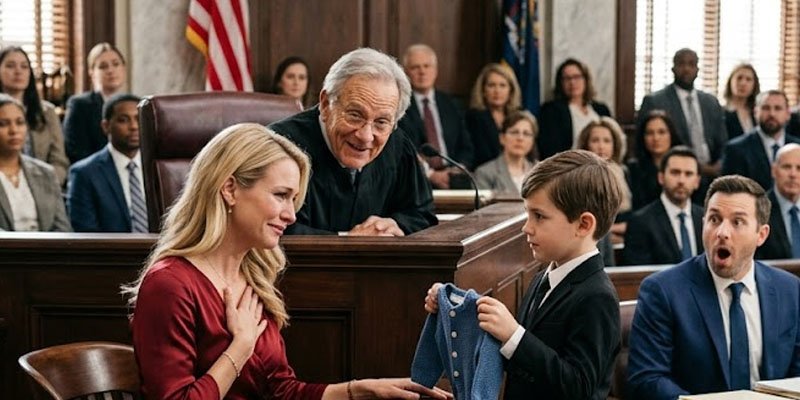
Then Nolan slowly stood up.
The unexpected movement caused Carroway to stop speaking in the middle of his sentence.
I reached toward my son.
“Nolan, please sit down.”
He quietly shook his head.
His ears had turned pink, and his hands trembled slightly as he gripped the bottom of his shirt.
“This is the shirt he’s talking about,” Nolan said.
The courtroom became completely silent.
Carroway tried to recover the moment.
“Your Honor, the child is understandably emotional, but—”
“Let him speak,” Judge Harlan replied.
Nolan looked directly at the judge.
“My mom bought this after working all night,” he said. “She thought I was asleep when she left it in my room, but I was awake.”
My chest tightened.
“She smiled because she knew how much I loved the moon,” Nolan continued. “Then she cried because she believed I couldn’t see her.”
I lowered my gaze.
For two years, I had tried to hide every difficult moment from him.
It turned out he had quietly witnessed every single one.
“My mom always gives me the better food,” Nolan said. “She tells me she isn’t hungry, even when she is. She helps me learn science even after she’s exhausted. She works because she wants me to have what I need, not because she wants to be away from me.”
Grant shifted uneasily in his seat.
Nolan lifted the bottom edge of his shirt.
“I wrote something inside it.”
Judge Harlan leaned forward.
“What did you write?”
Nolan looked back at me.
“Can I show him?”
The judge nodded.
A court officer walked over and gently folded the shirt’s lower seam outward.
Inside the shirt, written in slightly faded blue marker, were a few uneven words.
MY MOM MAKES OUR SMALL HOME FEEL LIKE THE WHOLE WORLD.
I covered my mouth.
I had washed that shirt countless times without ever noticing the message.
Judge Harlan silently read the words.
Then he looked toward Grant.
“Did you know your son had written this?”
Grant hesitated.
“I think I may have seen it once.”
Nolan’s face changed.
“Dad told me it was embarrassing.”
Grant immediately leaned toward his attorney.
Judge Harlan raised one hand.
“Mr. Bellamy, remain silent until you are addressed.”
What Grant Had Been Saying
Judge Harlan turned his attention back to Nolan.
“What did your father say was em.bar.ras.sing?”
Nolan looked down at his shoes.
“He told me to stop talking like we were poor.”
A quiet ripple of discomfort spread through the courtroom.
Grant finally spoke.
“That’s not what I meant.”
The judge’s expression became firmer.
“You were instructed not to speak.”
Carroway stood up.
“Your Honor, even if that comment was unfortunate, it does not erase the documented concerns about Mrs. Bellamy’s financial circumstances.”
He submitted rent records showing that three payments had been made late.
He also presented evidence of my changing work hours and the childcare arrangements involving my mother.
Then Judge Harlan asked a single question that shifted the entire direction of the hearing.
“Mr. Bellamy, were you paying child support during the months those rent payments were overdue?”
The confidence disappeared from Grant’s face.
Carroway answered before Grant could.
“There were disagreements regarding the payment schedule.”
“I asked Mr. Bellamy.”
Grant adjusted his tie.
“I had temporarily fallen behind.”
“For how long?”
“Approximately five months.”
I stared at him in complete disbelief.
Approximately.
As though those months had been dismissed as nothing more than a financial inconvenience instead of countless nights spent wondering whether the electricity would be shut off.
Judge Harlan shifted his attention toward me.
“Mrs. Bellamy, do you have documentation?”
I opened my folder.
My hands shook as I removed bank statements, child support records, and printed copies of our text messages.
One message from Grant stated:
You need to learn how to manage money instead of expecting me to solve everything.
My response said:
I am asking you to send the support Nolan is legally entitled to receive.
Judge Harlan reviewed every document with careful attention.
Carroway then presented an email intended to show that I had refused Grant’s offer to purchase new clothes for Nolan.
The printed exhibit included only my reply.
We do not need anything from you.
“This shows that personal pride is being placed ahead of the child’s needs,” Carroway argued.
I recognized the exchange immediately.
“That is not the complete email,” I said.
Judge Harlan looked at me.
“Do you have the full version?”
My phone was inside my purse.
I located the original email and handed my phone to the court officer.
Grant’s complete message read:
I will buy Nolan better clothes if you admit in writing that you cannot provide basic things for him. That admission could make the custody process easier.
My complete response read:
We do not need anything from you if your help comes with hum!liation. Send the support you already owe.
The judge’s expression immediately hardened.
“Mr. Carroway, the document you submitted omitted important context.”
Carroway briefly glanced toward Grant.
“I presented the materials my client provided.”
“Then I recommend reviewing future submissions much more carefully.”
For the first time that morning, Grant no longer looked confident.
My Mother Testified
Carroway called my mother to the witness stand.
Ruth walked forward wearing a navy-blue cardigan and the pearl earrings she always saved for important occasions. Her hands were folded tightly together, but her voice remained steady.
“You regularly care for Nolan while your daughter is at work, correct?” Carroway asked.
“I help care for him.”
“Would you say you are frequently his primary caregiver?”
“No.”
“But you cook his meals, supervise his homework, and stay with him while your daughter works evening shifts.”
My mother met his eyes.
“Helping my daughter does not replace her. It simply means our family supports one another.”
Carroway shifted to another approach.
“Do you become exhausted while caring for Nolan?”
“Of course.”
He nodded as though she had confirmed his point.
Then Ruth continued.
“My daughter gets tired too. Most parents get tired. Being tired does not prevent someone from being responsible, patient, or loving.”
Carroway’s smile faded.
“Wouldn’t Nolan be better off living in a home where the adults were less overwhelmed?”
My mother paused before answering.
“A larger house does not automatically create a kinder home.”
Even Judge Harlan appeared touched by her response.
Ruth explained our daily routine, Nolan’s school performance, his regular meals, and how Audrey—I—always checked on him every night, no matter how late I came home from work.
Before leaving the witness stand, she turned toward Grant.
“You keep focusing on everything my daughter cannot afford,” she said. “Not once have you talked about what your son is afraid of losing.”
The Truth Behind the Promises
During a brief recess, Nolan became unusually quiet.
I asked him what was bothering him.
After a moment, he admitted that Grant had promised him a larger bedroom, a brand-new bicycle, and even a puppy if he came to live at the townhouse.
That was not even the worst part.
Grant had also warned him that if he said anything negative during the hearing, the puppy would no longer be waiting for him.
When court resumed, I informed Judge Harlan.
The judge questioned Nolan gently.
“Did your father tell you that whether you received a puppy depended on what you said here?”
Nolan nodded.
“He said I should remember which house had a yard.”
Grant leaned forward.
“I was only trying to make him excited about spending more time with me.”
Judge Harlan’s voice became firm.
“A child’s love is not something to be bought, and his fears should never be used as leverage in a custody dispute.”
Grant lowered his gaze.
For years, he had always managed to make every explanation sound reasonable.
But inside that courtroom, his polished excuses finally stopped protecting him.
The Decision
Judge Harlan spent several quiet minutes studying the case file before finally addressing the courtroom.
Under the table, Nolan gripped my hand.
I could feel the slight shake in his fingers.
“This court does not judge a parent’s ability by designer clothing, the size of a home, or how polished someone appears professionally,” Judge Harlan said.
His eyes shifted toward Grant.
“Financial stability certainly matters, but it does not excuse harmful emotional behavior.”
He then looked directly at me.
“Mrs. Bellamy has worked long hours and faced significant financial challenges. The evidence also shows that many of those difficulties were intensified by delayed child support payments.”
Grant’s lawyer quietly lowered his pen.
“The child is healthy, doing well academically, deeply connected to his mother, and emotionally secure in her care.”
Judge Harlan raised the photograph of Nolan’s shirt.
“What was introduced as proof of parental neglect has instead become proof of sacrifice, devotion, and a child’s clear understanding of who has consistently cared for him.”
My eyes filled with tears.
“Primary custody will remain with Mrs. Bellamy.”
Nolan tightened his grip on my hand.
“Mr. Bellamy will be granted structured visitation after completing a court-approved co-parenting program. From this point forward, all communication will take place through the designated family application, and all unpaid child support will be reviewed without delay.”
Grant’s expression lost all color.
Carroway stood.
“Your Honor, we respectfully ask the court to reconsider—”
“The ruling is final.”
I leaned over and gently rested my forehead against Nolan’s hair.
“Can we go home now?” he asked softly.
“Yes,” I replied. “We can go home.”
Before we walked out, Judge Harlan addressed Nolan directly.
“Nolan, you showed remarkable courage today, but I want you to remember one thing.”
Nolan lifted his eyes.
“It was never your job to protect your mother. The adults should have listened much sooner, and you should never have felt responsible for defending the person who has always cared for you.”
Nolan gave a slow nod.
Outside the courtroom, my mother wrapped both of us in a long embrace.
She quietly cried against my shoulder.
“It’s over,” I whispered.
“No,” she answered softly. “The hardest part is over. Now your new beginning starts.”
The Home That Finally Felt Safe
Life was not suddenly perfect after the court hearing.
I still spent long hours at work.
The bills continued arriving.
Our apartment was still small, and the heater kept making strange noises on cold evenings.
But something inside our home was different.
We no longer lived with the constant fear that Grant could turn every financial hardship into evidence against me.
A few months later, the child support enforcement process allowed me to cut back on my evening cleaning jobs. I accepted a full-time administrative position at a local medical supply office with dependable hours and health insurance.
My mother began spending more time caring for her garden instead of arranging her entire schedule around my work shifts.
Nolan’s fascination with space never faded.
He covered the ceiling of his bedroom with glow-in-the-dark stars and often said that one day he would build a machine capable of reaching places no one had ever explored.
Eventually, the navy-blue shirt no longer fit him.
Nolan asked me not to give it away.
Together, we placed it inside a simple wooden frame, with the hidden message displayed beneath the embroidered moon.
MY MOM MAKES OUR SMALL HOME FEEL LIKE THE WHOLE WORLD.
We displayed it in the hallway.
As the years passed, guests would sometimes stop and ask about it.
Before replying, Nolan would always glance at me.
Then a smile would spread across his face.
“That was the day everyone realized a shirt could tell two completely different stories,” he would say.
He was completely right.
Grant’s lawyer had seen worn fabric, a stretched neckline, and a faint stain close to the bottom hem.
Nolan had seen a mother coming home after midnight with a small paper bag carrying twelve dollars’ worth of hope.
They had witnessed something that money could never buy.
My son had helped them understand what love had already placed in his life.
A parent’s worth should never be judged by the price of a child’s clothes, because genuine devotion, unwavering care, emotional stability, and the willingness to make sacrifices reveal far more than expensive brands ever could.
Struggling financially does not automatically mean a child will have an unhappy upbringing, especially when that child is raised in a home where questions are answered, fears are acknowledged, promises are kept, and love is never treated as something to bargain with.
Children may stay quiet while adults argue around them, yet they often notice much more than people imagine, including who consistently remains present, who continues making excuses, and who gives without expecting anything in return.
Even a modest home can offer tremendous security when the people living there provide patience, honesty, dependable routines, and the freedom to express emotions without fear of disappointing anyone.
True support should never come with humiliation, painful confessions, public embarrassment, or emotional debts, because real help protects a person’s dignity instead of using vulnerability to gain power or control.
Parents should never force children into the center of adult conflicts, because no child should feel responsible for taking sides, defending one parent, comforting the other, or carrying messages that belong only between adults.
A person who seems polished, accomplished, and self-assured may still fail to create emotional safety, while someone with far fewer resources may quietly build the most loving and secure environment a child could ever experience.
Speaking honestly can be intimidating when the other person has greater wealth, influence, or confidence, but carefully maintained records and calm truthfulness can eventually reveal everything appearances were meant to hide.
Healing does not always depend on forgiving every wrong or rebuilding every relationship, because sometimes healing simply means setting firm boundaries, protecting your peace, and no longer needing someone else to admit the harm they caused.
Love often leaves its evidence in the simplest moments—a packed lunch, a carefully mended sleeve, a handwritten note, or a kitchen light glowing late at night—and although those quiet signs are easy to miss, they can one day become the most powerful truth in the entire room.