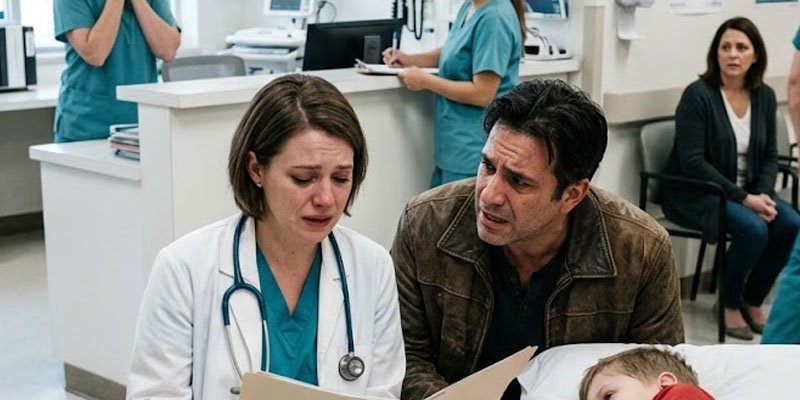
Noah dropped his eyes.
“I was bad.”
Those three words are something I will never forget.
Not because they were true.
But because he believed them with all his heart.
“I spilled some water,” he continued.
“I didn’t clean it up quickly enough. I fell asleep before I finished washing the dishes.”
Some people disguise cruelty with softer words.
They label fear as discipline.
They describe suffering as a lesson.
Yet children always know when something is deeply wrong.
As I reached toward his injured ankle, he instantly threw both hands over his head.
“Please don’t hit me,” he cried.
“I’ll be good now.”
That one sentence broke something inside me.
I had to step away for a moment just to calm the anger rising in my chest.
Then I came back.
I washed my hands.
I opened a new packet of bandages.
And I spoke the words he needed to hear more than anything.
“No one is going to hurt you here.”
At 6:18 p.m., I began documenting everything.
I took photographs of every injury.
I carefully recorded each bruise in the medical intake report.
I preserved the X-ray results.
I knew the truth needed more than feelings.
It needed proof.
At 6:47 p.m., I completed a medical incident report and documented every fact I was able to verify.
The bottles.
The coins.
The worn shoes.
The injuries.
The order in which everything had happened.
The truth would not disappear simply because someone influential wanted it to.
I offered Noah a bowl of soup from my lunch bag.
He ate with incredible caution.
Far too carefully.
Not like a hungry child excited to eat.
Like someone who believed the food might be taken away at any second.
When he finished the last spoonful, he looked into the empty bowl and softly asked if he should wash it.
That simple question stayed with me more than anything else.
A little boy who should have been asking for toys was asking permission simply to exist.
The waiting room remained quiet except for the steady rain tapping outside.
A small American flag stood beside the clipboard on the reception desk.
It was nothing more than a simple decoration.
Yet in that moment, it reminded me that ordinary places are supposed to be safe for everyone who walks through their doors.
Noah had never known that safety until he arrived at my clinic.
I carried him into the back room.
His forehead was burning with fever.
While he slept, he murmured words that made my hands shake.
“Don’t lock me inside.”
“Noah will listen.”
I remained beside him, watching my son sleep.
My son.
A little boy I had mourned for five long years even though he had been alive the entire time.
Then I picked up my phone.
The number was still saved after all those years.
The one I had promised myself I would never call again.
Michael answered almost immediately.
“Emma?”
I didn’t bother with a greeting.
“I found Noah.”
The silence that followed told me everything I needed to know.
Twenty minutes later, his SUV pulled up outside the clinic.
He hurried through the rain without an umbrella.
For the first time since I had known him, Michael Hayes looked frightened.
Not ashamed.
Not annoyed.
Frightened.
Part of me wanted him to understand what it truly felt like to lose everything.
For a brief moment, I considered leaving him outside.
I wanted him to stand in the cold.
I wanted him to experience even the smallest piece of what Noah had suffered.
But my anger would never heal my son.
So I opened the door.
“Come with me.”
He followed me into the back room.
Noah was sleeping.
One small hand rested beneath his cheek.
The other was curled beside his head.
As though even in sleep, he could never completely feel safe.
Michael slowly reached out toward him.
Noah flinched.
“Don’t hit me,” he whispered.
“Don’t lock me up.”
Michael stopped moving.
The room became completely silent.
The man who had once allowed his own family to separate us now stood before the little boy he had been meant to protect.
At that moment, he finally understood the cost of everything that had happened.
Because love is never measured by the promises people make when life is easy.
It is measured by the decisions they make when someone helpless is standing in front of them.
Noah slowly opened his eyes.
He looked at Michael.
Then he quietly whispered a single word.
“Daddy.”
Michael nearly lost his footing.
For five years, he had convinced himself everything had been handled.
That the decision made by his family had given Noah a better life.
Instead, the truth lay before him on a clinic bed.
The son he should have protected had learned fear long before he ever had the chance to learn trust.
The hours ahead would bring far more questions than answers.
There would be conversations that should have happened years earlier.
There would be evidence.
There would be painful truths about those missing five years that none of us were prepared to face.
But that night had started with a little boy walking through the rain carrying twelve dollars and a bag filled with empty bottles.
And it ended with a father realizing he had never truly understood what had happened to his own son.