PART 1 — THE THANKSGIVING BETRAYAL
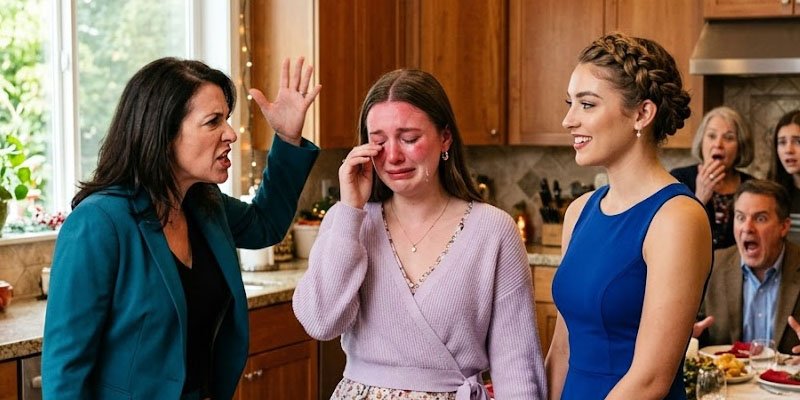
My mother’s hand struck my face without warning, and the entire Thanksgiving table instantly fell into silence.
For a few long moments, the only thing I could hear was the ringing in my ear. Gradually, the rest of the room came back into focus—the clatter of my aunt’s fork hitting her plate, my cousins staring in shock, and my father quietly looking into his wineglass as if nothing had happened.
On the opposite side of the table, my sister Vivian sat back with a pleased smile.
“Stop making this harder than it needs to be, Claire,” she said. “Daniel always belonged with me. You only ended up with him because I wasn’t interested.”
The engagement ring on my finger suddenly felt far heavier than it ever had before.
My mother stood over me, her face filled with anger.
“Vivian is finally ready to settle down,” she declared. “You know she and Daniel are meant for each other. He only picked you because she turned him away years ago.”
“Daniel asked me to marry him,” I answered.
Vivian let out a quiet chuckle.
“Only because I rejected him first.”
“That’s not how it happened.”
My mother lifted her hand once more.
Nobody stepped in to stop her.
Not my father.
Not my aunt or uncle.
Not even Grandma, who had spent years reminding me to “keep the peace” every time Vivian took something that belonged to me and insisted it was simply sharing.
Before Mom could slap me again, Daniel appeared in the doorway.
He still had on his navy coat, and his car keys were clenched in one hand.
“Lower your hand, Linda,” he said in an even voice.
The entire room went still.
Mom turned to face him.
“This is a private family issue.”
“I’m Claire’s fiancé,” Daniel replied. “That makes it my business too.”
The smile disappeared from Vivian’s face.
“Daniel, you’re making too much of this.”
He looked at her with disappointment instead of anger.
“You told me Claire already knew about this conversation.”
“She does,” Vivian insisted.
“No,” I said. “I came here believing we were having Thanksgiving dinner.”
Daniel walked over and stood beside me.
“Your mother invited me to come early so we could discuss what she called a reasonable solution,” he explained. “She told me you had agreed to end our engagement because you felt guilty for taking the future Vivian deserved.”
My stomach knotted.
Daniel went on. “I stayed in the hallway because I wanted to hear Claire say it herself. Instead, I heard what was really happening.”
Vivian pushed her chair back and stood.
“You know we had something together once.”
“We went on one date,” Daniel answered. “You left before it was over because another guy sent you a text.”
A quiet snicker escaped my cousin Tyler before he quickly lowered his eyes.
Daniel reached over and took my hand.
“Claire, we’re leaving.”
Mom pointed toward the front door.
“If you walk out now, don’t ever come back.”
I slowly looked around the table at every relative who had chosen to stay silent.
Then I turned back to my mother.
“Okay.”
For the first time in my life, I truly meant those words.
Outside, the cold November air brushed against my face. Somehow, it hurt far less than staying inside that house.
Daniel walked me toward his car.
Behind us, shouting filled the house. Vivian blamed Mom. Mom blamed me. Only after I was gone did my relatives finally begin asking questions.
Daniel stopped beneath the porch light.
“Claire, look at me.”
The moment he saw my face, his expression softened.
“I’m sorry.”
“You didn’t do anything wrong.”
“No,” he replied. “But I walked straight into their plan and almost became part of it.”
That was the moment I finally broke down in tears.
Daniel wrapped his arms around me as I stood in the driveway of the house where I had grown up, finally accepting that I had never truly felt safe there.
For years, I had found excuses for everything.
Vivian borrowed my clothes because she was supposedly more outgoing.
She got the bigger bedroom because everyone said she needed more privacy.
When she wrecked my first car, Mom told me I should forgive her because she was emotionally fragile.
When I was accepted to Northwestern while Vivian ended up on a waiting list at another school, Mom asked if I really needed to move so far from home.
I left anyway.
Maybe that was the first time I had truly chosen myself.
When we reached Daniel’s apartment, he made me a cup of tea and handed me an ice pack.
Meanwhile, my phone began filling with messages.
PART 2 — THE TRUTH IN THE YELLOW FOLDER
Grandma lived in a modest brick home with blue shutters about twenty minutes outside Chicago.
Daniel drove me there, then waited at a coffee shop nearby.
Before I even had the chance to knock, Grandma opened the front door.
She wore an expression I had rarely seen—calm, but deeply serious.
The inside of the house looked exactly as it always had: porcelain birds displayed on the mantel, carefully polished furniture, and family photos covering the hallway walls.
Yet that morning, I noticed something I had overlooked for years.
In nearly every photograph, Vivian stood front and center.
Most of the time, I was somewhere in the background behind everyone else.
Grandma noticed where I was looking.
“I owe you an apology,” she said quietly.
She guided me into the kitchen and poured us each a cup of coffee.
“I spent too many years telling you to keep the peace,” she said. “I convinced myself you were strong enough to handle the way your mother and sister treated you. But your strength was never a reason for them to treat you unfairly.”
I asked her why she wanted me to come.
“Because Thanksgiving wasn’t the first time your mother talked about giving Daniel to Vivian.”
She explained that two weeks before, Mom and Vivian had come to visit her.
They insisted that I had trapped Daniel because he had a reliable career and would make a good husband. Vivian claimed she had made mistakes but deserved another chance to have the life I was creating.
Grandma told them Daniel was a person, not something that could be handed from one sister to another.
Mom answered that, eventually, I would give in if the whole family kept pressuring me.
“So they planned all of this,” I said.
“Yes.”
“Did Dad know?”
Grandma lowered her eyes.
That told me everything.
“He knew they intended to confront you,” she admitted. “I can’t say whether he expected your mother to lose control.”
“But he still stood there and watched.”
“Yes.”
For years, I had believed my father was the kinder parent simply because he never raised his voice.
Now I realized that silence could be just as damaging.
Grandma set a yellow folder on the kitchen table.
My name was written across the tab.
Inside were bank records, printed emails, and a letter from a lawyer.
When I was sixteen years old, my grandfather passed away and left an education fund for each of his grandchildren.
Vivian spent her share on college tuition, rent for an apartment, and costs tied to a degree she never finished.
A portion of mine had already been taken out before I even turned eighteen.
“What is this?” I asked.
Grandma explained that Mom had convinced Dad to withdraw money from the account by insisting the family was dealing with a financial emergency.
She later discovered that part of those funds had gone toward Vivian’s pageant training and payments on a leased car.
“You knew?”
“I found out after it happened. I forced them to put some of the money back, but they never replaced all of it.”
While all of that was happening, I was earning scholarships, taking student loans, and working two jobs just to get through school.
Mom kept telling everyone that the missing money wasn’t important because I had always been so independent.
“I survived on instant noodles,” I said. “There were times I couldn’t even afford all of my textbooks. I honestly believed Grandpa had forgotten about me.”
“He never forgot you,” Grandma said softly. “He loved you very much.”
Learning the truth completely changed how I understood my childhood.
Every time I had been told Vivian needed more, it had really meant I was expected to settle for less.
Grandma had already spoken with her lawyer. She told me there could be legal options available, but the choice was entirely mine.
“What do you want me to do?” I asked.
“Nothing for my sake,” she replied. “I’m finally giving you the truth. What happens next is your decision.”
Daniel was waiting for me when I got back to the coffee shop.
After reading through the paperwork, he asked only one question.
“What do you want to do?”
No one in my family had ever asked me that before.
“I want to postpone the wedding,” I said.
His face remained calm.
“I’m not ending it,” I explained. “I love you. I just don’t want to begin our marriage while I’m still pretending none of this ever happened.”
“Then we’ll postpone it.”
No complaints.
No wounded ego.
Only support.
The following week, I retained an attorney named Melissa Grant.
Once she reviewed the documents, she recommended sending a formal demand letter.
Mom called me seventeen times after it was delivered.
Vivian accused me of being selfish and jealous.
My father left a voicemail insisting the money had belonged to the family and that they had simply done what was necessary.
I kept the recording.
Then I sent a single email to all three of them.
I informed them that, from that point forward, every conversation would go through my attorney. I would not discuss Daniel, the wedding, Thanksgiving, or the missing money unless there was accountability.
Vivian ignored that boundary and sent a message.
“Do you really think Daniel will stay once he realizes how cold you’ve become?”
Daniel answered her himself.
He told Vivian that he loved me exactly as I was and that her behavior had only reassured him he had made the right decision by never pursuing a relationship with her.
Then he instructed her never to contact me again.
Three months later, the financial dispute was resolved.
My parents agreed to repay every missing dollar along with interest.
My father signed a written statement acknowledging that the funds had been misused.
Mom signed only the settlement agreement.
Vivian insisted she had never known where the money had come from.
I believed that, at least in part.
Vivian had never been the type to question expensive gifts.
She simply expected them to appear.
PART 3 — UNAVAILABLE
By spring, the injuries on my face had healed, but I still had not spoken to my mother since Thanksgiving.
Then she showed up at my office.
I met her in the building lobby instead of bringing her upstairs.
“Claire,” she said.
“Linda.”
She winced.
“I’m your mother.”
“You can be Mom again when you start acting like one.”
She told me she had come to invite me to Easter.
I declined.
Mom lowered her voice.
“Vivian is having a hard time.”
There it was again.
Whenever Vivian suffered, it was treated like a crisis. Whenever I suffered, it was dismissed as drama.
“She lost friends after Tyler posted the video,” Mom said.
“She helped create what everyone saw.”
“She’s embarrassed.”
“I was publicly pressured to hand over my fiancé.”
“You’re making it sound much worse than it was.”
“It really was that bad.”
I gave my mother one clear opportunity to make things right.
“Say you’re sorry.”
For a brief second, I believed she actually might.
Instead, she replied, “I’m sorry you were hurt.”
I gave a small nod.
“Goodbye, Linda.”
Six months after that Thanksgiving, Daniel and I were married at a cozy lakeside inn in Wisconsin.
Only thirty-two guests were there.
Grandma sat proudly in the front row. Aunt Marcy attended after apologizing for staying silent. Tyler was there as well.
My parents and Vivian did not receive invitations.
Three days before the wedding, Dad mailed me a card.
Inside were only six words:
I am sorry I failed you.
I kept the card, but it did not change my choice.
Daniel cried as I walked toward him down the aisle.
During our vows, I promised that I would never mistake silence for peace again.
Daniel promised he would always stand beside me instead of in front of me—unless I asked him to shield a doorway.
One year later, Daniel and I hosted Thanksgiving in our apartment.
The turkey came out dry. The gravy had too much salt. The candles leaned slightly instead of standing straight.
But every person sitting around our table had chosen to be there without asking me to sacrifice anything.
At 6:15, my phone started ringing.
Mom.
I put the call on speaker and answered.
She wished me a happy Thanksgiving before telling me that she and Dad had separated.
He had moved out because he was exhausted from living with shame.
Vivian had moved back in with her.
Then Mom asked if Vivian could talk to Daniel because she wanted closure.
“No,” I answered.
“She needs to move forward.”
“She can write about it in a journal.”
Mom accused me of refusing to forgive.
“I’m not refusing forgiveness,” I replied. “I’m simply unavailable.”
The word felt clear.
Not angry.
Not spiteful.
Just unavailable.
Mom admitted she had no idea how to fix what had happened between us.
“You start by telling the truth,” I said. “No excuses. No focusing on Vivian’s feelings. Just the truth.”
After a long pause, she finally admitted it.
“I humiliated you in front of everyone.”
She then confessed that she had tried to pressure me into giving up my future because she believed Vivian deserved it more.
When I brought up the education fund, she fell silent again.
At last, she whispered, “I took it.”
She had convinced herself that I would be fine because I had always found a way to cope.
That belief had influenced my entire childhood.
The dependable daughter always received less because everyone assumed she could handle it.
I thanked Mom for finally being honest.
Then she asked if she could come over.
“No,” I replied.
She began crying.
“Not tonight,” I added. “Maybe someday, if you keep telling the truth without expecting forgiveness in return.”
After I ended the call, I looked around our imperfect Thanksgiving table.
Grandma reached over and squeezed my hand.
“Are you okay?” she asked.
“Yes.”
And I truly was.
Not because my family had suddenly become everything I needed.
Not because every apology had finally been spoken.
I was okay because I had finally stopped giving up pieces of myself just to keep everyone else comfortable.
I had learned that peace was not remaining in place while waiting for another wound.
Peace was recognizing when it was time to walk away.