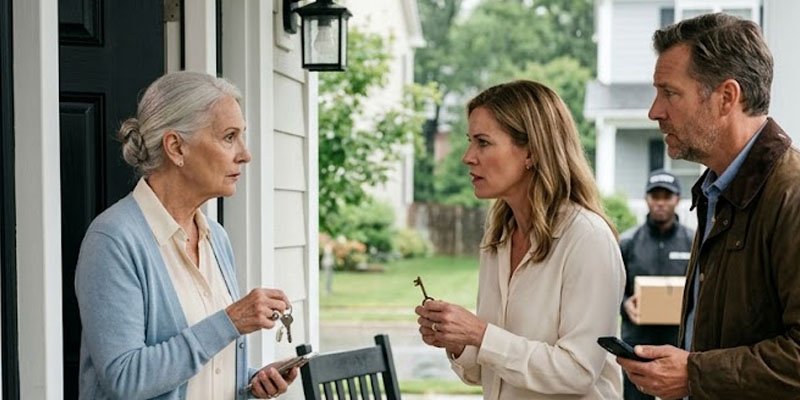
The afternoon I returned home and found my daughter-in-law standing on my front porch beside a contractor with a tape measure, ready to redesign my kitchen without saying a single word to me, I realized the spare key I had entrusted to her had stopped being a simple convenience—it had become permission she had quietly decided she possessed.
I had just finished working in the little garden behind my house and was heading back with dirt on my gloves and a basket filled with freshly picked basil when I noticed Clara on the porch. Her white SUV sat in the driveway with the engine off. Next to her stood a man wearing a work shirt, holding a clipboard with a tape measure clipped to his belt. He carried the relaxed confidence of someone who believed this was just another routine appointment.
Clara reached into her handbag.
Before the familiar old brass key appeared between her fingers, I already knew exactly what she intended to do.
For a brief moment I remained where I was, partly concealed by the hydrangea bushes bordering the walkway. The late-morning sun warmed the brick path beneath my feet. A robin hopped across the grass. Somewhere farther down the street, I heard the low hum of a garage door opening. It was a perfectly ordinary Thursday in Alder Creek Villas, the peaceful neighborhood just outside Columbus where I had lived for nearly twelve years.
And my daughter-in-law was moments away from unlocking my front door for someone I had never invited.
Not because I had requested it.
Not because I needed anyone’s assistance.
But because, somewhere along the way, Clara had decided that being family meant she no longer had to knock.
“Clara,” I called out.
She froze with the key suspended inches from the lock.
The contractor turned around before she did. Clara looked back more slowly, almost as though she wished she had imagined hearing my voice.
“Oh,” she said, forcing a cheerful smile. “Mom. You’re home.”
I had never truly liked hearing her call me Mom. It wasn’t that I disliked affection. In fact, I had wanted that connection. For years after she married David, I made every effort to build it gently. Birthday cards filled with handwritten notes. Homemade chicken soup after the twins were born. Babysitting whenever they needed me. Quiet support without asking for anything in return. Yet whenever Clara called me Mom, it never sounded warm. It sounded as if she believed the title gave her a certain authority over me.
“I live here,” I replied.
The contractor shifted his clipboard from one hand to the other.
Clara’s smile slipped for a moment before she quickly recovered it. At thirty-eight, she was slender, impeccably groomed, with honey-brown hair cut just above her shoulders and the kind of wardrobe that made even a grocery trip appear carefully planned. That morning she wore cream-colored slacks, a pale blue blouse, and sunglasses resting atop her head like someone arriving to supervise a remodeling project.
“I thought you were out with your walking group,” she said. “This was meant to be a surprise.”
“I can see that.”
The contractor cleared his throat. “Ma’am, I’m with Nolan Home Design. I was informed we’d be taking measurements for new kitchen cabinets today.”
“You were informed incorrectly,” I answered.
Clara let out a small laugh, the kind designed to make everyone else think someone else was overreacting. “It’s just a consultation. We’re not starting any work today.”
I walked up the porch steps and calmly positioned myself between them and my front door. I didn’t rush. I didn’t raise my voice. I didn’t reach for the key. I simply stood exactly where permission should have existed in the first place.
“My kitchen is not available for any consultation.”
Clara’s smile grew tighter. “We already talked about this, remember? You mentioned that the cabinet doors were sticking.”
“I said one drawer needed a little oil.”
“And I explained that the entire kitchen could be brighter and safer. David agrees.”
“My son does not own this house.”
The contractor lowered his gaze toward the clipboard.
A hint of color spread across Clara’s cheeks. “That’s not what I meant.”
“It’s precisely what you intended.”
Silence settled over the porch. The porch light beside my front door remained switched on because I preferred leaving it that way, even during daylight hours. My late husband, Robert, had installed it himself after I slipped on the icy front step one February evening. I could still picture him wearing his old Cleveland Browns sweatshirt with a screwdriver clenched between his teeth, insisting that no wife of his was going to break an ankle because a builder had tried to save money on outdoor lighting.
Robert had passed away three years earlier.
Yet the house still held pieces of him.
It remembered the oak dining table he refinished in the sunroom. It remembered the dent in the hallway from the afternoon he insisted on carrying a heavy bookcase by himself. It even seemed to remember the scent of his aftershave, which somehow lingered inside the linen closet long after he was gone. Every drawer, every lamp, every chipped blue mug remained exactly where I had chosen to keep it.
Clara saw a house that needed updating.
I saw the story of my life.
“I’m only trying to help you,” she said, her voice growing tighter.
“I never asked for your help.”
“You never ask anyone for anything.”
“That doesn’t give you the right to make decisions for me.”
The contractor quietly stepped backward. “Perhaps we should come back another time.”
“There won’t be another appointment,” I said as I turned toward him. “I’m sorry you were brought here under the wrong impression.”
His expression softened. “No problem, ma’am.”
Clara shot him an irritated look. “Just give us one minute.”
“No,” I replied. “You’re free to leave now. So is he.”
Her eyes met mine.
Something changed in that instant. I had seen Clara annoyed before. I had seen her impatient. I had even seen her put on exaggerated sympathy. But this was different. For the very first time, she understood that I wasn’t simply objecting out of politeness.
I was refusing.
“David is going to be very upset,” she warned.
“Then David can call me.”
She continued staring at me, the spare key still resting in her hand.
“Please return it.”
“What?”
“The spare key.”
Her fingers curled more tightly around it. “It’s for emergencies.”
“Exactly.”
“It’s safer if we keep it.”
“It’s safer when I know exactly who has access to my home.”
She parted her lips as if preparing to argue, then decided against it. Instead of handing me the key, she slipped it back into her purse and headed toward the driveway.
“Come on,” she called to the contractor, even though he was already halfway down the path.
I stood there and watched them leave without another word.
As Clara backed her SUV out of the driveway, she never once looked in my direction. The contractor lifted one apologetic hand from inside his truck before pulling away. Within moments, the neighborhood had returned to its usual quiet. The hydrangeas swayed softly in the breeze. A sprinkler began clicking two houses down the street. My basket of basil still rested where I had left it, its fresh leaves already beginning to wilt beneath the warm sun.
I unlocked the front door to my house and stepped inside.
The familiar scent of lemon furniture polish, aging books, and the cup of tea I’d left on the kitchen counter greeted me. Everything looked exactly as it had when I left that morning. Even so, for the first time since becoming an adult, I found myself standing in my own foyer feeling like a guest waiting for someone else to decide how my home should look.
My name is Ardis Whitaker. I am sixty-five years old, widowed, and retired after spending thirty-seven years working as a school librarian. I am fully capable of deciding for myself whether my kitchen cabinets need replacing.
That should never have been something anyone questioned.
After Robert passed away, though, people gradually began treating me differently. Not everyone did. My neighbors still called me Ardis. The women in my book club still wanted my opinions on novels, recipes, and local elections. Mr. Henderson, the manager of Alder Creek Villas, continued to see me as a resident perfectly capable of making my own decisions and signing my own paperwork.
David, however, was different.
The change didn’t happen all at once. He is my only child, and I love him with the complicated affection that many mothers continue to feel even when their adult children let them down. He had always been kindhearted, but conflict made him uncomfortable. As a little boy, he sided with whichever friend had spoken most recently. As a teenager, he avoided difficult conversations by lingering at basketball practice. As a husband, he seemed to believe that maintaining peace meant allowing Clara to define every issue while expecting everyone else to accept whatever she decided.
Clara herself hadn’t changed after Robert died.
She had simply become more confident.
At first, everything appeared thoughtful. She arrived with casseroles in disposable containers. She emailed me information about grief support groups. She offered to help write thank-you notes after the memorial service and stayed for three hours, although somehow my dining-room drawers had been reorganized while I was in the bathroom. When she and David asked if they could have a spare key “just in case,” I handed one over without hesitation.
At the time, “just in case” meant an accident, an illness, severe weather, or another genuine emergency.
It was never supposed to mean coming home and discovering my mail had been moved from the kitchen counter to the sideboard because Clara believed paper piles created “visual stress.”
It wasn’t supposed to mean finding my thermostat adjusted to seventy-two after I returned from Kroger, even though Robert and I had agreed years earlier that sixty-eight was the perfect sweater-weather temperature.
It certainly didn’t mean discovering the slippers I always kept beneath my bed neatly placed in the hallway because Clara insisted that “older people need fewer trip hazards,” delivering the comment with the absolute confidence of someone who had read a single article and adopted it as a personal philosophy.
The first few times it happened, I questioned myself.
That was the hardest part.
I stood in my kitchen holding my mail, wondering if perhaps I had moved it without remembering. I looked at the thermostat and assumed I must have changed it by accident. When I found my slippers in the hallway, I felt unsettled but convinced myself I was imagining things because the alternative was far more disturbing.
Who wants to believe that the people claiming to care about you are quietly removing your right to set boundaries in your own home?
The answer arrived because of my porch camera.
My neighbor, Bev Lawson, had encouraged me to install it after several packages were mistakenly delivered throughout the neighborhood. Bev was seventy-two, sharp as wintergreen, and never lacked an opinion, whether about the correct color of mulch or the decline of society caused by self-checkout lanes. Her nephew installed the small camera above my porch light, and for months I used it only to see when Amazon delivered my vitamins or when the twins ran up my front steps on Sunday afternoons.
Then, one evening, after realizing someone had alphabetized my spice rack despite clearly not knowing the difference between cumin and coriander, I opened the camera app.
There she was.
Not David.
Clara.
Clara arriving on Tuesday at 2:14 p.m., unlocking my front door with the spare key while carrying a tote bag. Clara returning Thursday at 10:07 a.m. and leaving with neatly folded towels she had apparently decided should be washed at her own house. Clara coming back the following Monday, staying for six minutes, and walking away with a stack of unopened mail, presumably intending to “organize” it.
The footage wasn’t dramatic.
That made it even more unsettling.
She walked through my home with the casual confidence of someone who considered it an extension of her own. She never hesitated, never glanced toward the camera, and never appeared to think she was doing anything wrong.
I sat in my favorite armchair, phone in hand, replaying each short recording while the late-afternoon sunlight stretched across the living-room carpet. Robert’s photograph rested on the mantel, showing him beside Lake Erie in his windbreaker, smiling as though the breeze had just shared a private joke.
“What would you do?” I asked the photograph.
Deep down, I already knew.
Robert had always been gentle, but he was never uncertain. He would have made a pot of coffee, invited David to the kitchen table, and calmly said, “Son, you don’t enter another adult’s home without permission. Not even mine. Especially not mine.”
I wished I could borrow his voice for just five minutes.
Instead, I decided to rely on my own.
The next morning, after returning from my walk, I noticed the front door standing unlocked.
My first feeling wasn’t fear.
It was irritation—steady, cold, and so precise that it almost brought me peace.
I quietly pushed the door open.
Clara was in my kitchen, putting groceries into my pantry.
She had brought reusable canvas bags from an upscale organic grocery store twenty minutes away, the sort of place where carrots still had dirt clinging to them and cost enough to make me wonder whether they had been serenaded with classical music while growing. She hummed softly as she unpacked almond flour, gourmet crackers, herbal tea, and three jars labeled adaptogenic broth.
She never heard me come in.
“Clara,” I called.
She turned toward me wearing the smooth, practiced smile of someone who had been expecting appreciation before I even arrived.
“Oh, hi, Mom. I was just bringing over a few groceries. You seemed tired last Sunday, and I figured grocery shopping might be getting to be a bit much.”
I stayed where I was in the doorway, still wearing my walking shoes. “I buy exactly what I need.”
“I know, but you always get the same things.”
“That’s because they’re the things I want.”
She let out a light laugh. “You’ve always been such a creature of habit.”
There it was once more. A comment wrapped in affection that really meant stubborn.
I walked over to the pantry and looked at everything she had already rearranged. My canned tomatoes had been placed on a higher shelf. My oatmeal had disappeared behind boxes of quinoa cereal. The peanut butter Robert had always loved—the same brand I still bought because some routines become a way of remembering someone—had been left sitting on the counter as though it no longer belonged.
“I don’t need anyone organizing my pantry.”
“I’m only trying to make things healthier for you.”
“Please take these groceries back with you when you leave.”
Clara stared at me.
For a brief instant, her pleasant smile disappeared completely. What replaced it was not hurt.
It was indignation.
“That’s actually pretty rude,” she said.
“No,” I replied. “It’s honest.”
“I drove all the way over here.”
“You live ten minutes away.”
She placed a jar onto the counter harder than she intended, then quickly composed herself again. “David and I have been talking. We both think this house is becoming too much for you. There are some really nice smaller places closer to us. They’re all on one level, recently updated, and you wouldn’t have to worry about yard maintenance.”
“This house is already one level,” I answered. “And the community takes care of the yard.”
“You know what I’m trying to say.”
“Yes,” I replied. “I do.”
She looked away first, confirming that she understood exactly what she had been implying.
The problem was never the house.
The problem was that my independence made her uncomfortable.
I removed every item she had put into the pantry and carefully packed each one back into the canvas shopping bags. I moved without rushing. Crackers. Tea. Broth. Flour. Every item settled into the bag with a quiet thud, as though each one added another piece to the boundary I was rebuilding.
“Please take these with you.”
Clara looked at the bags as though they had insulted her personally. “You’re making this incredibly awkward.”
“I’m fixing an awkward situation.”
Her phone buzzed on the counter. She glanced at the screen, then picked up the bags.
“Fine,” she said. “I’m leaving.”
I walked with her to the front door.
I didn’t offer to make tea. I didn’t tell her to drive carefully. I didn’t soften the moment with nervous small talk the way I would have the year before. I simply opened the door and waited.
As she stepped outside, she turned back toward me.
“David’s worried about you.”
“David is welcome to call me.”
Then I quietly closed the door.
David arrived later that evening.
Even before I saw the expression on his face, I knew Clara had asked him to come. He stood on the porch wearing his navy jacket over his work clothes, shoulders slightly rounded, both hands tucked into his pockets. He had inherited Robert’s dark eyes, but not Robert’s calm nature. Robert could stand inside discomfort without flinching, like a man calmly waiting beneath an umbrella during a storm. David preferred to walk around discomfort until someone else carried it instead.
I invited him inside because he had knocked first.
That mattered.
He sat down at the kitchen table while I prepared a pot of tea. His eyes quietly swept across the room, checking the pantry, the thermostat, the basket of mail, and every other place Clara had been unable to rearrange.
“Mom,” he said at last, “Clara was only trying to help.”
“I understand that’s the version she prefers to tell.”
He frowned. “Because that’s the truth.”
“No, David. Checking on me means calling first. Walking into my home without asking is not checking on me.”
He shifted uneasily in his chair. “We have a key.”
“That key is for emergencies.”
“What if you fell?”
“Then I would use the phone I carry with me on my walks or the one I keep beside my bed.”
“What if you didn’t have your phone?”
“Then you follow the emergency instructions taped inside the pantry door. They include the community office, Bev, and you. You know that because I gave you a copy.”
He pressed his fingers against his forehead.
I looked at him, and for a fleeting moment I saw the seven-year-old boy who had once sat at this very table with a skinned knee, insisting he didn’t need a bandage while crying over his peanut butter sandwich. That is one of the cruel truths of motherhood. Every version of your child stays with you forever, even when the grown version standing before you lets you down.
“Mom, Clara feels like you don’t appreciate her.”
“I feel like my privacy has been violated.”
“She’s busy. She’s raising the kids, taking care of the house, working, and she still tries to make time for you.”
“I never asked her to spend that time inside my house while I wasn’t there.”
He turned his gaze toward the window.
I let the silence settle between us.
That was something I had only learned later in life. Silence is not a void that has to be filled to ease someone else’s discomfort. Sometimes it is the only place where honesty can quietly exist.
After a while, David finally spoke.
“She thinks you’re pushing us away.”
“I’m refusing uninvited access.”
“You make it sound so official.”
“It is official,” I answered. “A front door is a boundary.”
He gave a tired laugh. “It’s only a house.”
His words landed heavily between us.
I set my teacup down.
“No,” I replied softly. “It isn’t only a house.”
David looked at me, and perhaps he remembered this was the place where his father built shelves in the garage, carved pumpkins with his grandchildren, cheered far too loudly during Ohio State games, and took his last breath one rainy morning in our bedroom while I held his hand and listened to the distant wail of the approaching ambulance.
Perhaps he remembered.
Perhaps he didn’t.
“This is my home,” I said. “It was your father’s last home. It holds my privacy, my routines, my memories, and my choices. You don’t have to understand every emotion I connect to it, but you do have to respect that it belongs to me.”
He swallowed hard.
For a brief, hopeful moment, I thought we might finally reach an understanding.
Then he said, “Clara’s going to be upset.”
There it was.
The quiet heartbreak inside my son’s marriage: Clara’s unhappiness was treated like a dangerous storm everyone had to prepare for, while mine was treated like unwanted clutter that should simply be pushed aside.
I rose from the table.
“Then Clara can deal with her feelings in her own home.”
David left about twenty minutes later, polite but clearly unhappy. At the door, he looked back at me and said, “I wish you’d make this easier.”
I almost answered.
Instead, I gave him the kind of look Robert always appreciated.
“Good night, David.”
After his car disappeared down the street, I went back to the kitchen table and spread out my bills.
For several months, David and Clara had been paying two small household expenses: the water bill and part of the electric bill. That arrangement started after Robert passed away. David insisted it made him feel helpful. At the time, I accepted because grief had drained me, and refusing kindness seemed ungrateful while people were dropping off casseroles and speaking to me in soft, careful voices.
But help that comes with expectations is not truly help.
It is leverage.
I signed into my utility accounts on my laptop. My reading glasses slipped lower on my nose as the kitchen clock continued ticking above the sink. I removed David and Clara’s bank account from the water bill, updated the electric payment information, and enrolled both accounts in automatic payments from my own checking account. Then I downloaded the confirmation receipts and saved them in a folder labeled Household — Paid by Ardis.
I had more than enough money. Robert and I had planned carefully for years. My pension arrived reliably. The house was fully paid off. My savings were well organized, my insurance policies were current, and every February I completed my taxes because I preferred finishing unpleasant tasks before the robins returned.
I didn’t need their financial help.
I had simply forgotten that for a little while.
Clara called the next day.
I let the phone ring twice before picking up.
“Ardis,” she said.
Not Mom.
That caught my attention.
“Clara.”
“Did you switch the utility accounts?”
“Yes.”
“Why would you do that?”
“Because I would rather manage my own bills.”
“We were only trying to help you.”
“I understand. I’m choosing not to accept that help anymore.”
A brief silence settled before her voice turned firmer.
“You’re making this far more difficult than it needs to be.”
“I’m simply being clear.”
“David and I were trying to help you save money. You’re retired now. You need to be cautious.”
“I am cautious.”
“You’re acting as though we’re trying to control you.”
I looked at the confirmation email still open on my laptop.
“Aren’t you?”
She inhaled sharply.
“I’m not going to argue about this,” I replied. “The accounts are in my name, and the bills come from my bank account. This discussion is finished.”
“You can’t just—”
“I can. Goodbye, Clara.”
I ended the call.
For a long moment, I sat there staring at my phone, waiting for guilt to wash over me.
It arrived, but only lightly. Familiar guilt. Learned guilt. The kind that appears simply because it always has, not because it truly belongs.
I made myself a cup of tea and waited until the feeling faded away.
Over the next week, the house felt different. It wasn’t completely peaceful because the disagreement still existed. Clara remained determined to prove she was right, and David was still too fearful of disappointing her. Even so, the house felt less crowded somehow. My mail stayed exactly where I left it. The thermostat remained set at sixty-eight. My slippers stayed neatly beneath the bed, exactly where respectable slippers belong.
I spent time working in the garden. I read my books. On Wednesday, I hosted book club, and Bev brought lemon bars that were much too tart, although nobody commented because Bev never handled criticism well when it was directed at her. We talked about a mystery novel and spent almost no time discussing my family, which was its own quiet act of kindness.
Then came the morning the contractor entered the picture.
Once Clara drove away, I realized that believing she had learned anything was not an actual plan.
Hope belonged with stained-glass windows and blooming spring flowers.
It had no value as a lock.
The following morning, I called a locksmith.
His name was Theo. He arrived in a red van with a dent in the bumper, while an old Motown station played softly from the radio. He looked to be in his thirties, wore a wedding band, had kind eyes, and kept a pencil tucked behind one ear. He replaced the deadbolt on the front door, changed the lock at the back entrance, and reset the garage keypad code.
The sound of the drill echoed throughout the quiet house.
I stood in the hallway holding Robert’s old mug with both hands. I wasn’t drinking from it. I simply needed something to hold. Normally the drilling noise might have unsettled me, but instead each turn of the drill felt like another full breath filling my lungs.
When Theo finished, he handed me two brand-new keys attached to a small silver key ring.
“Just these two?” he asked.
“Yes.”
“Would you like a few extra copies?”
“Not today.”
He nodded as though he understood everything I had chosen not to say. “These are solid locks. You’ll notice the difference.”
He was right.
The new key slid smoothly into the lock and turned with a firm, satisfying click. It was an ordinary sound, yet it was powerful enough to bring tears to my eyes.
For the three years following Robert’s death, I had lived with the constant knowledge that someone could let themselves into my home whenever they wished. I had never put that feeling into words because doing so would have meant admitting how deeply it unsettled me. Standing in the foyer with the new keys resting in my hand, I finally realized that privacy was never the opposite of love.
It was the structure that kept love from becoming possession.
Clara discovered the lock change less than an hour later.
My phone rang while I was dusting the hallway table.
It was David.
“Mom,” he said as soon as I answered, his voice tight with tension. “What happened to the locks?”
“I had them changed.”
“Clara says her key doesn’t work.”
“That’s correct.”
“Why would you do that?”
I looked toward the front door.
“Because Clara attempted to bring a contractor into my kitchen without my permission after repeatedly entering my home without being invited.”
“She was only trying to do something kind.”
“If it were truly kind, she would have asked whether I wanted it first.”
“She feels humiliated.”
“I’m sorry she feels that way.”
“Mom.”
“David.”
He let out a long sigh. “You don’t lock your family out.”
“I lock my home. Family members are welcome to knock.”
Silence followed.
Then he said, “You’re making it sound as though we’re strangers.”
“No. I’m reminding you that when you enter a house you do not own, you are guests.”
He began the same argument again. Emergencies. Concern. My age. My safety. The familiar list, carefully refined by Clara and repeated word for word by my son. I listened for about thirty seconds because he was still my child, and I wanted to see if a single independent thought might finally surface.
It never did.
At last, I said, “If there’s a genuine emergency, call me. If I invite you to my home, then come. Otherwise, do not arrive expecting to be let in. I’m not discussing this any further today.”
Before he had the chance to turn my decision into yet another debate, I ended the conversation.
The silence afterward felt immense.
For two full days, there were no phone calls. No text messages with links to supposedly helpful articles. No emails suggesting smaller houses. No photos from Clara of cabinet samples accompanied by notes saying, “just dreaming!” The peace I had wanted arrived so completely that, for a brief moment, it almost felt like abandonment.
That is another reality people seldom acknowledge about boundaries. Even when they are necessary, they can leave behind a chilly emptiness where unhealthy relationships once existed.
I chose to fill that emptiness with purpose.
I called Miriam and met her for lunch at a little diner where the waitress still called every customer sweetheart. I walked the long trail that circled the retention pond. I organized my sewing basket—not because Clara would have approved, but because I wanted the green thread somewhere easy to find. I bought a brushed stainless-steel kettle without asking anyone whether they thought it was too expensive.
On Sunday, the twins called using David’s phone.
“Grandma, did you change your door?” Lily asked. She was eight years old, endlessly inquisitive, and missing one of her front teeth.
“I changed the locks, yes.”
“Mom said it’s because you want privacy.”
“That’s correct.”
Ben leaned into the screen beside his sister. “Can we still come over for pancakes?”
I smiled. “Whenever you’re invited, absolutely.”
Lily paused to think it through. “That’s how it works at school too. You can’t just walk into the principal’s office.”
“Exactly.”
Somewhere off camera, I heard David clear his throat.
I didn’t soften the lesson.
Children often understand boundaries far better than adults who benefit from ignoring them.
By the following week, I was certain Clara expected me to call and apologize. I also knew she would try something else eventually. Maybe not because she genuinely wanted to visit, but because people who treat access as a source of control rarely surrender it without resistance.
So I made quiet preparations.
I scheduled a meeting with Mr. Henderson at the community office.
His office was next to the clubhouse, a neat brick building decorated with seasonal wreaths on the front door and a bulletin board covered with notices for water aerobics, bridge night, and a missing gray cat that was probably not missing at all—just enjoying meals at houses with better food. Mr. Henderson was a composed man in his late fifties with a carefully trimmed beard, wire-rimmed glasses, and the posture of someone who had settled countless disagreements over parking spaces, decorative mailboxes, backyard fences, and noisy pickleball games.
He listened without interrupting as I explained everything.
The spare key. The unauthorized visits. The mail being moved. The utility bills being paid. The contractor. The new locks.
“I’m not trying to create conflict,” I told him. “I simply want to ensure that the office, maintenance team, and community patrol understand that no one is to be given access to my house unless I personally approve it.”
Mr. Henderson nodded and brought up my resident file on his computer.
“That is completely reasonable.”
“I don’t want anyone to feel embarrassed.”
“Mrs. Whitaker,” he replied kindly, “people who respect your home won’t be embarrassed by being asked to wait outside.”
His words wrapped around me like a warm quilt.
He added a note to my resident record stating that no relatives or visitors were to receive access assistance without my direct authorization. He also gave me the afternoon patrol phone number and explained that they could include my street in their regular patrol route if I expected any problems.
“I hope it never comes to that,” I said.
“I hope not either,” he replied. “But it’s always better to have a plan you never need than to need one you never made.”
Robert used to say something very similar about checking tire pressure and keeping flashlights ready.
I walked out of his office feeling noticeably lighter.
Not because the problem had disappeared, but because someone outside my family had treated my right to privacy as completely reasonable. There is a unique comfort in hearing a stranger validate something your loved ones have repeatedly made you question.
The final confrontation came on a Thursday.
The rain had cleared earlier that morning, leaving the streets of Alder Creek clean and gleaming. I had just brought a small parcel inside when there was a knock at the door.