
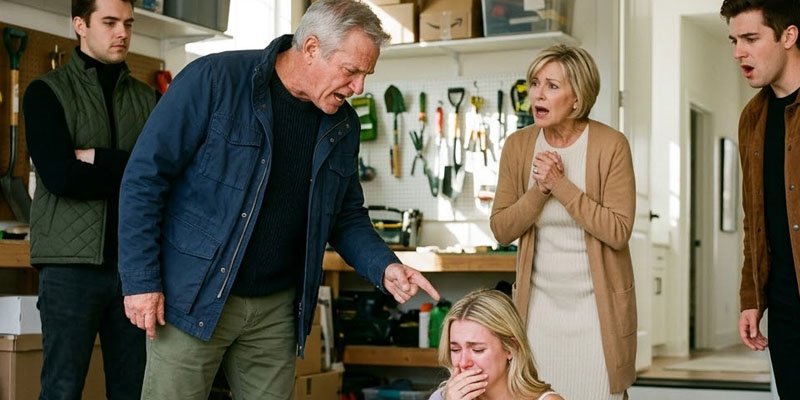
My daughter left me a voicemail that lasted only six seconds.
“Dad… the garage… please.”
That was it.
No sobbing. No details. Just a fragile, strained voice, as though she was terrified someone might hear her.
I tried calling back three times while driving across Columbus, Ohio, but every attempt went straight to voicemail. My grip on the steering wheel was so tight my knuckles had turned completely white. Emily had married into the Whitmore family a year and a half earlier. From the outside, they seemed like the perfect family: a beautiful home, regular churchgoers, confident handshakes, and flawless smiles. But I had watched my daughter slowly change. She apologized before speaking. Her laughter had become faint. And her husband, Garrett, always spoke on her behalf.
When I reached their house, warm golden light spilled from the windows. Looking through the dining room, I saw five people gathered around the table: Garrett, his parents, his sister, and her husband. They were calmly eating roast chicken as though it were just another ordinary Thursday evening.
I didn’t bother knocking.
Garrett’s mother, Patricia, noticed me first. Pearls rested around her neck, and she greeted me with an untroubled smile.
“Robert,” she said casually, as though I had simply arrived a little early for dessert. “Emily’s being dramatic again.”
I ignored her.
Garrett shoved his chair backward and stood. “You can’t just come into my house.”
“My daughter called me,” I replied.
“She’s perfectly fine,” Patricia answered without losing her smile. “She locked herself in the garage after a small disagreement.”
A small disagreement.
I walked right past her.
Garrett reached out and grabbed my arm. I slowly turned and stared at his hand until he released it.
“Open it,” I said.
He stayed where he was.
That silence told me everything I needed to know.
I walked through the kitchen, down the short hallway, and reached the garage entrance. A heavy metal storage shelf had been shoved against the door from the outside, with stacked boxes bracing it in place. My stomach sank.
Behind me, Patricia said, “She just needed time to cool down.”
I hurled the boxes aside. One burst open, scattering old tax documents across the floor. Garrett started yelling. His father, Malcolm, demanded that I calm myself. I forced the shelf aside and pulled the garage door open.
The first thing that hit me was the smell: gasoline, dust, and sheer terror.
Emily lay on the concrete beside the lawn mower. Her wrists were secured behind her back with zip ties, and a strip of duct tape hung loose from one side of her face. Her left eye was swollen almost completely shut. A dark red mark circled her neck. The side entrance to the garage had been secured with a padlock from the outside, and the remote starter for the car rested on the workbench beside Garrett’s keys.
For a brief moment, no one said a word.
Then Emily quietly whispered, “He said nobody would believe me.”
I pulled out my phone and dialed 911.
Over the next twenty minutes, Garrett Whitmore, Patricia Whitmore, and Malcolm Whitmore would discover just how mistaken they had been.
The dispatcher asked whether anyone there was in immediate danger.
I looked at Garrett standing in the garage doorway, his face pale with anger, his hands repeatedly clenching into fists.
“Yes,” I answered. “My daughter has been assaulted, tied up, and locked inside a garage. Three adults are involved. Send police and an ambulance immediately.”
Patricia’s pleasant smile disappeared at last.
“Robert, you’re making this bigger than it is,” she said sharply. “You don’t understand how she behaves. She gets emotional. She threatens things. We were only trying to keep her safe from herself.”
Emily recoiled the moment she heard Patricia speak.
That tiny reaction awakened something icy inside me.
I knelt beside my daughter while keeping the dispatcher on the phone. “Stay as still as you can, sweetheart. Help is on the way.”
Her lips shook. “Dad, I tried to leave.”
“I know.”
“He took my phone away. I only got it back after they went inside. I had just enough time.”
“I know,” I repeated, because saying anything more would have shattered me.
Garrett stepped farther into the garage.
“Emily, tell him what really happened.”
I stood up.
He froze.
I wasn’t an imposing man in the cinematic sense. I was sixty-one years old, retired after thirty-two years with the Franklin County Sheriff’s Office, living with aching knees and reading glasses tucked into my shirt pocket. But I had spent decades facing men who believed locked doors gave them absolute control.
Garrett saw something in my expression and instinctively stepped backward.
“Don’t come any closer,” I warned.
Malcolm moved up behind him. “This is a private family issue.”
“No,” I replied. “The second I opened that garage door, it became a crime scene.”
Patricia let out a short, bitter laugh. “A crime scene? Don’t be ridiculous. She bruises easily.”
Emily made a quiet sound, as though the words had struck her all over again.
The dispatcher remained connected. I gave the exact address and described every detail: Emily’s injuries, the restraints, the blocked garage door, the padlock, the remote starter, Garrett’s keys, and every individual inside the house. While talking, I photographed everything—the zip ties, Emily lying on the floor, the shelf blocking the door, the padlock, the remote starter, and Garrett’s keys.
Garrett suddenly lunged toward my phone.
I shifted, grabbed his wrist, and shoved him backward into the washing machine with enough force to make the detergent bottles shake.
“Lay another hand on me or my daughter,” I said, “and tonight you’ll be answering for far more than domestic violence.”
Garrett’s sister, Lauren, burst into tears in the kitchen. Her husband quietly muttered, “Garrett… what have you done?”
Garrett spun toward him and shouted, “Shut up!”
That was the moment Emily finally spoke loudly enough for everyone to hear.
“He was going to start the car,” she said.
Silence swallowed the garage.
Patricia quietly breathed, “Emily.”
My daughter met her gaze with her one uninjured eye.
“You told him to wait until after dinner.”
The sound of approaching sirens echoed outside.
For the first time since I arrived, fear crossed Garrett’s face.
I heard tires stop at the curb, vehicle doors slam, and police radios crackle. Red and blue lights flashed across the garage walls.
When the first officer stepped inside, I immediately raised both hands.
“I’m Robert Hale,” I said. “I’m the one who called. My daughter is the victim. That man is her husband.”
Emily lifted her shaking hands and pointed.
“Him,” she said. “And them.”
The first officer to enter the garage was Officer Denise Alvarez, a young police officer. I knew she was young not because she lacked experience, but because she still carried herself with the kind of purpose that comes from believing in the badge. Her eyes moved from me to Emily and finally to the zip ties securing my daughter’s wrists.
Her expression hardened instantly.
“Sir, please step away from the victim,” she instructed.
I stepped back without hesitation.
Emily reached toward me with her restrained hands, but I gently shook my head.
“Let them help you, sweetheart.”
Officer Alvarez knelt beside her.
“Ma’am, my name is Officer Alvarez. Can you tell me your name?”
“Emily Hale Whitmore,” she answered softly.
“Emily, besides your face, are you injured anywhere else?”
“My ribs,” she whispered. “My throat. My wrists.”
An older officer, Sergeant James Porter, walked in behind Officer Alvarez with another patrol officer. In an instant, the garage felt tighter, packed with uniforms, fear, and the reality that everyone in that house had spent the evening trying to hide behind a family dinner.
Sergeant Porter fixed his eyes on Garrett. “Are you the husband?”
Garrett lifted his head confidently. “Yes, and this whole thing is being exaggerated.”
“Keep your hands where I can see them.”
Garrett parted his lips as if to argue, but no sensible words came. Slowly, he raised both hands.
Patricia stepped forward, trying to regain control of the situation. “Officer, my son is a respected financial adviser. This girl has emotional problems. She attacked him earlier, and we only restrained her because she was unstable.”
Emily closed her eyes.
I had heard that kind of voice before.
Not Patricia’s specifically, but the voice of people like her.
Calm. Refined. Dangerous.
The kind that disguises cruelty as concern.
Sergeant Porter showed no sign of being convinced. “Ma’am, go wait in the kitchen.”
“I beg your pardon?”
“The kitchen. Now.”
Malcolm gently touched Patricia’s shoulder. “Let’s cooperate.”
But the calm in his voice didn’t match his eyes. His gaze kept moving around the garage, silently counting every piece of evidence that could destroy them—the storage shelf, the stacked boxes, the padlock, the zip ties, and the remote starter resting on the workbench.
A paramedic arrived and carefully cut the zip ties from Emily’s wrists. The skin beneath them was swollen, raw, and dark purple. Once her hands were free, she didn’t burst into tears. Instead, she folded inward, like someone expecting another attack at any moment.
That was when I almost lost my composure.
Not after hearing the voicemail.
Not when Garrett stood in my way.
Not even when I found Emily lying on the floor.
It was watching my daughter be terrified of freedom.
I turned toward the wall and focused on it until the burning anger clouding my vision finally eased.
Officer Alvarez spoke gently. “Emily, can you tell us what happened tonight?”
Emily looked directly at Garrett.
Garrett smiled at her.
It was barely noticeable, but I caught it.
Officer Alvarez did too.
“Emily,” she said softly, “he doesn’t get to control your answer anymore.”
Emily swallowed hard.
“I told Garrett I wanted a divorce,” she began. “I packed a suitcase while he was still at work. Around five-thirty, his mother came over. I thought she wanted to help. Instead, she said we should all sit down and talk before I ruined my life.”
Patricia shouted from the kitchen, “That isn’t what I said.”
Sergeant Porter turned toward her. “Ma’am, interrupt again and you’ll be detained.”
Emily continued. Her voice trembled, but she kept speaking.
“Garrett came home early. His father came with him. They took my car keys first, then my phone. Garrett kept asking who I had told. I said no one yet. Then he slapped me. I tried to leave through the front door, but Malcolm stood in front of it.”
Malcolm’s expression hardened. “I never laid a hand on her.”
Emily looked at him.
“No,” she replied. “You just made sure he could.”
That sentence struck the room harder than any raised voice.
Officer Alvarez asked, “How did you end up in the garage?”
Emily wrapped the blanket tighter around herself.
“Garrett dragged me there. Patricia brought the zip ties from the junk drawer. She said I was humiliating the family. Malcolm shoved the storage shelf in front of the garage door after they locked me inside.”
“That’s not true,” Patricia snapped.
But the confidence had disappeared from her voice.
The paramedic examined Emily’s neck.
“She needs to go to the hospital,” he said. “Possible strangulation injuries. Bruised ribs. Facial trauma.”
The moment Sergeant Porter heard the word strangulation, his jaw tightened.
He faced Garrett.
“Turn around.”
Garrett frowned. “What?”
“Turn around. Put your hands behind your back.”
“For what? You haven’t even heard my side.”
“We have enough to detain you while we investigate. Turn around.”
Garrett glanced toward his father.
Malcolm avoided his eyes.
That was the first betrayal Garrett clearly hadn’t expected.
The patrol officer secured handcuffs around Garrett’s wrists.
The sharp metallic click echoed through the garage.
Patricia screamed.
“You can’t arrest him! She’s manipulating all of you!”
Officer Alvarez stood.
“Patricia Whitmore, did you provide the zip ties that were used to restrain Emily?”
“I didn’t restrain her.”
“That wasn’t my question.”
Patricia’s face went completely rigid.
Sergeant Porter stepped toward the kitchen entrance.
“Malcolm Whitmore, Patricia Whitmore, come into the garage.”
Lauren, Garrett’s sister, had been standing near the stove with both hands covering her mouth. Her husband, Eric, looked pale and visibly shaken.
“Lauren,” Sergeant Porter asked, “did you witness anything before officers arrived?”
Lauren shook her head almost immediately.
Eric spoke instead.
“We got here around seven. Emily wasn’t at the dinner table. Patricia told us she was upstairs resting.”
Patricia spun toward him.
“Eric.”
He took a step backward.
“No. I’m not lying for this.”
Lauren broke down crying.
“Mom told us not to ask questions.”
Sergeant Porter listened without changing his expression.
He pointed toward the workbench.
“Whose keys are these?”
Garrett remained silent.
Emily answered.
“They’re Garrett’s.”
The sergeant carefully picked up the keys while wearing a glove. Hanging from the key ring was the remote starter for Garrett’s sedan, parked only a few feet away inside the garage. The vehicle wasn’t running, but the meaning behind it filled the room like smoke.
Officer Alvarez asked, “Did he threaten to start the car?”
Emily nodded.
“He said accidents happen. He told me that if I wanted to leave him that badly, I could leave everyone.”
My chest tightened.
For a brief moment, I was twenty years younger again, teaching Emily to ride a bicycle in an empty school parking lot.
She had fallen twice and scraped both knees.
She looked at me through angry tears and said, “Don’t help me unless I ask.”
So I stayed beside her without touching the bike, letting her wobble until she found her own balance.
Now she was sitting on a garage floor with bruises around her neck because I had mistaken silence for independence, privacy for safety, and politeness for peace.
I had noticed the warning signs.
Of course I had.
A lunch she suddenly canceled.
Long sleeves in the middle of July.
Garrett answering her phone.
Patricia constantly correcting Emily whenever she spoke.
Emily saying, “It’s not that bad,” while her eyes silently begged me not to ask more questions in front of him.
And I waited.
Because she was an adult.
Because I didn’t want to push her away.
Because every parent of a grown child eventually learns how painful it is to stay close without interfering.
But standing there that night, staring at the remote starter in Sergeant Porter’s gloved hand, I made myself a promise.
I would never again mistake patience for helplessness.
The officers separated everyone.
Garrett was placed in the back of a patrol car, still yelling through the closed window. Patricia was handcuffed after angrily admitting that she had “only brought the ties so Emily wouldn’t hurt anyone.” Malcolm was also detained after Eric confirmed he had watched Malcolm move the storage shelf away from the garage door just before I arrived, then push it back when Garrett instructed him to.
Three people ended the night in handcuffs.
Not because I attacked anyone.
Not because I threatened anyone.
Not because I became the violent man Garrett expected me to become.
Because I opened the garage door, called 911, preserved the evidence, photographed the scene, kept Emily alive, and refused to let a wealthy family dismiss abuse as nothing more than family drama.
At the hospital, Emily finally cried.
It happened after the CT scan.
After the nurse photographed every injury.
After Detective Monica Vance quietly asked her careful questions in a private room.
Emily had stayed remarkably strong for hours.
Too strong.
The kind of strength that is really shock pretending to be courage.
When Detective Vance stepped outside, Emily looked at me from her hospital bed.
“I’m sorry,” she whispered.
That hurt me more than anything else that night.
I sat beside her and gently took her hand, avoiding the bruises around her wrist.
“No,” I said. “You never apologize for surviving.”
“I should have told you sooner.”
“You told me as soon as you were able.”
“I thought I could fix it.”
“I know.”
“I believed if I loved him enough, he’d stop being angry.”
I closed my eyes.
Some sentences no father should ever have to hear.
That was one of them.
“Emily,” I said quietly, “his anger was never your burden to carry.”
She stared up at the ceiling while tears slipped into her hair.
“Patricia kept telling me marriage is hard for everyone. She said women in their family don’t run away when things get difficult.”
“Patricia will have plenty of time to explain those family values to a judge.”
Emily almost smiled.
Almost.
The legal proceedings stretched on for months.
Garrett’s lawyer tried every possible defense.
He claimed Emily was emotionally unstable.
He argued the zip ties were used for her own safety.
He insisted the blocked garage door was an accident.
He claimed the remote starter meant nothing.
He argued that family disagreements should not become criminal cases.
But evidence does not bend.
The photographs showed Emily restrained on the garage floor.
Medical records documented bruises around her neck from strangulation, injured ribs, and trauma consistent with assault.
The 911 recording captured Patricia saying Emily had been “dramatic again,” while Malcolm referred to it as “a family matter.”
Eric gave a formal statement.
Eventually, Lauren did as well, admitting she had heard Garrett threaten Emily before and that both of her parents had repeatedly pressured Emily not to “embarrass” him.
The strongest evidence came from the house itself.
Investigators discovered a security camera mounted above the back porch that Garrett had completely forgotten existed. It did not capture the inside of the garage, but it clearly recorded Patricia arriving with Malcolm before Garrett returned home. It showed Emily attempting to leave through the side gate carrying a duffel bag. It showed Garrett snatching the bag from her and tossing it into the bushes. It showed Malcolm stepping in front of Emily to block her path while Patricia gestured toward the garage.
There was no sound.
There did not need to be.
Rather than risk going to trial on every charge, Garrett ultimately accepted a plea agreement. He admitted guilt to domestic violence, unlawful restraint, assault, and attempted intimidation. The strangulation-related charge carried significant consequences under Ohio law, and the judge made it clear that the court did not view the incident as merely a private family dispute.
Patricia pleaded guilty to unlawful restraint and obstruction. She wept during sentencing, but not because of Emily. She cried because members of her church were seated in the courtroom and because the local newspaper had published the Whitmore family name.
Malcolm pleaded guilty to complicity and obstruction. He spoke only once, saying that he had simply been trying to “keep the family together.”
The judge looked down from the bench before replying, “Families are not kept together by trapping people in garages.”
Garrett was sentenced to prison. Patricia and Malcolm received shorter sentences, probation, mandatory counseling, and no-contact orders. It was not flawless justice. I had lived long enough to understand that justice almost never feels as complete as people imagine. But it happened in public. It was officially recorded. It was real.
Emily moved into my home for six months.
At first, she could only sleep with the bedroom light left on. A car door slamming outside made her flinch. She apologized for using too many towels, for eating the last banana, for crying over breakfast, and even for not crying when others expected her to.
Little by little, those apologies became less common.
She began attending therapy twice each week. She cut her hair to shoulder length because Garrett had always wanted it long. She changed her phone number. She found a new job at a pediatric dental office where no one knew the Whitmore family. Every Sunday, we made pancakes, even on mornings when neither of us actually wanted pancakes, because routines can become the rope that helps someone climb out of darkness.
One morning in April, I found her standing in the garage.
My garage.
For a brief moment, my heart nearly stopped.
She was beside an old workbench holding a cardboard box marked “Emily — College.” Inside were photographs, notebooks, a cracked softball trophy, and a blue ceramic mug she had made in seventh grade.
She looked at me and quietly said, “I wanted to see if I could stand in here.”
I remained close to the doorway. “Can you?”
She inhaled deeply.
Then took another breath.
“Yes,” she answered. “I think I can.”
I simply nodded because I could not find any words.
She lifted the small trophy and laughed. “I was terrible at softball.”
“You were aggressive.”
“I struck out in every game.”
“You struck out with confidence.”
This time, the laugh sounded like the one I remembered.
That was the first moment I truly believed she would do more than survive everything she had been through. I believed she might actually become herself again.
A year later, Emily rented a small apartment only ten minutes away from me. She painted the kitchen bright yellow, adopted a one-eyed orange cat named Biscuit, and enrolled in evening classes for social work. She told me she wanted to help women who had experienced what she had, although she knew she needed more healing before she could do that.
I helped her carry boxes up two flights of stairs.
When we finished, she handed me a glass of tap water and leaned against the kitchen counter.
“Dad,” she asked, “do you ever think about what would have happened if you hadn’t listened to that voicemail?”
I did.
Every single night.
I thought about those six seconds. About those three words. About how close silence had come to becoming permanent.
But I refused to place that burden on her.
“I think about how smart you were to make that call,” I said.
Her eyes filled with tears, but she smiled. “I wasn’t sure you’d understand.”
“I heard the word ‘garage,'” I replied. “That was enough.”
She glanced toward the window where the late afternoon sunlight stretched across the floor of her new apartment.
“For so long,” she said, “I believed nobody would ever believe me.”
“I believed you before I even knew the whole story.”
She turned and looked back at me.
That was the truth.
I never needed photographs to believe my daughter. I did not need bruises, recordings, witnesses, or police reports. Those things were important in court. They mattered for charges, convictions, and sentencing.
But belief came first.
Belief was what carried me past Patricia’s smile. Belief was what made me push that shelf aside. Belief transformed a six-second voicemail into sirens, arrests, hospital records, courtroom hearings, and eventually, a yellow kitchen where a one-eyed cat slept peacefully in a patch of sunlight.
Emily still has difficult days.
So do I.
Sometimes she calls me simply to talk while walking from her car to her apartment. Sometimes I drive past her building at night—not because she asks me to, but because fathers are not always rational. She pretends she doesn’t notice. I pretend I don’t know that she does.
We have both discovered new ways to be truthful.
The Whitmores lost the polished image they had carefully maintained. Their house was sold. Garrett’s professional license was suspended. Patricia stopped attending the church where she had once smiled from the front pew. Malcolm wrote Emily a letter that her attorney returned unopened.
Emily kept only one thing from that chapter of her life: the voicemail.
She first saved it under a filename that tightened my throat the first time I saw it.
“Proof I Asked.”
Several months later, she renamed it.
Now it is called, “Proof I Got Out.”
And whenever my phone rings, I answer it.