
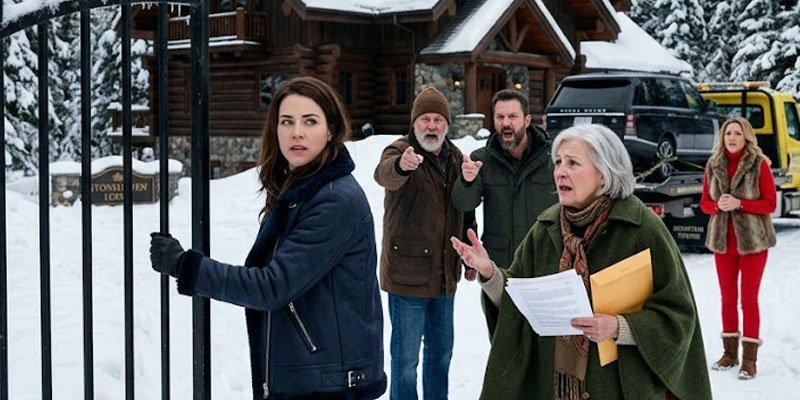
For the first time in more than a decade, Megan Holloway woke to a silence that belonged solely to her.
There was no worn-out furnace clanging beneath her aunt’s basement floor. No cousins pounding on the bathroom door. No phone vibrating with requests for money disguised as emergencies. There were only towering pines, crisp mountain air, and the gentle sound of the creek flowing behind the cabin she had finally bought in Briar Ridge, Colorado, with savings she had protected as though they were a secret.
The cabin was simple yet solid, featuring two bedrooms, a stone fireplace, a wraparound porch, and a black wrought-iron gate at the bottom of the private gravel driveway. The property deed listed only one owner.
Megan Holloway.
On the second evening after moving in, she sat on the porch in thick wool socks, cradling coffee in a worn blue mug when her phone screen lit up.
The message was from her cousin Darren.
“We’re bringing the whole family this weekend. Aunt said you owe us space.”
Megan read the text once.
Then she read it again.
A second message appeared moments later.
“Don’t make this awkward. We’ll need both bedrooms. The kids can sleep wherever. Aunt Ruth says after everything she’s done for you, that cabin is basically family property.”
Megan gazed through the porch railing toward the distant lights shining near the entrance gate. For years, the word “family” had meant her salary paying Ruth’s property taxes, Darren’s unpaid truck loan, Melissa’s childcare bills, and Uncle Frank’s medical co-pays while Megan herself lived behind a curtain in an unfinished basement instead of having a real room.
She smiled.
Then she chose not to respond.
Instead, she stepped inside, opened the folder waiting on the kitchen table, and carefully reviewed the documents she had prepared before relocating. The agreement with the security company. The private-road access contract. The posted no-trespassing notices. The certified letter that had been delivered to Ruth’s house two weeks earlier, clearly stating that no family member had permission to enter, stay, store belongings, park vehicles, or claim any type of residency on Megan’s property.
At exactly 5:42 the next morning, headlights appeared beyond the gate.
By the time the sun rose, three cars and a rented passenger van were parked haphazardly outside the locked entrance. Darren yelled into the intercom. Melissa filmed herself while crying. Aunt Ruth, bundled in a fur-trimmed coat, jabbed her finger repeatedly at the keypad.
The access code had been disabled.
At 7:10, two tow trucks arrived behind them.
At 7:25, a sheriff’s deputy stepped out of his patrol vehicle and handed Ruth a folded legal document. It was not an eviction notice from the cabin because none of them had ever entered the property. It was an official order directing them to leave the private road immediately or face trespassing charges.
Ruth’s hands shook as she looked over the paperwork.
From the porch, Megan watched quietly as the porch light glowed behind her and steam drifted upward from her coffee into the chilly morning air.
Megan’s mother, Claire, passed away when Megan was seventeen. Since the court would not allow a minor to live independently, Ruth took her into her home. Only two months after Megan turned eighteen, Ruth started charging her rent. Megan spent her mornings working at a diner, her evenings at a pharmacy, and her weekends cleaning vacation rentals. Ruth insisted she was simply “teaching responsibility.”
At the bottom of the email, Ruth had written:
“I am willing to forgive today’s embarrassment if you sign a family-use agreement. This will allow relatives to visit the cabin on major holidays and selected weekends. No one should have exclusive control over something that could benefit everyone.”
A document was attached.
Megan opened the attachment and read just enough to understand exactly what Ruth wanted.
Ruth was asking for permanent access. She wanted a shared reservation calendar, permission to bring guests whenever she wished, the right to store belongings in the shed, while Megan would continue paying for utilities, maintenance, snow removal, and “reasonable hospitality.”
Megan leaned back in her chair.
Then she laughed.
It was neither loud nor bitter. It was the quiet, surprised laugh of someone who had finally reached the deepest point of an old fear and realized there was nothing left waiting there.
She forwarded the email to her attorney, Naomi Price.
Twenty minutes later, Naomi replied.
“Do not respond directly. I’ll handle it.”
Megan placed her phone beside the folder of documents and looked around her cabin.
Everything in the living room had been bought secondhand: a green sofa, a pine coffee table, and two lamps that didn’t match. The bookshelves were only partly filled. In the bedroom, there was a mattress, a dresser, and curtains she had sewn herself. Nothing in the house was luxurious.
But every single thing belonged to her.
At six o’clock, she lit a fire.
At seven, she made soup.
By eight, thin silver flakes of snow drifted quietly past the windows.
At exactly 9:13, the gate camera sent an alert.
Megan paused with her spoon halfway to her mouth.
A white pickup truck sat outside the gate. Its headlights shone directly into the camera, washing the screen in harsh white light. The driver’s door swung open.
Darren stepped out.
He wore a black coat but had no hat. Snow quickly gathered in his hair. He looked around once before walking to the keypad and entering a code.
The gate stayed shut.
He tried again.
Still nothing happened.
Megan felt her stomach tighten, but her hands remained steady. She set down her spoon and switched on the live speaker.
“Go home, Darren,” she said through the intercom.
He jerked slightly before glaring into the camera.
“You owe me towing fees.”
“No.”
“You set us up.”
“You drove two hours intending to take over my home after you were clearly told not to come.”
He leaned closer to the speaker.
“You think that gate makes you safe?”
Megan picked up the second phone beside her. Without hesitation, she called Deputy Whitman’s direct number—the one he had given her in case anyone returned.
Darren continued, his voice low and hostile.
“Aunt Ruth is talking to a lawyer. She says we can prove you were financially connected to the family. She says you used family money to buy this place.”
Family wealth management
Megan watched his breath form white clouds in the cold air.
“I used my own salary,” she answered. “From my job. Into my own account. After I stopped handing it over to you.”
Darren slammed the side of his fist against the gate.
The metallic bang echoed through the snowy night.
Megan flinched.
Only once.
Deputy Whitman answered the second phone.
“He’s back,” Megan said.
Darren heard enough through the intercom to realize who she was speaking to. His posture changed. The fury on his face gave way to careful calculation.
“You really are something,” he said.
“No,” Megan replied. “I’m the one who kept every receipt.”
And she truly had.
She had receipts for every bank transfer marked “temporary help” that was never repaid. Every rent payment made to Ruth. Every utility bill Megan had paid while Ruth insisted she “barely contributed.” Every message from Darren asking for money “just this once.” Every promise from Melissa to pay her back after tax season. Every voicemail from Ruth warning her not to “act independent” because she was still “part of this family system.”
Merchant Services & Payment Systems
Family system.
There had been a time when Megan believed those words meant she belonged somewhere.
Now she understood they simply meant other people expected unlimited access to her.
Darren turned and headed back toward his truck, but before he could drive away, a sheriff’s cruiser rounded the bend below. Red and blue lights flashed across the snow-covered road and the surrounding trees. Deputy Whitman stepped out with one hand resting near his belt.
Watching through the camera app, Megan saw Darren trying to explain himself.
His arms moved wildly as he pointed toward the cabin, the gate, and then himself.
Whitman listened without interrupting before motioning toward the road.
Darren protested.