
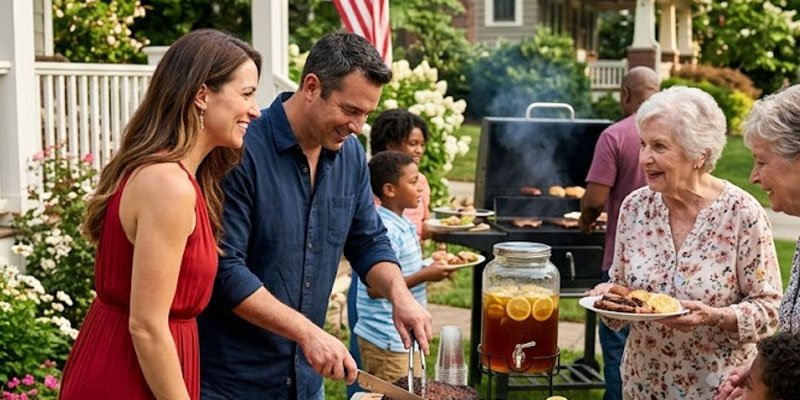
The patio was swallowed by a heavy, suffocating silence the instant I pulled the plastic container straight from my son’s hands. I had been awake before sunrise, carefully tending the grill and preparing a Sunday barbecue that was meant to bring our family together. Instead, my daughter-in-law, Rachel, and her mother, Stella, behaved like scavengers fighting over the best scraps, stuffing the finest brisket and ribs into containers before anyone else had even been invited to take another serving. My husband, Tom, stood frozen beside the grill with his jaw locked so tightly it looked painful, while my nieces stared in complete disbelief.
My name is Betty Miller. I’m sixty-five years old, and for most of my life I’ve believed that preparing food for people is one of the truest ways to show love. My modest house outside Fort Worth has been the heart of family gatherings for nearly four decades. It has welcomed birthday celebrations, graduations, holiday dinners, and the traditional Sunday cookouts that become treasured family memories. For this event, I didn’t cut corners. I personally chose thirty-three pounds of premium meat from Davis Market, including brisket, ribs, skirt steak, sausages, and several thick-cut steaks.
The groceries alone totaled an incredible $250, a considerable amount to spend on one Sunday meal. That didn’t even include all the side dishes—fresh potatoes, crisp salads, artisan bread, drinks, and the homemade peach cobbler I had spent hours preparing from scratch. Tom and I were awake at dawn, seasoning the meat, carefully managing the grill, and getting everything ready for what we hoped would be a peaceful afternoon. My nieces, Erica and Louisa, arrived early as well, bringing an apple pie, a fresh fruit salad, and a bottle of wine to complete the meal.
Rachel and her mother, Stella, were another story entirely. Rather than bringing food or drinks to contribute, they arrived carrying two oversized bags packed with empty plastic containers. The atmosphere shifted almost immediately after they walked into the backyard. Instead of offering compliments, they criticized the way I had arranged the table, commented negatively about the condition of my rose bushes, and even complained that my sausages were “a bit too salty” while helping themselves to generous portions. Throughout lunch, they spent more time photographing the food for social media than enjoying the company, carefully arranging the serving platters so it appeared as though they had been responsible for preparing the feast.
Their true sense of entitlement became impossible to ignore once everyone had finished eating. Without asking anyone, Rachel opened one of her tote bags. Julian, my son, immediately rushed to follow her instructions, using the serving tongs to pack the containers with the most expensive, leanest cuts of meat—the very portions Tom and I had planned to enjoy for lunches during the coming week. She didn’t even try to hide what she was doing. Pointing toward another untouched platter, she instructed Julian to collect the “softer pieces,” treating my backyard as though it were a restaurant handing out complimentary takeout.
Their behavior was so outrageously entitled that I could hardly believe what I was witnessing. They insisted they were “avoiding waste,” despite the fact that no one had even been asked whether they wanted another helping. They hadn’t brought a single ingredient, offered no assistance with cleaning, and were practically emptying the serving table while the rest of our guests were still sitting and talking. Tom looked at me, silently waiting to see what I would do. That was my breaking point. I walked over, placed the lid back onto the container Julian was filling, and met all three of their eyes.
“Please leave,” I said calmly, my voice firm and unwavering. “Right now.”
The reaction was immediate. For the first time that day, Rachel had no words. Stella’s face flushed bright red as she stumbled over complaints about how “embarrassing” I was, while Rachel exploded, accusing me of being jealous of her. None of it changed my mind. I escorted them to the gate myself and watched them walk away, my heart pounding inside my chest.
The aftermath unfolded exactly as I expected, though it still hurt deeply. Julian took his wife’s side, insisting that I had “humiliated” Rachel over a few leftovers and demanding that I apologize simply to “keep the peace.” He stopped calling. He stopped visiting. For weeks afterward, the silence inside my house felt overwhelming. Emotionally drained and no longer comfortable in my own home, I packed a bag and drove to stay with my sister, Isabella, in San Antonio.
Isabella is the one person who understands me well enough to point out my mistakes, and during a quiet evening with a glass of wine, she helped me recognize what had really happened. The disagreement had never truly been about $250 worth of barbecue or a stack of plastic containers. It was about boundaries. For years, I had allowed my generosity to be interpreted as unlimited permission. I had taught my son to be compassionate, but I had never shown him that compassion should never become an invitation for others to take advantage. I had spent decades playing the endlessly accommodating host, and Rachel and Stella had simply learned to view my home as something they could freely use instead of a place that deserved respect.
Everything finally changed when my phone rang one afternoon. It was Julian. He didn’t begin the conversation with an apology, but he did begin with an admission. “Mom,” he said quietly, “I finally understand what you were trying to tell me. I finally see why you were so upset.” He explained that Rachel had eventually confessed the real reason behind her behavior—it had never been about the leftover food. Instead, she had wanted to establish control and prove that she could take whatever she wanted from my home without facing any consequences. Julian had finally reached his own breaking point, and for the first time as an adult, he was seeing his wife without blindly accepting her demands. Rebuilding our relationship took time, but an important lesson had been learned. I stopped being the woman who always said yes to everyone, and I became someone who understood the true value of her time, her kindness, and her brisket.