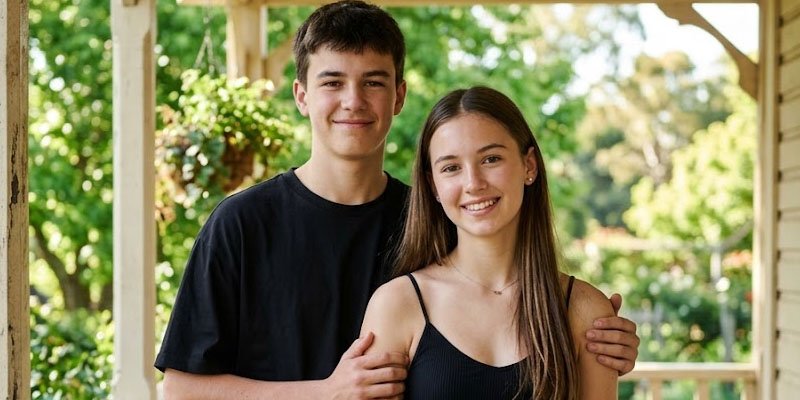
The instinct to protect your child is one of the strongest forces a parent can ever experience, and it never truly disappears, regardless of how grown they become. I have always devoted myself to being the best mother I could be, and for the past twenty-two years, my son Xavier has been the center of my world. So when he called to announce that he was engaged after dating someone for only three months, I felt both thrilled and deeply uneasy. I imagined meeting a lovely young bride-to-be, but the moment I answered the door, everything changed. The woman standing on my porch was someone I believed I recognized immediately—a notorious swindler who had once torn apart my closest friend’s family. Convinced I had to protect my son, I acted without hesitation, locking her in the basement before she could deceive him.
In the weeks leading up to that unforgettable evening, an uncomfortable feeling had settled over me. Xavier had spent four years in college without mentioning a single girlfriend, and then, almost overnight, he was planning a wedding with a woman none of us had met. When he finally announced he was bringing her home for dinner, I prepared everything with care. I roasted a chicken, baked my homemade cherry pie, and set out our finest china because I wanted the evening to be perfect. But the instant I saw the petite brunette with wide, expressive eyes standing at my front door, I froze. Months earlier, my dear friend Margaret had shown me a photograph of the woman who had manipulated her son into losing thousands of dollars, leaving him emotionally shattered and financially ruined.
The similarity was impossible for me to ignore. I stood in my living room with an artificial smile stretched across my face while my pulse pounded in my ears. I was convinced I knew exactly who she was and what she was capable of. My husband, Nathan, noticed my obvious distress and quietly drew me into the kitchen. In a hushed voice, I confessed my fears, insisting that our family was about to become the next target. Nathan urged me to slow down and be certain before making accusations, but I refused to risk Xavier becoming another victim like Margaret’s son. I believed I had no time to waste and needed to stop her before she could manipulate my family.
Pretending I needed assistance selecting a bottle of wine, I invited her downstairs to the basement. She followed without hesitation, unaware of what I intended. The second she stepped onto the concrete floor, I rushed back, slammed the basement door shut, and locked it. The confused expression on her face as I hurried upstairs remained etched in my memory, but at that moment I was consumed by the belief that I was protecting my child. I immediately called the police while Xavier stared at me in disbelief, his face drained of color. He pleaded with me, insisting I was making a terrible mistake, but I refused to listen. Instead, I held up my phone and showed him the photograph Margaret had once sent me, demanding that he recognize the danger I believed was standing in our house.
The officers arrived not long afterward, and their presence made the entire situation feel even more serious. At first, I remained convinced I had prevented a tragedy that would have destroyed Xavier’s future. But when the police escorted the young woman upstairs from the basement, my certainty began to crumble. She didn’t resemble someone who had just been exposed as a criminal. Instead, she appeared frustrated, emotionally drained, and weary from repeatedly paying the price for someone else’s actions. Looking directly into my eyes with naturally blue eyes—unlike the woman in the photograph—she calmly began telling her side of the story.
She explained that this was far from the first occasion on which someone had confused her with the real scammer. According to her, the actual criminal was well known to law enforcement and merely bore a passing resemblance to her. One of the officers confirmed every word, explaining that the real woman had blonde hair, brown eyes, and had already been arrested and sentenced to prison several months earlier. The person I had locked in my basement was entirely innocent, a woman who had spent years dealing with mistaken identity because of someone who looked somewhat like her. Relief spread across her face, but it was overshadowed by the overwhelming shame that suddenly consumed me.
I stood frozen, shaking as I realized I had allowed fear to replace reason. My desperate desire to protect my son had led me to accuse an innocent woman of terrible crimes and imprison her in my own home without proof. I tried to apologize, stumbling over my words, yet every sentence felt hopelessly inadequate. To my astonishment, she didn’t explode in anger or threaten legal action. Instead, she let out a tired laugh that filled the silent room. Smiling, she joked that being locked in a basement was certainly one unforgettable way to meet her future in-laws and quipped that at least I had chosen a respectable bottle of wine.
Her laughter dissolved the unbearable tension that had settled over the room, allowing everyone to breathe again. Xavier remained understandably upset, standing firmly beside his fiancée with a loyalty that showed just how deeply he loved her. That evening changed all of us. In the weeks that followed, I worked hard to rebuild the trust I had shattered. I was forced to confront the pride and excessive protectiveness that had turned me into the antagonist of my own family’s story. As time passed, I truly got to know Danielle, discovering her genuine warmth and seeing how much happiness she brought into Xavier’s life.
That experience taught me that being a parent does not grant me the authority to serve as judge and jury, especially when my decisions are driven by fear and assumptions instead of facts. Our family managed to move forward, but none of us will ever forget what happened that night. Danielle still jokes about the incident from time to time, making sure I never forget the lesson in humility it taught me. My actions were motivated by love, but they were still undeniably wrong. In the end, I learned that sometimes the greatest danger our children face is not an outside threat, but the fear we allow to guide our own actions.