
Part 1
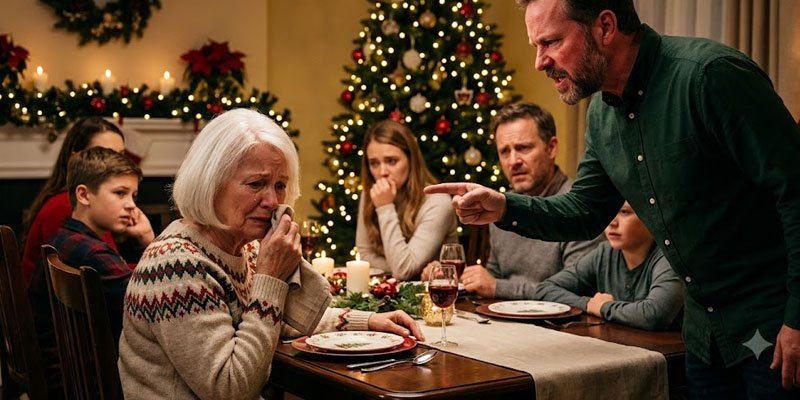
My son, Daniel Whitaker, slammed his hand onto the Christmas dinner table so hard that every crystal glass trembled.
“Pay the rent or disappear!”
The room instantly fell silent.
Twenty-two relatives sat around my dining table—my sisters and their husbands, Daniel’s cousins, my daughter-in-law Melissa, three teenagers who barely looked up from their phones, and my two grandsons, their forks suspended over mashed potatoes. The turkey had already been served. Candlelight flickered gently. Snow drifted outside the windows of the house where I had spent the past thirty-one years.
My house.
Daniel stood at the end of the table as if he were the owner.
I looked up at him, my napkin neatly resting across my lap, my hands calm even though my chest felt painfully tight.
“Daniel,” I said softly, “sit down.”
“No,” he shot back. “You sit there pretending you’re the victim, but this is reality. Melissa and I can’t keep supporting you.”
A few family members shifted awkwardly in their seats.
Supporting me.
The words almost made me smile.
For the last six years, I had been the one paying the mortgage on Daniel and Melissa’s townhouse after his construction company collapsed. I paid for daycare, car insurance, school expenses, dental appointments, soccer uniforms, and the “temporary” credit card balance that somehow grew every Christmas. I had also let them believe they would eventually inherit the family home because it was easier than telling them I had changed my mind.
Melissa leaned back with a polished red smile.
“Let’s see how you survive,” she said. “You can’t even manage online banking without Daniel.”
My grandson Ethan quietly muttered, “Mom…”
Melissa ignored him completely.
Daniel pointed toward the hallway.
“You’ve got until New Year’s. Either start paying your share or find somewhere else to go with all this drama.”
My sister Linda began to speak, but I raised one finger. Not to silence her, but to stop her from wasting her words.
I stood.
The chair scraped against the hardwood floor.
At seventy-two, people expected me to look frail. I was supposed to tremble, cry, beg, or defend myself. Instead, I walked to the coat closet, took down my wool coat, and slipped my hand into its pocket.
Inside was a small brass key.
It wasn’t for this house.
It belonged to another one.
A single-story brick home in Lancaster, Pennsylvania, which I had quietly bought three months earlier using my late husband’s life insurance money and savings Daniel believed had already disappeared.
“I’m not waiting until New Year’s,” I said.
Daniel frowned. “What?”
“I’m leaving tonight.”
Melissa laughed.
“With what? Your pension?”
“With every account that has my name on it—the same accounts you’ve been depending on.”
Her laughter vanished.
I packed two suitcases, my medications, my jewelry box, and a framed photograph of my husband, Robert. No one offered assistance. No one asked me to stay.
At 9:30 that evening, I drove through the falling snow toward my new home.
Before midnight, every password had been changed.
By sunrise, every automatic payment, every favor, and every dollar they had counted on from me had come to an end.
Part 2
At exactly 7:14 the following morning, Daniel had already called seventeen times.
I watched his name repeatedly flash across my phone while sitting at the small kitchen table in my new home, sipping coffee from a blue mug Robert had bought during a trip to Maine twenty years earlier. The house smelled faintly of fresh paint and pine cleaner. Outside, a snowplow slowly cleared the quiet neighborhood.
There were no raised voices. No slammed doors. No Melissa criticizing the groceries I purchased as “cheap old-lady food” while happily eating them herself.
I answered the eighteenth call.
“Mom, what did you do?” Daniel demanded.
“Good morning to you too.”
“Stop playing games. The mortgage payment bounced.”
“No,” I replied. “My payment stopped. Your mortgage is your responsibility now.”
He inhaled sharply. I pictured him pacing barefoot across the townhouse kitchen while Melissa hovered nearby telling him what to say.
“You’re being vindictive.”
“No,” I answered. “I’m being truthful.”
“You can’t just cut us off.”
“I can. And I already did.”
For a moment, he said nothing.
Then his voice shifted into the wounded tone he always used whenever anger failed to work.
“It was Christmas. People say things.”
“Yes,” I said. “And sometimes people finally listen.”
Melissa grabbed the phone.
“Evelyn, this is ridiculous. We have children.”
“I know,” I replied. “That’s why I paid their school tuition last semester and their medical bills back in October. You’re welcome.”
“So you’re really going to punish your grandkids?”
“No. I’m simply no longer financing their parents.”
She gave a dismissive laugh.
“You won’t survive two weeks on your own.”
I looked around my comfortable kitchen—the neatly organized folders on the counter, the locksmith’s receipt, my new bank card, the envelope from my attorney, and the instructions for my security system.
I had faced loneliness before. I had buried my husband, survived breast cancer, spent forty years working in payroll, and raised Daniel through childhood asthma, college tuition, and the phase when he insisted rules were simply “emotional control.”
“I think I’ll be just fine,” I said.
Then I ended the call.
By lunchtime, the second round began.
My nephew Kyle sent a message.
Aunt Ev, Daniel says there’s been a misunderstanding.
Linda phoned, crying—not because she disagreed with me, but because she had seen Daniel’s face when he realized my warning had not been empty.
“You should have seen him,” she said. “He kept refreshing the accounts like the money would suddenly come back.”
“It won’t.”
“Are you safe?”
“Yes.”
“Do they know where you are?”
“No.”
She paused.
“Good.”
That afternoon, I visited my attorney.
His office sat along a narrow snow-covered street between a bakery and a tax office. Mr. Howard Greene, who had handled Robert’s estate, greeted me as though he had expected my arrival. The updated documents were already waiting.
“Are you certain?” he asked.
“Absolutely.”
He slid the paperwork across the desk.
I removed Daniel as my medical power of attorney and as the beneficiary of two financial accounts. I revised my will. The family home would be sold instead of inherited. Part of the proceeds would establish education trusts for Ethan and Noah that neither of their parents could access. The remaining funds would support my retirement and later create a trade-school scholarship in Robert’s memory.
My hand never wavered as I signed the final page.
Mr. Greene looked over the top of his glasses.
“Mrs. Whitaker, do you think your son will challenge this?”
“I expect him to make plenty of poor decisions.”
“Then we’ll make sure everything is thoroughly documented.”
I reached into my handbag and placed my phone on his desk.
It contained a recording of Christmas dinner.
Daniel’s voice filled the office.
“Pay the rent or disappear!”
Then came Melissa’s.
“Let’s see how you survive!”
Mr. Greene listened without showing any emotion.
When the recording ended, he simply said,
“That will be helpful.”
For the first time all day, I smiled.
That evening, I sat alone in my new living room, eating a bowl of soup without turning on the television.
For the first time, the silence around me no longer felt empty.
PART 3
Daniel’s first move was not an apology.
It was a threat.
On December 27, he went to the old house and discovered the locks had been changed. He tried hiring a locksmith by falsely claiming he owned the property. The locksmith contacted me instead. After that failed, Daniel called the police, insisting that his elderly mother was “confused” and being “manipulated by relatives.”
I found out when Officer Grant from the Lancaster Police Department arrived at my new home around 4:20 that afternoon, with melting snow dripping from his boots.
“Mrs. Whitaker,” he said, “your son requested that we perform a welfare check.”
I invited him inside.
He looked around the living room, where everything was neat and organized—books sorted by author, Robert’s photograph hanging above the fireplace, fresh groceries in the kitchen, and important papers carefully arranged in labeled folders.
“Are you living here by your own choice?” he asked.
“Yes.”
“Do you feel unsafe or threatened?”
For a brief second, I almost lied to protect my family’s image. The old habit surfaced immediately: defend Daniel, minimize what he had done, and make excuses for him.
Then I remembered standing at my own Christmas dinner while twenty-two relatives watched him humiliate me.
“I feel like I’m being harassed,” I answered.
Officer Grant nodded. “Has he threatened you?”
I handed him my phone containing the messages.
You better fix this.
You have no idea what you’ve started.
I’ll make sure everyone knows what kind of mother you are.
He carefully read each one.
“You have every right to tell him not to contact you,” he said. “If he ignores that, keep records of everything. Considering your age, financial coercion can sometimes fall under elder abuse.”
Those two words settled heavily in my mind.
Elder abuse.
I had never imagined Daniel fitting that description. Somewhere in my heart, he was still the little boy who cried after scraping his knee on the driveway. The child who refused to sleep without his plastic dinosaur beside him. The son Robert had proudly taken fishing at Lake Wallenpaupack.
But he was also the grown man who stood over me on Christmas Day and demanded rent for a house that legally belonged to me.
After Officer Grant left, I called Mr. Greene.
“Excellent,” he said after hearing the story. “Let him keep building the evidence himself.”
And Daniel did exactly that.
On December 28, Melissa made a Facebook post.
Some people care more about money than grandchildren. Praying for a cold heart to soften.
Before I had finished breakfast, relatives began sending me screenshots. Some were worried. Others criticized me. One cousin from Ohio simply wrote, Family is family, Evelyn.
I responded only once, directly under Melissa’s post.
For six years, I covered your mortgage, vehicle insurance, daycare, medical expenses, school costs, and credit card balances. On Christmas evening, in front of twenty-two people, Daniel told me to “pay the rent or disappear” from a home that legally belongs to me. I chose to disappear, and so did my financial support. I sincerely hope the children find stability and peace.
There were no insults, no emotional emojis, and no dramatic wording.
Then I turned off the notifications.
The post spread much further than Melissa had expected.
By lunchtime, even one of her own aunts commented, Wait, you weren’t paying your own mortgage?
Daniel quickly deleted the post.
But screenshots live forever.
Two days later, Ethan and Noah called using Ethan’s phone.
At fifteen, Ethan understood much more than most adults realized. Noah, only eleven, still tried to keep everyone happy by pretending everything was fine.
“Grandma?” Ethan said.
“Hello, sweetheart.”
“Are you okay?”
“I’m doing well.”
“Dad told us you abandoned us.”
My chest tightened, but I kept my voice calm. Children deserve honesty without being burdened with bitterness.
“I left because I was treated badly,” I said. “I didn’t leave because of you or Noah.”
Then Noah’s softer voice came through.
“Can we still come see you?”
“Always—as long as it’s safe and your parents allow it.”
There was a long pause before Ethan spoke again.
“Mom and Dad have been arguing a lot.”
“I’m sorry to hear that.”
“Dad says the mortgage payment is due on Friday.”
“That’s something your parents need to work out with the bank.”
“He said maybe you could help just this one last time.”
There it was.
Daniel had sent his own son to knock on a door he could no longer open himself.
I closed my eyes.
“Ethan,” I said gently, “listen carefully. I love you very much. I’ll always help you and Noah directly—with school, clothing, food, medical care, and your education. But I won’t give your parents money anymore.”
He let out a long breath filled with both relief and worry.
“Okay,” he replied. “I understand.”
And I believed he truly did.
The first official legal letter arrived on January 4.
Daniel had hired an attorney named Paula Vickers.
Her letter claimed that I had made a “verbal promise” to financially support their housing for life and argued that ending those payments had caused hardship for a dependent household.
After reading it, Mr. Greene chuckled.
“A lifelong verbal agreement to pay his mortgage forever?” he said. “That’s certainly creative.”
“Could he actually win?”
“No,” he replied. “But he can definitely create a lot of noise.”
And that was exactly what Daniel did.
He began telling relatives I was mentally unstable. He told neighbors I had dementia. On two different occasions, he contacted my bank and falsely reported my own withdrawals as fraudulent. He even returned to the old house and shouted outside until the new property manager threatened to call the police.
There was one important detail Daniel still didn’t know.
The house had already been placed under contract.
Selling it wasn’t a decision I made in anger. Everything had been arranged months earlier. The buyers were a young doctor and her husband, who loved the garden Robert had planted and promised they would take care of the old apple tree.
That promise meant a great deal to me.
The closing was scheduled for February.
Daniel only found out after seeing the real estate sign in the yard.
The very next day, he came to my new home.
Through the security camera, I watched him standing on the porch in a black winter coat, his face red from both the freezing weather and his anger. Melissa remained in the SUV at the curb, her arms folded tightly across her chest.
Daniel rang the doorbell five separate times.
I never opened the door.
Instead, he stepped closer to the camera.
“Mom,” he called. “Open the door. We need to talk.”
I switched on the intercom.
“You can talk from where you’re standing.”
His eyes immediately shifted toward the camera. He clearly disliked realizing the conversation was being recorded.
“This is ridiculous,” he said. “You’re really selling Dad’s house?”
“My house.”
“It was supposed to stay in the family.”
“It remained in the family for thirty-one years. Then the family decided to treat me like I was only a tenant.”
His jaw tightened.
“You’re twisting everything.”
“No,” I answered. “I documented exactly what happened.”
He froze.
Melissa climbed out of the SUV.
“You recorded us?” she shouted.
“Yes.”
“That’s disgusting.”
“No, Melissa. The disgusting part happened before I stopped recording.”
Daniel lowered his voice.
“Mom… please. We’re going to lose the townhouse.”
I studied his face on the monitor.
For the first time, the anger had cracked enough for genuine fear to show through.
But fear is not the same thing as remorse.
Fear appears only when consequences become unavoidable.
“What happened to the money I gave you in October?” I asked.
He looked away.
Melissa answered instead.
“We had expenses.”
“What kind of expenses?”
“That’s none of your business.”
“My money made it my business.”
Daniel rubbed his forehead.
“The business was having problems. I was trying to recover.”
“You told me everything was fine.”
“I didn’t want you worrying.”
“But you had no problem making me worry on Christmas.”
Melissa stepped closer to the porch.
“Are you enjoying watching your own son beg?”
I looked at her through the camera.
At thirty-eight, she was polished, sharp, and remarkably skilled at making everyone in a room turn against anyone who challenged her.
For years, I had mistaken that confidence for real strength.
Now I finally saw it for what it truly was.
She survived by making people so uncomfortable that they eventually gave in.
“No,” I replied. “I’m not enjoying this at all. Which is why this conversation is finished.”
Daniel pressed his hand firmly against the front door.
“Mom.”
His voice became gentle.
For a moment, I heard the child he had once been.
But I also heard myself at Christmas, quietly enduring humiliation as the gravy grew cold.
“Send communication through Mr. Greene,” I said.
I shut off the intercom.
He remained on the porch for twelve minutes.
Then he returned to the SUV and left.
Foreclosure proceedings began on the townhouse in March. Daniel blamed me first, then the lender, the economy, Melissa’s purchases, and finally his former business partner.
He never blamed the years spent treating my support as regular income. He never mentioned the holidays they took while I delayed my own dental care. He never considered the leased SUV in their driveway while I used coupons in the kitchen he described as “outdated.”
Melissa filed for separation in April.
The announcement surprised everyone except me.
Once the money disappeared, their marriage became a brightly lit room. There was nowhere left to conceal unpaid accounts, dishonesty, or resentment. Melissa took Noah to her sister’s home in New Jersey for six weeks, then came back after learning Daniel had no secret funds worth fighting over.
In May, Ethan asked to visit me.
At first, Daniel refused. Then Ethan, taller and more withdrawn after the difficult winter, told his father that he would always remember being sent to ask his grandmother for mortgage money.
Daniel drove him to my home the next Saturday.
He remained outside.
Ethan entered alone.
He embraced me tightly in the doorway.
“I missed you,” he said.
“I missed you too.”
We spent the afternoon cooking chicken soup and organizing Robert’s old fishing equipment. Ethan asked about his grandfather’s Navy service and how Robert had begun as an electrician’s apprentice before opening a repair company.
“He always said a person should know how to stand on their own feet,” I told him.
Ethan rotated a silver fishing lure between his fingers.
“Dad doesn’t know how.”
I considered my response.
“Your father knows,” I said. “He forgot.”
Ethan studied me. “Do you hate him?”
“No.”
“Are you going to forgive him?”
“That depends on what you mean by forgive. I’m not carrying rage around like a hot coal. But I’m also not handing him my wallet and calling it peace.”
He nodded, as though preserving the words for later.
In June, Daniel finally visited by himself.
He arrived without Melissa, yelling, or intimidation. His truck was older; the luxury SUV had disappeared. He wore work boots and a gray shirt marked with paint.
I opened the front door but left the safety chain attached.
He saw it. Hurt briefly passed across his expression, but he did not argue.
“I’m working for Martin Plumbing,” he said. “Warehouse first. Maybe project coordination later.”
“That’s good.”
He swallowed.
“I lost the townhouse.”
“I know.”
“We’re renting a smaller place in York.”
“I know that too.”
Naturally, Ethan had informed me, carefully and without requesting assistance.
Daniel stared down at the porch.
“I kept thinking you’d step in,” he said.
“I know.”
“And when you didn’t, I hated you.”
“That was easier than looking at yourself.”
His eyes filled with redness. “Yeah.”
The answer was quiet and nearly weightless.
Yet it was the first truly honest thing he had offered me in months.
“I’m sorry,” he said.
I waited for more.
He raised his head.
“I’m sorry for Christmas. For saying that in front of everyone. For acting like your money was mine. For letting Melissa talk to you like that. For using the boys. For calling you unstable. All of it.”
His apology could not restore what had broken. But it placed every broken piece in plain sight instead of pretending nothing had fractured.
“Thank you,” I said.
Disappointment crossed his face, as if some part of him had expected tears, an embrace, a check, or instant forgiveness.
I offered none.
“Can we start over?” he asked.
“No.”
His expression fell.
“We can start from here,” I said. “Not over. Here. With memory.”
He nodded slowly.
“That’s fair.”
“It will be slow.”
“I know.”
“You will not have access to my finances.”
“I know.”
“You will not pressure me through the boys.”
“I won’t.”
“If Melissa insults me again, I leave. Immediately.”
He glanced toward the road and then returned his attention to me.
“She’s angry.”
“I’m not responsible for Melissa’s anger.”
“No,” he said. “You’re not.”
I shut the door, unfastened the chain, and reopened it.
He crossed the threshold like someone entering a church after shattering one of its windows.
We shared coffee at my kitchen table. No money passed between us. No documents were executed. No sweeping promises were offered.
There was only one agreement: the next month, Daniel, Ethan, Noah, and I would have dinner together.
Melissa would not attend.
That was her decision.
By August, the young physician and her husband owned the family house. They sent me a picture of Robert’s apple tree covered in white blossoms against the fence.
The photograph made me cry, but not because I wished I had kept the property.
I cried because someone loved it.
In September, the first scholarship payment in Robert’s name went to a nineteen-year-old welding student from Harrisburg. Mr. Greene sent me a copy of the student’s thank-you letter. He wrote that his grandfather had worked as a mechanic and that he hoped to build a future with his own hands.
Robert would have approved.
The educational trusts for Ethan and Noah remained secure, untouched by their parents. I ordered Noah’s winter boots directly from the retailer and had them sent to his school after Melissa claimed she was too occupied. I paid Ethan’s SAT registration through the school’s portal rather than sending money through Daniel.
Helping became uncomplicated once it no longer passed through hands that distorted it.
Then Thanksgiving arrived.
It was not held in the old house or around a table crowded with twenty-two relatives waiting for conflict beside the cranberry sauce.
There were only five people in my new dining room: Linda, Daniel, Ethan, Noah, and me. Daniel brought bakery rolls because he admitted he was afraid of cooking. Noah created name cards. After watching an instructional video twice, Ethan carved the turkey.
Before we began eating, Daniel stood stiffly near the table.
“I want to say something,” he said.
Linda looked toward me.
I nodded slightly.
Daniel looked at his sons and then at me.
“Last Christmas, I embarrassed my mother because I was scared and selfish. I treated help like something I was owed. I hurt her, and I hurt this family. I’m not asking everyone to forget it. I just want to say, in front of people this time, that I was wrong.”
Noah stared at his plate.
Ethan studied his father closely.
I experienced no dramatic victory. There was no swelling music or sudden, complete healing.
Real life rarely provides perfect conclusions.
It gives us destructive habits abandoned gradually. It gives us a grown man learning to cover his own rent. It gives us a woman understanding that love without limits can turn into imprisonment.
“Thank you,” I said.
Then we ate.
The turkey was somewhat dry, but the gravy tasted wonderful. Linda shared a story about losing her way in Baltimore in 1989, and Noah laughed until cider spilled across his place card.
Daniel cleaned the mess without being told.
After dessert, I went alone onto the back porch.
The night air was cold and the neighborhood peaceful. Somewhere nearby, a dog barked twice. I pulled Robert’s old cardigan more tightly around my shoulders and watched through the kitchen window.
Daniel washed the plates. Ethan dried them. Noah secretly reached for another piece of pie. Linda pretended she had not noticed.
My phone vibrated.
Melissa had sent a message.
Happy Thanksgiving. Hope you’re satisfied.
I read it once.
Then I erased it.
There would be no answer.
No justification.
No door opened again.
From inside, Noah called, “Grandma, do you have more whipped cream?”
Smiling, I returned to my home.
My new home.
My peaceful home.
My fully paid home.
And for the first time in years, Christmas approached without fear.