Part 1: The Breach of Trust
Twelve hours into a exhausting double shift in the cardiac unit, my phone buzzed beneath a heavy stack of patient charts. The notification flashing on the screen had nothing to do with a medical emergency.
It had everything to do with a dying family illusion.
My father had tagged me in the main family group chat at exactly 3:07 a.m.
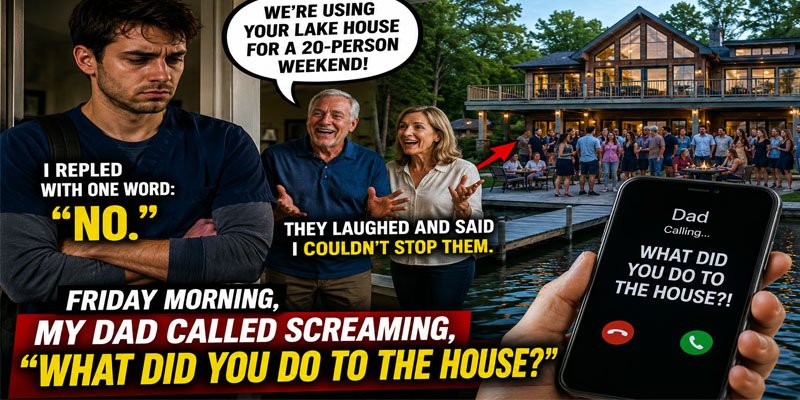
Father: “We Are Using Arden’s Lake House This Weekend. Twenty Guests. Friday Through Tuesday. Everyone Bring Towels. Arden, Get The Place Ready.”
I stood at the nurses’ station in Charlotte, North Carolina, the sharp smell of antiseptic clinging to my scrubs and old coffee burning in the pot behind me. Across the glass wall, the heart monitor from Room 12 blinked its steady green rhythm. Down the corridor, a ventilator sighed mechanically.
I read the message once. Then twice. Then a third time.
After fourteen years as a registered nurse, I knew better than to trust my eyes at 3:00 a.m. But the words didn’t change.
My name is Arden Voss. I was thirty-six years old, single, bone-tired, and the sole legal owner of a modest lake house on Lake Norman. I bought that sanctuary after nine years of relentless double shifts, packed lunches, clearance-rack scrubs, and driving a dented silver Honda Civic that my family loved to mock.
The house wasn’t “family property.” Every single mortgage payment, repair bill, property tax statement, and bag of mulch came directly out of my checking account. I bought it because I needed one place in the universe where nobody could dictate who I was supposed to be.
Then my mother chimed in under my father’s text.
Mother: “Fill The Fridge, Sweetheart. Aunt Liora Likes Fresh Flowers In The Main Bedroom. Do Not Make This Awkward.”
Within two minutes, the thumbs-up reactions poured in.
-
Cousin Hollis: “Finally. That Place Needs Real Family Energy.”
-
Brother Keaton: “About Time You Shared Something.”
Then someone asked if the Wi-Fi password was still the same. I stared at that one the longest. I had never given any of them my Wi-Fi password.
The Discovery
The unit was quiet, save for the hum of the machines. I scrolled back through the chat, slow and cold, looking for what I had missed. Nurses are trained to notice the skipped dose or the hidden bruise. I found the truth buried deep under a conversation from Memorial Day weekend.
My mother had written: “We Are At Arden’s Lake Place. She Does Not Know, So Do Not Post Yet.”
Forty-three relatives had seen it. Not one person had warned me.
My hand went completely still. I didn’t gasp or cry. Standing in the dim blue light of the station, I realized my family had been treating my home like a free resort while I was saving lives. My mother had stolen a key. My father had opened a door I never unlocked.
I typed one word into the chat: “No.”
No explanations, no apologies, no soft emojis. Just no.
My mother fired back instantly: “You Really Think You Can Stop Us? Arden, We Are Your Parents.” My father added: “Do Not Start Drama At Your Age.”
Then came the laughing reactions.
When my shift ended at 7:19 a.m., I drove through the morning fog toward Lake Norman. Pulling into my driveway, the violations became painfully visible:
-
Fresh tire tracks cutting through the manicured side lawn.
-
Two cigarette butts discarded near the side porch.
-
A gas station receipt dated three weeks ago trapped under the welcome mat.
Inside, the house smelled of someone else’s powdery floral perfume. A wine glass sat upside down by the sink—I don’t drink wine. In the fridge, a half-empty jar of pickles bore a sticky note: “Save For Next Time.”
I sat straight down on the kitchen floor in my wrinkled navy scrubs and stared at that note until my vision blurred. Then, I stood up, washed my hands, opened my laptop, and created three distinct lists: Legal, Logistical, and Personal.
At the top of the page, I typed:
“This House Is Mine, And They Are About To Learn What Mine Means.”
Part 2: Drawing the Line
The old Arden would have called them crying, begging for respect. But the woman standing in my kitchen that Tuesday morning was done pleading.
I called Soraya Flint, a sharp civil attorney I knew from high school. When I laid out the facts, Soraya asked me one crucial question: “Do you want to scare them, or do you want to end this?”
“I want to end it,” I replied. “I want this to be the last weekend they ever assume anything about me.”
“Good,” Soraya said. “Then do not argue with them. Let them keep talking. People who think they are entitled will put their entitlement in writing if you give them enough silence.”
By noon, I was in her office reviewing the deed and the screenshots. Soraya outlined a scorched-earth legal approach:
-
Formal cease-and-desist letters sent via registered mail to every adult relative involved.
-
Complete lock replacement and security system overhaul.
-
High-definition cameras and explicit removal of my parents from the lake association emergency contacts.
“Let the paper do the talking,” Soraya told me. “Paper does not get tired. Paper does not get guilted by its mother.”
Securing the Sanctuary
By 5:30 p.m., a silver-haired locksmith named Roman was drilling out my old locks. As he worked, he murmured, “Most people think a lock keeps strangers out. Really, a lock reminds people they need permission.”
When he handed me the four keys on a plain steel ring, he asked, “Only you?” “Only me,” I confirmed.
That night, I reviewed twelve years of bank records to calculate the true cost of my enabling behavior. I found the $2,800 wired to save Keaton’s truck, the $5,000 “pandemic relief” I gave my parents while they secretly vacationed in Key West, and the $1,300 birthday dinner for my mother.
The hard, documented total was $26,740.
My silence had trained them to exploit me. Every swallowed insult had been taken as permission.
At 10:16 p.m., my mother texted me privately: “Your Father Says You Are Being Dramatic. I Told Him You Are Just Tired. Call Me Tomorrow And We Will Fix This.”
I screenshotted it, put my phone away, and watched a lone heron standing patiently in the dark waters by my dock. It didn’t chase the fish. It just waited for them to get close enough.
Part 3: The Secret Spreadsheet
By Wednesday morning, my mother had launched a covert group chat called Lake Weekend Crew. She didn’t invite me, but my nineteen-year-old cousin Elowen—who still possessed a conscience—secretly added me and forwarded the screenshots.
It was far worse than I imagined. My mother had constructed an entire itinerary, including a tab titled Arden Duties:
-
Stock Fridge For Twenty People.
-
Wash All Linens.
-
Have Boat Fueled.
-
Buy Oat Milk For Sable.
-
Pick Up Aunt Liora And Uncle Penn At Charlotte Airport.
-
Stay Out Of Main Bedroom And Main Bathroom During Visit.
They were commanding me to stay out of my own bedroom in the house I paid for. Soraya’s directive remained absolute: “This Is Excellent Evidence. Do Not Respond.”
My parents and brother bombarded me with calls, pivoting from sweet cajoling to aggressive threats. My mother left a scathing voicemail that I saved immediately:
Mother’s Voicemail: “Arden, listen to me carefully. This weekend is happening whether you like it or not. Your father has the spare key. If that house is not ready, you are going to humiliate us… That house exists because of us. Do not test me.”
The Real Motive
On Thursday evening, my brother Keaton called three times sequentially. On the third ring, I answered.
“Mom is losing her mind,” he barked. “You always act like you are above everyone because you have some job and some house.”
“I have a house because I paid for it, Keaton.”
Then his voice dropped, losing its venom and becoming dangerously small. “Arden, I need this weekend. I told some people they could use the place… They are connected to some money I owe. Eighteen thousand.”
The pieces clicked into place. My family hadn’t just planned a vacation; my brother had used my hard-earned home as collateral for an underground debt, and my parents were helping him cover it up.
“They are not entering my house,” I said flatly. “I love you, Keaton, but I am not your bank, and my house is not a poker chip you get to throw on a table when you are scared.”
He exploded into ugly, desperate insults. I let him run out of breath before stating, “Keaton, I want you to know this conversation is being documented for my records. Good night.”
By midnight, Elowen’s leaked screenshots showed the chat collapsing under the weight of my silence. Relatives began dropping out with sudden excuses. Finally, my father posted a desperate, stubborn ultimatum:
Father: “Trip Is Still On. Noon Tomorrow. No More Discussion.”
Only seven people reacted. The herd was thinning, but the core transgressors were still coming.
Part 4: The Standby
Friday morning arrived with an almost mocking beauty—crisp blue skies and perfectly still waters.
My new locks were secured, the alarm was armed, the high-definition cameras were recording, and the registered legal letters had already been delivered to their doorsteps. I sat on my screened porch in sweatpants, waiting.
At 11:46 a.m., the first vehicle pulled into my driveway.
It wasn’t my parents. It was a black SUV with Ohio license plates. Two imposing men in their forties stepped out without luggage. One aggressively tried the front door handle, then pounded heavily on the doorbell.
When I didn’t answer, he pulled out his phone. Seconds later, my phone lit up with a call from Keaton. I ignored it.
Realizing they were locked out, the two men backed their SUV down to the very edge of my property line and parked horizontally directly across the entrance, effectively blocking the entire driveway.
They had crossed the line.
I calmly dialed the county sheriff’s non-emergency line, providing my address and explaining the situation clearly: “Unknown individuals are blocking access to my private driveway after being illegally invited to my property by a family member with zero ownership rights.”
The dispatcher asked, “Ma’am, do you feel unsafe?”
I looked at my laptop screen, watching the live, crystal-clear camera feed of the men waiting by their vehicle.
“I feel prepared,” I answered evenly. “But yes, I want a deputy here.”
At 11:58 a.m., my parents’ beige Cadillac rolled up, screeching to a halt right behind the black SUV. My father slammed his door, his face bright red as he began furiously waving his arms. My mother stepped out behind him, clutching a heavy tote bag and dragging a rolling suitcase that kept violently tipping over onto the gravel.
She looked so much smaller than she sounded on the phone. And the police sirens were already echoing in the distance.
Part 2 (Final): After a Long Night at Work, I Walked Into My Parents Casually Revealing They’d Planned a 20-Person Getaway at My Lake House Without My Permission. I Told Them, “Absolutely Not.” They Brushed Me Off, Certain I Had No Way to Stop Them. Then Friday Morning Arrived, and My Phone Exploded With My Dad Shouting, “What on Earth Happened to the House?!”
Aapki kahani ko bilkul isi core plot, characters aur emotional depth ke sath ek naye aur behtareen andaz mein rewrite kiya gaya hai.
Here is the rewritten version of Arden’s journey to reclaiming her life:
Part 4: The Standing Ovation
Fear doesn’t make people kinder. It just shrinks them.
Having spent years working in hospital wards, I had seen this transformation time and again. Normal time ages a person by steady, predictable degrees. But fear? Fear ages you all at once, hollows you out in a single breath.
My mother dragged her heavy suitcase up the front walk, her knuckles white as she jammed the key into the lock.
It didn’t turn.
She tried again, her movements growing frantic. On the third failed attempt, she abandoned the key altogether and began furiously pounding her fist against the wood.
“Arden! Open this door! Arden, I know you’re in there!”
Her voice cut through the thick wood of the door while simultaneously blaring from the porch camera’s speaker. It created an eerie, overlapping echo—the woman who raised me, amplified and multiplied by technology.
My father trotted up the porch steps next, fresh from an argument with the men in the black SUV. Judging by the tight line of his jaw, he had lost. He slammed his open palm against the door.
“Arden! What did you do to the house?”
There it was. The exact sentence I had been bracing myself to hear.
Not “What did we do?” Not “Can we talk?”
Simply: What did you do to the house? As if securing my own property was an act of malicious vandalism. As if protecting what belonged to me was an unprovoked assault on them.
I tapped the intercom button on my phone app.
“Mom. Dad. The house is unavailable this weekend. The locks have been changed, the security system is armed, and cameras are recording everything inside and out. Please leave the property immediately.”
My mother let out a sharp, strangled sound—a jagged noise caught somewhere between a sob and a shriek. My father stared directly into the camera lens. For the first time in my adult life, his face lacked anger or smug superiority. He just looked utterly bewildered.
I had said “no” to them in the past, but those nos had always been soft, negotiable things. This was the first time a “no” came backed by a deadbolt.
“Open the door,” my father demanded, trying to steady his voice. “We need to discuss this like adults.”
“We are discussing it like adults,” I replied through the speaker. “I am an adult in my own home, informing you that you do not have permission to enter.”
“You cannot do this to your mother!”
“I’m not doing anything to her. I am simply keeping my house closed.”
My mother gripped the doorframe, her voice trembling with indignation. “I gave birth to you!”
Through the high-definition lens, I studied her. Her hair was still coiffed into perfect curls, but her lipstick had bled slightly into the corners of her mouth. Her suitcase lay abandoned on its side.
“And I bought this house,” I said.
The Arrival of the Law
Deputy Harlan arrived at exactly 12:13 PM. She was a woman in her fifties, her dark hair shot through with silver, carrying the patient, unbothered expression of someone who had mediated far too many family dramas to be moved by theatrics.
She questioned the men in the SUV first. Whatever they told her took less than five minutes; they quietly climbed back into their vehicle and drove away without looking back.
When the deputy walked up the porch, I unlocked the door, stepped outside, and pulled it firmly shut behind me. I did not invite my parents into the warmth.
Deputy Harlan looked at me. “Ma’am, are you the legal owner of this property?”
“Yes. My name is Arden Voss. I have the deed right inside.”
She turned her gaze to my parents. “Are either of you listed on the deed, the mortgage, or any legal ownership documents for this residence?”
My father opened his mouth to bluster, but my mother cut in. “We are her parents.”
Deputy Harlan didn’t blink. “That isn’t what I asked.”
My mother’s face flushed a deep, angry crimson. “No. But we have always been welcome here.”
“Today you are not,” Deputy Harlan stated flatly. “Your daughter has asked you to leave, and she has the legal right to enforce that.”
My father made one last desperate play. “Our son is on his way. This is just a massive misunderstanding.”
“Keaton isn’t welcome here either,” I said.
The deputy nodded once. “Then I suggest you call him and save him the trip.”
My mother looked at me then—truly looked at me. I watched the exact millisecond the realization settled into her bones. She realized that tears wouldn’t manipulate me, public embarrassment wouldn’t shame me, and my father’s intimidation wouldn’t break me. The sacred shield of “family” was no longer a skeleton key to my life.
They left the driveway at 12:29 PM.
My father glanced back one last time from the car. It wasn’t a look of hatred; it was something far heavier: recognition. He finally saw that the daughter he had spent thirty-six years bending to his will hadn’t been weak. She had just been kneeling.
And she had finally stood up.
At 12:41 PM, I sat alone at my kitchen table and ate a slice of frozen chocolate cake. It was the sweetest thing I had ever tasted.
Part 5: The Architecture of Silence
By Friday evening, the family group chat fell completely silent. By Saturday morning, my mother had deleted it entirely.
Elowen texted me a screenshot of the blank screen with a caption: “Evidence Graveyard.”
I laughed out loud. It was a strange, sudden sound that startled even me. For years, my laughter had been a social performance—a polite noise made to convince everyone I was okay. This laugh came from somewhere deep, raw, and untouched. It sounded like a heavy door swinging open in a long-forgotten room.
But the silence never lasts in families like mine.
By Saturday afternoon, two new chats had risen from the ashes. I wasn’t invited to the first one, but Elowen was, so the screenshots kept coming. My mother had christened it Family Support.
In that digital echo chamber, she began rewriting history. According to her, I had suffered a mental breakdown. I was working too many night shifts. I had humiliated my own flesh and blood in front of the police. I had locked them out of a house they had “helped me get.”
Aunt Liora, who had canceled her trip before even reaching the airport, chipped in: “Something Has Always Been Off With Arden. I Never Wanted To Say Anything.”
As I read the words, I waited for the familiar, crushing pain to hit my chest. It never arrived. Not because the text wasn’t cruel, but because I had finally stopped treating their cruelty as a medical emergency.
The second group chat was much smaller. It was created by Uncle Penn, Aunt Liora’s historically quiet husband. He added me, Elowen, my cousin Bryony, and two older relatives.
His opening message read: “This Chat Is For People Who Care About Arden. Anyone Who Wants To Defend What Happened Can Leave.”
Nobody left.
Later that afternoon, Bryony messaged me privately.
“Arden, I owe you a massive apology. Your mother told me you said something horrific about Grandma right before she passed away. I believed her because I was drowning in grief, and I cut you off based on a lie. I am so deeply sorry.”
Before I could even process the shock, another bubble popped up.
“And there were other things she told people. I think you need to know the truth.”
We spoke on the phone for two hours that night. It was an interrogation of my past. I discovered that my mother hadn’t just criticized me over the years; she had actively managed me.
Whenever I grew close to a relative, a strategic rumor would surface. If someone wanted to invite me over, my mother would quietly intervene, painting me as too busy, too judgmental, too unstable, or too cold. She told one cousin I despised children; she told another I looked down on them.
For over a decade, I believed the distance between me and my extended family was natural—a byproduct of my introverted nature and grueling nursing shifts. But it wasn’t natural distance. It was architecture.
My mother had systematically built brick walls around my life and then convinced the world that I preferred the isolation.
I didn’t forgive her. Forgiveness isn’t a vending machine where you insert an apology and regain immediate access to someone’s life. What I felt wasn’t mercy; it was profound, crystalline clarity. I could finally see the exact dimensions of the cage I had been trapped in. And once you can see the walls, you can find the exit.
Nonsense Dressed in a Suit
On Monday morning, my lawyer, Soraya, called with an update. Several certified letters had been dispatched. My mother had flatly refused to sign for hers—which Soraya noted was perfectly fine, as a refusal still legally proved attempted delivery. My father ignored his completely.
Keaton, however, had retained counsel.
His lawyer sent a formal letter claiming my parents possessed an “informal family agreement” that granted them lifetime access to the lake house in exchange for “decades of parental support.”
Soraya read the legal jargon aloud over the phone and let out a loud, unbothered laugh. “Arden, this is nothing but absolute nonsense dressed up in a three-piece suit.”
“What’s our next move?” I asked.
“We respond once. We state firmly and politely that no such agreement exists, they have zero ownership equity, and any future attempts to enter the property will result in immediate criminal prosecution for trespassing.”
“Should we sue them?”
“We can,” Soraya said gently. “You have more than enough evidence to win a public judgment. But you have to ask yourself if you want to tether the next two years of your life to them in a courtroom.”
I looked out across the water. A lone boat slipped quietly across the glassy surface of the lake, leaving a beautiful, undisturbed white wake behind it.
“No,” I decided. “I don’t want a courtroom. I want my house. I want my time. I want my mind back.”
“Then that right there is your victory,” Soraya smiled.
The letter went out that afternoon. Keaton’s lawyer never wrote back.
Part 6: The Emergency Key
For six weeks, the silence was total.
Then, at 1:00 AM during a chaotic night shift, my father made his move. He called the cardiac unit directly, telling the desk clerk he was experiencing severe chest pains and desperately needed to speak with his nurse daughter before heading to the emergency room.
The unit clerk tracked me down in Room 7, where I was hanging an IV bag. “Arden, your dad is on line one. He says it’s his heart.”
For one terrifying second, the old conditioning kicked in, and I was a terrified daughter again. Then the logic of my training took over. Nurses know the exact difference between a clinical emergency and a calculated strategy.
I picked up the receiver. “Dad, if you are experiencing chest pain, hang up right now and dial 911.”
“I just needed to hear your voice,” his voice came through, entirely too steady. “In case something happens to me.”
“Hang up and call 911.”
“Your mother and I have been doing a lot of thinking, Arden—”
There it was. The mask slipped. There was no medical crisis—just an emotional ambush disguised as one.
“If you ever call my place of employment again fabricating a medical emergency to bypass my boundaries,” I said, my voice ice-cold, “I will have hospital security file a formal harassment report. Good night.”
I hung up the phone. My hands were perfectly steady. My heart was pounding, yes, but steady hands were more than enough to get through the night.
The Birthday Surprise
My mother made her play in August.
She materialized in the hospital lobby holding a lush bouquet of pink peonies, sweetly telling the volunteer at the front desk that she was there to surprise her daughter for her birthday.
My birthday is in November.
The charge nurse on duty that morning was Veda, a formidable woman capable of silencing an entire ICU corridor with a single glance. She called my cell phone, waking me up from a deep sleep after my shift.
“Arden, your mother is downstairs with a garden’s worth of flowers. Claims it’s your birthday.”
“It’s August, Veda.”
“Figured as much. What do you want to do?”
I sat up in bed, watching the morning sunlight filter through my blinds. My bedroom. The one no one else could claim. “Tell her I am completely unavailable. If she refuses to leave the premises, have security escort her out.”
“Consider it done.”
Veda later relished telling me the details. My mother had staged a grand, theatrical performance in the lobby, weeping loudly enough to draw a crowd. She had turned to the security guard, asking him if he had children of his own, demanding to know if he would ever tolerate being discarded by his own flesh and blood.
The guard had simply looked at her and said, “Ma’am, I hope my kids have the strength to set firm boundaries if I ever act in a way that makes them need to.”
I sent that guard a thank-you note the following week. The peonies ended up in the staff break room. They looked vibrant for about three days before collapsing into a messy heap of dry petals on the counter. It felt poetically appropriate.
Building the New Foundation
In September, I adopted a rescue mutt named Juniper. She was forty pounds of skepticism with one floppy ear and the cynical demeanor of a seasoned detective. The day I brought her home, she walked a slow, methodical lap around the perimeter of every single room, sniffing the baseboards as if ensuring the title of the house was clear.
I knew exactly how she felt.
I also committed to therapy. My therapist, Dr. Selene Marr, operated out of an office that smelled faintly of cedar wood and peppermint tea. During our intake session, I laid out the entire timeline of the lake house saga like a patient’s medical chart—all cold facts, dates, and legal outcomes.
When I finished, Dr. Marr leaned forward. “That is what happened, Arden. Now tell me why it took thirty-six years for you to turn the key.”
I opened my mouth, but the words withered. The small water fountain in the corner hummed into the silence.
“I didn’t know I was allowed to,” I whispered.
“That,” Dr. Marr nodded gently, “is exactly where we begin.”
We traced the roots back to when I was ten years old, when my mother lost her job and my father began retreating into the garage with a twelve-pack of beer every Saturday. We talked about Keaton at six, eating dry cereal for dinner because no adult had remembered to buy groceries. We talked about me, a child, signing his school permission slips because Mom was always “too exhausted for paperwork.”
I had played the role of the family martyr for so long that I had fundamentally mistaken psychological exhaustion for love. Dr. Marr taught me a truth that changed everything: Boundaries aren’t brick walls meant to punish people. They are doors with locks that you control. The goal isn’t to lock out the entire world forever; it’s to stop letting people walk into your life without knocking first.
An Unexpected Confession
In October, Keaton called me from an unlisted number. I answered, assuming it was a local pharmacy calling about a prescription. When his voice came through the line, my finger hovered over the end-call button.
“Arden, please don’t hang up,” he said breathlessly. “I’m not calling to ask for money. I swear.”
His tone was entirely different. It lacked his usual salesman swagger. He sounded smaller, incredibly tired, and stripped of his usual manipulative polish.
“I’m enrolled in a court-mandated rehabilitation program,” he explained. “Part of the stepwork involves making amends. But I’m not calling just because a counselor told me to. I’m calling because I genuinely owe you this.”
I kept silent, listening to his breathing.
“I am so sorry,” he choked out. “For the house. For the financial ruin I put you through. For the things I said to you on that porch. I’m sorry we all treated you like a maid meant to clean up our messes. I know a phone call doesn’t fix a damn thing. I just needed to say it without dangling a favor at the end of it.”
I closed my eyes, feeling a profound shift in the air. “Thank you, Keaton. I appreciate the apology, and I believe you mean it today. But I am not in a place where I want a relationship with you.”
“I understand.”
“Maybe that changes down the road. Maybe it doesn’t.”
“That’s completely fair,” he said quietly. Then, he offered the one piece of truth that finally shattered my armor. “Mom is still telling the family that you abandoned us. I confronted her last week. I told her it was a lie. I told her that you loved us far better than we ever deserved, and we simply used it all up.”
After we hung up, I wept until my ribs ached. Not out of grief, and not because I had magically forgiven him—but because someone had finally told the truth. And the truth, no matter how late it arrives, has a way of untying the oldest knots in your soul.
Part 7: Letters and Legacies
In early November, a legal packet arrived from an attorney’s office in Raleigh. Inside was a letter from my grandmother. She had been dead for four long years.
The cover note explained that Urielle Voss had left a series of time-capsule letters to be distributed at specific milestones. Mine had been timed to reach me on my thirty-seventh birthday.
I took the envelope out to the screened porch, Juniper curling up tightly against my shins. The handwriting was unmistakably hers—elegant, slanted blue ink with careful, deliberate loops.
Arden, My Dear Girl,
I am penning this in the winter of 2019, and I do not know if I will still be walking this earth when you finally lay eyes on these words. I have watched you shoulder the weight of this family since you were a little girl. I watched you become useful long before you were ever allowed to be happy. We all willingly profited from your infinite patience, and I carry a deep shame that I didn’t tell you to drop the bags sooner.
So I am telling you now, Arden.
Stop.
You do not owe them the remainder of your life just because they happened to provide the messy beginning of it. You are legally, morally, and spiritually allowed to have a sanctuary that belongs entirely to you. You are allowed to pursue a joy that doesn’t require a family vote. You are allowed to disappoint the people who were merely counting on your lifelong obedience.
Do not wait until you are an old woman to become free.
All my love, Grandma Urielle
I read that letter until the ink blurred under my eyes. Then, I walked inside and tucked it safely into the desk drawer alongside the deed to the lake house.
Two pieces of paper. One proved the house belonged to me. The other proved my life did.
The Mid-Winter Reckoning
The final face-to-face confrontation with my mother didn’t happen until December.
Two weeks before Christmas, her face flashed onto my doorbell camera app. She was wearing a tailored gray wool coat I had purchased for her three winters ago. She stood on the porch completely alone—no moving men, no luggage, no father standing guard, no audience to witness her performance.
I watched her through the screen for sixty seconds. Then, I opened the door. I did not step aside to let her cross the threshold.
“Mom.”
“Arden,” she whispered, her hands clasped tightly over her purse. “Can we please talk?”
“We can talk right here on the porch.”
Her jaw tightened instinctively, but to my utter shock, she nodded and took a seat. That was a miraculous shift.
We sat together on the screened porch, the vast expanse of the lake stretching out behind us, looking flat and silver under the heavy winter sky. Juniper wedged herself firmly between my knees, keeping a militant, unblinking watch on my mother.
My mother looked significantly older. Not frail, and certainly not helpless, but older in the way a person looks when they have spent months forced to look in a mirror and didn’t like who was looking back.
“I started going to therapy,” she said, breaking the silence.
I didn’t offer a reaction.
“Not because I wanted to,” she confessed, looking out at the water. “Keaton informed me he wouldn’t come home for the holidays unless I checked myself into counseling. I thought he was bluffing. He wasn’t.”
The winter wind rattled the bare branches of the oak trees near the dock. She looked down at her manicured hands.
“I have not been a good mother to you, Arden.”
The words hung in the cold air between us. It was the exact confession I had spent a lifetime praying to hear. Yet, when it finally arrived, it didn’t magically repair the fractures. It just sat there—heavy, blunt, and devastatingly late.
“I used you,” she continued, her voice cracking. “When you were a child, I used you to raise your brother. When you were a teenager, I used your perfectionism to make our dysfunctional house look normal to the neighbors. When you became a successful nurse, I paraded your accomplishments around so I could feel like I had succeeded at parenting. And when you bought this lake house, I genuinely believed I owned a piece of it because I had created you. It is an ugly truth. But it is the truth.”
A tight ache formed in my throat. She began to cry, but it was a quiet, internal weeping. For the first time in her life, her tears weren’t an active demand for me to comfort her.
“I can’t restore what I stole from your youth,” she said softly. “I know that. I’m not asking to come inside your home. I’m not even asking for our old dynamic back. I am simply asking if, somewhere down the line, we could grab a coffee in a public place and talk for thirty minutes. If that is too much to ask, I will respect your decision.”
The ghost of the old Arden screamed at me to wrap my arms around her, to tell her everything was okay, to hand over more of myself than she had ever earned because she looked so desperately hungry for it.
The new Arden let the silence settle.
“Your apology does not erase the past, Mom,” I said firmly.
“I know.”
“You are not permitted in this house unless you receive an explicit, written invitation from me.”
“I understand.”
“You will never call my hospital again. You will not recruit aunts or cousins to relay messages to me. You will not pry into my personal finances, my schedule, or my personal relationships.”
She nodded. “Okay.”
“If we do coffee, it is a single public meeting. Thirty minutes max. The moment you push past a boundary, it is over permanently.”
“Alright,” she whispered.
I studied her face for a long moment. “I will consider it.”
She left after twenty minutes. She didn’t ask to step inside to use the restroom, she didn’t peer through the kitchen windows, and she didn’t lay a single finger on my door.
Choosing Peace
When Sebastian arrived that evening carrying bags of fresh groceries and a new chew toy for Juniper, I relayed the entire interaction while he quietly unpacked oranges into a glass bowl on the kitchen island.
Sebastian was a respiratory therapist from the floor right below mine. He was forty-one, comfortably divorced, and possessed a quiet kindness that didn’t feel like a performance. We had been dating with intentional slowness since the autumn, transitioning from hospital cafeteria coffees to long dinners, to him standing at my stove humming along to jazz tracks.
When I finished speaking, he stopped what he was doing and looked at me. “How do you feel?”
I weighed the emotion in my chest. “Like I didn’t betray myself.”
He smiled, a warm, genuine thing. “That sounds a whole lot like peace.”
It did. It wasn’t unbridled euphoria—not just yet. But it was peace.
Part 8: The Owner of the Key
It is June now. I am sitting on the screened porch of the lake house that remains entirely, legally mine.
The heavy-duty locks are still brand new. The security system still blinks its vigilant red light every night. The Wi-Fi password is an inside joke that absolutely no one in my biological family could ever decipher.
My father and I remain completely estranged. That word used to terrify me; it sounded like a badge of absolute failure. Now, it just sounds like a healthy geographical distance secured by a deadbolt. He has sent two generic birthday cards and one brief email reminding me that “time is precious.” I haven’t replied. Perhaps I will one day. Perhaps I never will.
My mother and I meet for coffee exactly once a month at a nondescript diner positioned directly halfway between Charlotte and the lake. Thirty minutes on the dot. A public booth. Separate checks. She is undeniably different, but I don’t stake my emotional stability on her progress. I observe it, I respect the visible effort, and I keep my hand firmly on the boundary line.
Keaton is still working his recovery program. He rings me every few weeks. Sometimes I pick up; sometimes I let it go to voicemail. When I do answer, he never hints at financial trouble. That alone feels like a quiet, beautiful miracle.
Elowen walked across the stage at her graduation this past May. I sat proudly in the stadium bleachers flanked by Uncle Penn and Bryony, cheering so loudly that she burst out laughing when she spotted us from the field.
Afterward, we snapped photos under a massive white tent while the air hung heavy with the scent of sunscreen, fresh-cut grass, and concessions lemonade. My mother attended as well, maintaining a respectful, quiet distance on the periphery. She didn’t try to force her way into a big family photo. I noticed the restraint. But I didn’t reward it by pretending everything was magically healed. Both things can exist at the exact same time.
Sebastian keeps a spare toothbrush at my place now, but he doesn’t have a house key. He has never once asked for one. One evening, when I told him how much his patience meant to me, he reached across the table and squeezed my hand.
“A key should only ever be offered as a gift, Arden,” he said gently. “It should never be hunted down.”
That was the exact moment I realized I loved him. Not because he was desperate to get into my world, but because he profoundly respected the purpose of the door.
The Architecture of “No”
Sometimes, on quiet, sun-drenched afternoons, my mind drifts back to that frantic Friday. I can still hear my mother pounding against the wood, still hear my father demanding to know what I had done to the house. I see the deputy standing guard on my porch, the black SUV retreating down the gravel road, and the slice of chocolate cake thawing on my fork.
I used to think that cataclysmic afternoon was the absolute end of the story. I was wrong. It was only the prologue.
That is the great secret nobody ever shares about the architecture of saying “no.” The very first “no” feels like an act of total violence because everything that was previously built on your silent compliance suddenly begins to shatter. People will panic. They will brand you as cold, heartless, and profoundly selfish. They will scream that you have changed—and they are entirely right.
You have changed. You have officially stopped operating as an unlocked door.
The first “no” is an agonizing laceration. The second one still stings. But by the tenth, you begin to recognize the rich, resonant texture of your own authentic voice. By the twentieth, you look back in absolute wonder at how you ever managed to mistake absolute obedience for love.
I still pull the brutal night shifts. I still hold the hands of terrified patients when the world goes dark. I still drive my reliable old Honda, even though Sebastian fills my inbox with listings for vehicles boasting heated seats. And I still buy that outrageously expensive chocolate cake from the bakery in Davidson whenever life gives me a reason to celebrate.
Last week, I cut myself a thick slice at three in the afternoon. Juniper was snoring contentedly under the kitchen table, and a solitary blue heron stood motionless at the edge of my dock, still as a passing thought.
The lake was blindingly bright. The house was wonderfully quiet. My phone sat completely silent on the counter.
I walked over to the desk drawer and looked at the two pieces of paper resting side by side: the deed and my grandmother’s final blessing.
The house was mine. The life was mine. The “no” was entirely mine.
And for the very first time in thirty-seven years, absolutely nobody else held a key.
THE END