My father’s shout hit the house so hard the framed pictures in the hallway trembled.
“What have you done?”
I was still standing by the front door, one hand gripping my overnight bag, the other clutching the positive test I had stared at for an hour in numb disbelief. Before I could even answer, he snatched it from me, read it once, and went pale with a kind of fury I had never seen on a human face.
Fifteen years later, he was pounding on my door again.
Only this time, he was saying please.
I turned toward the television above the fireplace. Every local station carried the same image: Rachel’s old DMV photo beside the words MISSING WOMAN FOUND AFTER FIFTEEN YEARS. Beneath it, a red banner crawled across the screen: POLICE SEEK INFORMATION ABOUT FORMER DETECTIVE DANIEL HARPER.
My son stood frozen in the hallway in his socks, the blue light from the television washing all the color from his face.
Noah was fourteen, tall and broad-shouldered for his age, dark hair falling over his forehead, my eyes staring out of a face that—when fear caught it just right—looked painfully like someone else.
“Go upstairs,” I told him.
“I’m not leaving you.”
“Noah.”
He hesitated, then only moved as far as the staircase, fingers curling around the railing.
Outside, the knocking turned frantic.
“Elena!” my father shouted. “Open the door. Please!”
Please.
That word had never existed the night he threw me out.
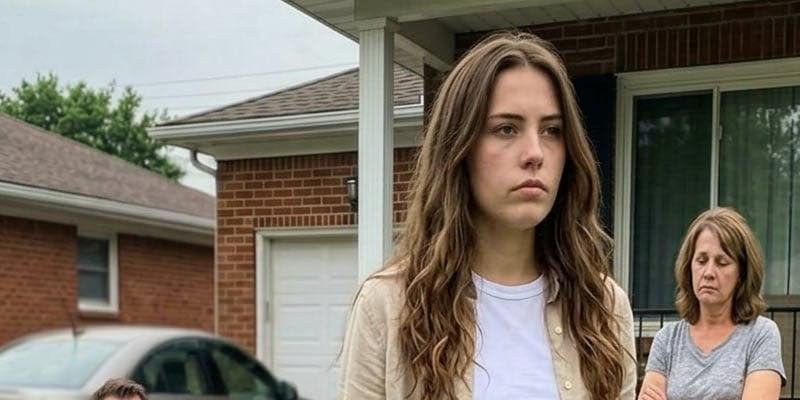
Rachel swayed on the porch like she might collapse. My mother stood beside her, trembling so hard she could barely remain upright.
Against every instinct inside me, I unlocked the door.
My father stumbled in first. He looked older, smaller, as if time had finally taken a bite out of him. But there was still something of that old command in him, that lifelong habit of entering a room as though everyone in it belonged to him.
My mother followed, white-faced and shaking.
Rachel came in last.
The second she crossed the threshold, her eyes found Noah.
He looked back.
And something in the room changed.
My father saw it too.
I watched the blood drain from his face so quickly it was almost unreal. His mouth opened, but nothing came out. Rachel let out a strangled, broken sound.
“Oh my God.”
Noah turned to me, confusion already hardening into fear.
“Mom… why is she looking at me like that?”
I couldn’t answer. Not yet. Maybe not ever, not in a way that could put something back together after this.
My father found his voice first.
“We need to leave. Now. All of us.”
A laugh escaped me, sharp and hollow. “You don’t get to walk into my house after fifteen years and start giving orders.”
“Elena, listen to me,” he said, more desperate than I had ever heard him. “Daniel knows where she is. If Rachel’s alive, then he knows. He’ll come here.”
That name broke across the room like glass.
Detective Daniel Harper.
The man my parents had told everyone I’d run away with. The officer who had “ruined” me. The one they said disappeared before anyone could question him. In their version of the story, I had been reckless, foolish, shameful. He had been the villain they could point to. Clean. Convenient.
But even that lie had been hiding something worse.
Rachel took a shaky step forward, arms wrapped tightly around herself like she still lived somewhere cold, somewhere survival meant making yourself smaller.
“You told them I was dead.”
My mother broke into tears.
“No,” I said quietly, staring at Rachel. “They told me you were dead.”
Rachel looked at me as if I had struck her.
“What?”
My father dragged both hands over his face. “This is not the time.”
“No,” I snapped. “This is exactly the time.”
Rachel’s face had changed in fifteen years. Of course it had. She looked older than thirty-three, as if every missing year had carved itself into her features one night at a time. A pale scar cut through her eyebrow. Another traced her jaw.
She drew one thin breath after another and then began speaking, the words coming like they had been trapped too long.
“I was sixteen,” she whispered. “He took me from the church parking lot after choir practice. He showed me his badge and said there’d been an accident, that Mom needed me downtown.”
Her voice shook so badly the last word nearly disappeared.
“I believed him.”
Noah had stopped halfway down the stairs now. He was hearing everything. I should have sent him away. I should have done a thousand things differently. But I stood there unable to move.
Rachel kept going.
“He kept me in different places. Cabins. Motels. Basements. Always moving. Always saying Dad was helping him. That Dad knew where I was. That no one was coming.”
I turned, slowly, toward my father.
He didn’t deny it quickly enough.
My mother let out a sound I had never heard from another person. It wasn’t a scream. It wasn’t a sob. It was something deeper—something torn straight out of disbelief.
“Tell her she’s lying, Daniel.”
For one disoriented second, my mind didn’t understand what I’d heard.
Then I did.
My father’s name was Thomas.
Daniel was the detective.
My mother wasn’t speaking to my father.
She was staring at Noah.
The room tilted.
Noah stood three steps above us, both hands locked around the railing. “Why did Grandma just call me that?”
No one answered.
He looked at me, and I saw the exact moment something opened beneath him, some hidden trapdoor under the life he thought he knew.
“Elena,” my father said hoarsely, “you should have told him.”
“Told him what?” Noah demanded.
Rachel was staring too now, not confused anymore. Recognizing.
She stepped toward the stairs, her face drained of color. “How old are you?”
“Fourteen.”
“When’s your birthday?”
Noah swallowed. “October seventeenth.”
Rachel closed her eyes.
And my pulse went wild in my throat.
Because October seventeenth was impossible.
Because according to the story I’d been forced to live inside, my son had been born seven months after I was thrown out.
Because I had lied to everyone. Including Noah.
His voice broke on one word.
“Mom.”
I climbed one step toward him, my whole body shaking. “I can explain.”
Before I could say another word, the lights went out.
The whole house dropped into darkness.
A car door slammed outside.
Then a man’s voice crackled through the security intercom at the gate.
“Family reunion’s over.”
Rachel screamed.
And Noah whispered into the dark, so softly I almost missed it, “That voice… I know that voice.”
For a second, no one moved.
Then my father lunged toward the kitchen drawer where I kept the flashlight as if he knew this house better than he had any right to. That cold little detail ran through me like ice, but there was no time to think.
Outside, footsteps crunched over gravel, slow and deliberate.
I grabbed Noah and pulled him down behind the staircase. “Stay low.”
Rachel backed into the wall, shaking so violently she looked as though her bones might come apart. My mother clung to her, sobbing openly now.
The flashlight clicked on, throwing a brutal white beam across the entryway.
My father looked twenty years older in that light.
“He found us,” Rachel whispered.
“No,” Noah said.
Something in his voice stopped all of us.
“That’s not him.”
We turned toward him.
Noah swallowed and stepped out from behind me before I could stop him. “I know that voice because I heard it on Mom’s old cassette tapes.”
My heart stopped.
There were three tapes. Locked in a box in my closet. Recordings I had made the year I was thrown out—every threat, every conversation, every lie I was afraid no one would ever believe.
I had never told him about them.
He looked at me, hurt already burning behind the fear. “I found them last month. I didn’t understand all of it. But I know that voice.”
The knocking came then. Not frantic. Measured. Almost polite.
My father shut his eyes.
Noah pointed toward the door the way a witness points in court.
“It’s Grandpa.”
Silence hit us like a physical thing.
My mother made a choking sound. Rachel stared at my father as if the last thread holding her together had finally snapped.
And then my father sank onto the bottom stair like a man too tired to carry his lies any farther.
“Yes,” he said.
That single word broke the room open.
My mother recoiled as if he had struck her. “No.”
He looked at her with eyes so hollow they barely seemed human.
“I didn’t mean for it to go that far.”
Rachel let out a sob so raw I felt it in my own chest.
“You told me Dad knew. You told me he was helping.”
“He was,” I said quietly, because suddenly I understood.
All the scattered pieces, all the memories I had kept boxed away, all the things I had refused to place side by side—they locked together with sickening precision.
Fifteen years ago, I had not become pregnant because of one reckless mistake.
I had become pregnant after finding Rachel.
I had discovered the hidden room behind my father’s repair shop by accident. Rachel had been there—weak, filthy, half-starved, but alive. I had tried to get her out.
My father caught us before we reached the road.
He told me if I went to the police, Rachel would disappear forever.
He said Daniel Harper—a disgraced detective drowning in debt—had helped him move her, hide her, keep people away. He said no one would ever believe a pregnant seventeen-year-old over a respected deacon and a decorated cop. He said if I stayed quiet, Rachel would live.
Then one night, Daniel Harper vanished.
And my father told me Rachel had died in transit.
I had believed him.
Not completely. Not enough to stay.
So I left with the only proof I had left.
Noah.
Not Daniel Harper’s son.
Not some nameless boy’s son.
My father’s.
A low, broken sound came out of Noah as the truth reached him.
I turned toward him, arms instinctively lifting. “Noah—”
He stumbled backward. “Don’t.”
His face had gone white, but he kept looking at me, as if he was still searching for one thing he could hold onto.
“Did you know? The whole time?”
Tears blurred everything. “Not the whole time. I suspected. Then I knew. But I couldn’t say it. I couldn’t let him near you. I changed our names. I moved twice. Everything I built was built around keeping you safe.”
The front door handle rattled.
My father looked up, suddenly sharp again. “I came here tonight because Rachel escaped two days ago,” he said. “She made it to a shelter in Ohio. They called me after she gave my name. I knew the police would come. I knew he’d panic.”
“He?” I asked.
He nodded toward the door. “Daniel Harper kept records. Videos. Insurance payouts. Blackmail. Money. He did the dirtiest work, but he never trusted me. If Rachel resurfaced, he’d come for both of us.”
As if the words had summoned him, a gunshot ripped through the front window.
Glass exploded inward.
My mother screamed.
Rachel dropped to the floor.
I dragged Noah down just as another bullet tore into the wall above us.
“Back hallway!” my father shouted.
We ran.
The alarm shrieked alive, red lights flashing through the dark like a warning from somewhere hellish. My father shoved open the mudroom door to the garage—
Then stopped.
Daniel Harper was already inside.
Older now. Heavier. One side of his face twisted by an old burn scar. But unmistakable.
He held a gun in one hand and a ring of keys in the other, smiling as though he’d arrived at a private joke only he understood.
“Tom,” he said. “You always did wait too long.”
Rachel shrank behind me.
Noah pressed close to my shoulder, breathing hard.
Daniel’s eyes moved lazily over all of us—then landed on Noah.
For the first time, his smile faltered.
“Well,” he murmured. “That’s unfortunate.”
My father stepped in front of us.
“I gave you money,” he said. “You should have stayed gone.”
Daniel laughed, low and ugly. “You gave me enough to disappear. Not enough to forgive.”
He raised the gun.
After that, everything happened all at once.
My father lunged.
The shot detonated inside the garage like a bomb.
Daniel staggered into the workbench, and the gun skidded across the concrete.
Before I could move, Noah kicked it hard under the car.
Rachel grabbed a metal jack handle and swung with the force of fifteen stolen years.
The crack against Daniel’s skull was sickening.
He dropped to one knee. Tried to rise.
My father, blood spreading fast through his shirt, caught him by the collar and rasped, “You don’t get another girl.”
Then he slammed Daniel’s head into the concrete pillar.
Daniel went still.
Sirens were already coming, louder by the second.
For one impossible moment, nobody moved.
Then my father collapsed.
My mother fell beside him, hands shaking as she pressed uselessly against the blood.
He looked at me.
Then Rachel.
Then Noah.
There was no hope in his face. No real plea for forgiveness. He knew better than to ask for that.
Only ruin. And the stripped-bare truth of what he had become.
“I told myself,” he whispered, struggling for air, “that I was protecting the family. Then I kept protecting myself. That’s how evil works. It asks for one lie first.”
Rachel knelt beside him, tears slipping silently down her face.
He looked at her the longest.
“I’m sorry.”
She closed her eyes. “You should be.”
When the police arrived, we told them everything.
The tapes. The hidden room behind the repair shop. Daniel Harper’s records in a storage unit under a false name. The payments. The threats. The years of lies. The names of girls no one had found. The families who had stopped hoping.
By morning, investigators were pulling enough evidence together to crack open far more than one case.
My father lived long enough to be arrested.
He died in the hospital two days later.
In the months that followed, more victims were identified through Daniel’s files. Families got answers they had stopped believing were possible. My mother moved into a small apartment near Rachel’s trauma center and spent her days trying to become someone who had not looked away.
Rachel didn’t forgive quickly.
But she stayed.
And that, on its own, felt like a miracle.
Noah didn’t speak to me for three weeks after the truth came out.
Not one word.
He moved through the house like a wound I had to watch breathing. Ate in silence. Avoided my eyes. Shut himself in his room with music loud enough to tell me exactly how much distance he needed.
I let him.
Because after everything, I had no right to demand anything from him—not understanding, not comfort, not even anger spoken aloud.
Then one night, I found him in the garage.
He was standing beside the old workbench, staring at a rusted socket wrench as if it had personally betrayed him.
“I hate him,” he said.
It was the first thing he had said to me in twenty-three days.
I stayed where I was. “I know.”
He laughed once, bitterly. “No. I mean I really hate him. And I hate that I look like him when I’m upset. I hate that people can see him in me.”
I took a slow breath. “I know that too.”
He looked at me then, eyes red, furious, wounded all the way through.
“Why didn’t you tell me?”
There it was. The question that had lived between us since that night.
“Because I wanted one thing in your life to be untouched,” I said. “I wanted you to belong to yourself before you belonged to that story.”
He stared at the floor.
“And because I was ashamed,” I added quietly. “Not of you. Never of you. But of how you came into the world. Of how afraid I was. Of how much power he still had over me, even after I ran.”
Noah’s jaw tightened.
“You should’ve told me anyway.”
“Yes,” I said. “I should have.”
That answer seemed to stop him more than anything else. No defense. No excuses. Just the truth.
He sat down hard on the old stool by the workbench and pressed both hands over his face. His shoulders shook once, then again.
I didn’t rush to him.
I just waited.
After a minute, he dragged his hands down and looked at me with a kind of exhausted honesty that only belongs to the very young and the very broken.
“I don’t know what to do with this.”
“You don’t have to know yet.”
His voice cracked. “What if it’s in me?”
I moved then, slowly, and knelt in front of him.
“It isn’t,” I said. “You are not what he did. You are not what he was. You are every choice you make after this.”
He stared at me for a long time.
Then, like a child much younger than fourteen, he leaned forward and let me hold him.
I wrapped my arms around him and felt years of fear, silence, and survival break open between us. He cried the way he hadn’t cried since he was small—deep, helpless, furious sobs that came from somewhere he had been holding shut.
“I’m sorry,” I whispered into his hair. “I am so, so sorry.”
When he finally pulled back, he wiped his face roughly and said, “I still don’t forgive you.”
“I know.”
“But I don’t want to lose you.”
That almost broke me more than everything else.
“You won’t,” I said. “You won’t lose me.”
Life after truth was not clean.
Rachel had nightmares and panic attacks and days when she could not bear to be touched. My mother carried her guilt like something physical. I saw it in the way she folded into herself whenever Rachel entered a room.
And yet, slowly, something strange began to grow in the wreckage.
Not peace. Not exactly.
Something harder earned than peace.
Honesty.
Rachel started coming to the house on Sundays. At first she stayed near the window or door, always aware of exits. Then she stayed long enough for coffee. Later, long enough for dinner.
Noah listened more than he spoke. But one afternoon, I found him sitting across from her at the kitchen table, asking in a quiet voice what kind of music she used to like before everything happened.
Rachel blinked at him like the question itself was a gift.
“Choir music,” she said, almost smiling. “And terrible pop songs I was too embarrassed to admit I liked.”
Noah nodded seriously. “That sounds very sixteen.”
She laughed then—small, startled, real.
It was the first time I had heard that sound from her.
A month later, Noah asked if he could go with me to the courthouse.
“For what?”
He shrugged, trying and failing to look casual. “To change my last name. Officially.”
My throat tightened. “What do you want it to be?”
He looked at me for one long second.
“Yours.”
The paperwork took less than twenty minutes. The meaning of it felt larger than language.
When we walked out, he shoved his hands in his pockets and looked straight ahead. “Don’t make it weird.”
I laughed through tears. “I’ll do my best.”
Years later, people would ask how we survived it—how we lived with the knowledge, the horror, the shame, the grief. As if there were a clean answer. As if trauma came with a neat philosophy attached.
It doesn’t.
You survive it in pieces.
In phone calls answered.
In doors opened.
In truths spoken too late but still spoken.
In a son choosing a name.
In a sister staying for coffee.
In a mother learning that love is not silence and protection is not secrecy.
Sometimes I still wake in the dark hearing my father pounding on that door.
Sometimes I still see Rachel stepping across my threshold and staring at Noah like she had seen a ghost rise up wearing the face of a child.
Sometimes I still think of the girl I was—the one standing by the door with an overnight bag in one hand and a test in the other while her father’s rage tore her life in half.
I want to reach back through time and tell her one thing.
He does not get to define what comes next.
Because fifteen years after he threw me out, my family came to my door expecting fear, silence, and control.
What they found instead was the truth.
And once the truth entered that house, none of us ever belonged to his lies again.